
Geotextile for Road Construction: Separation and Drainage
By GeoTexGrid Engineering Team
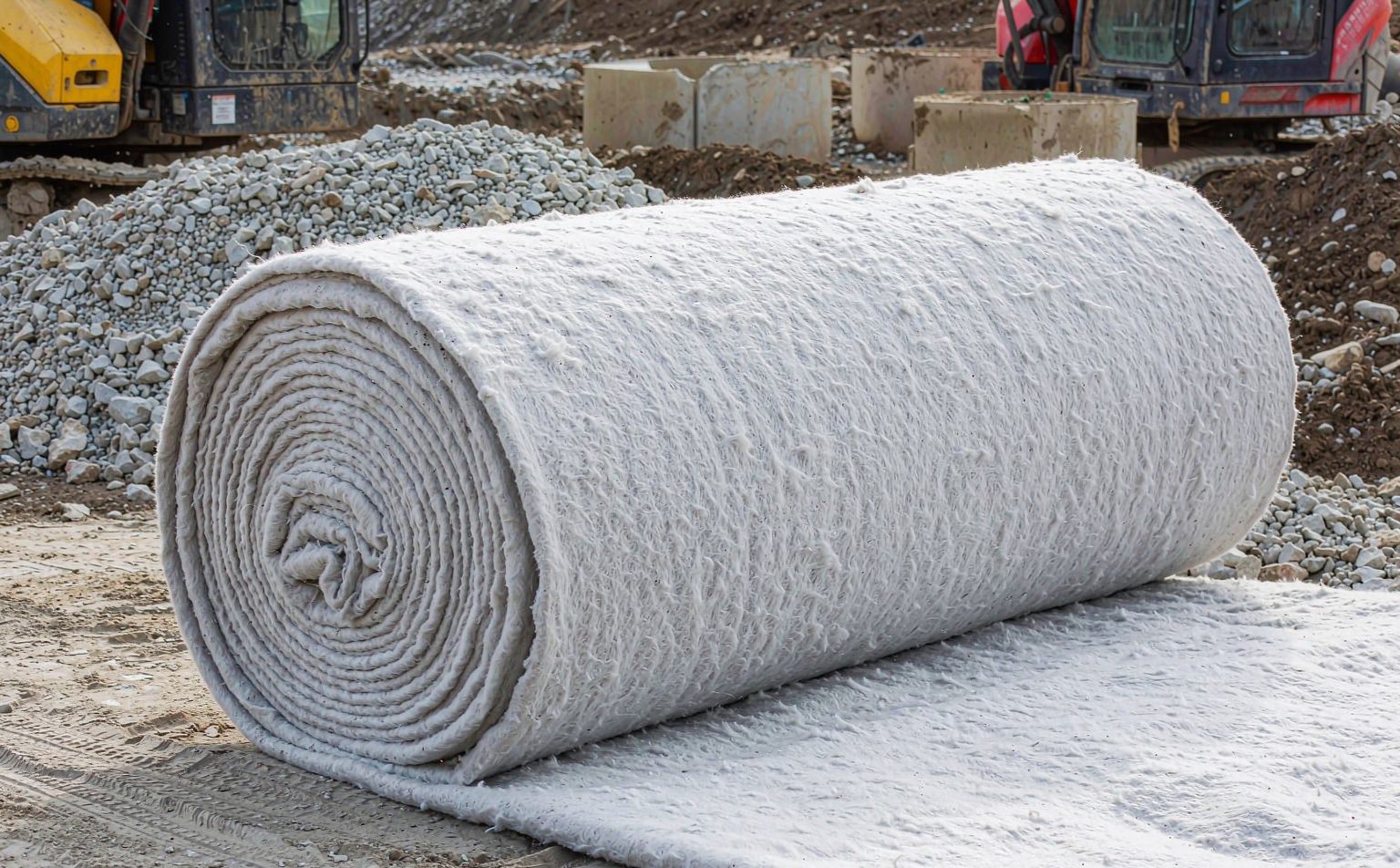
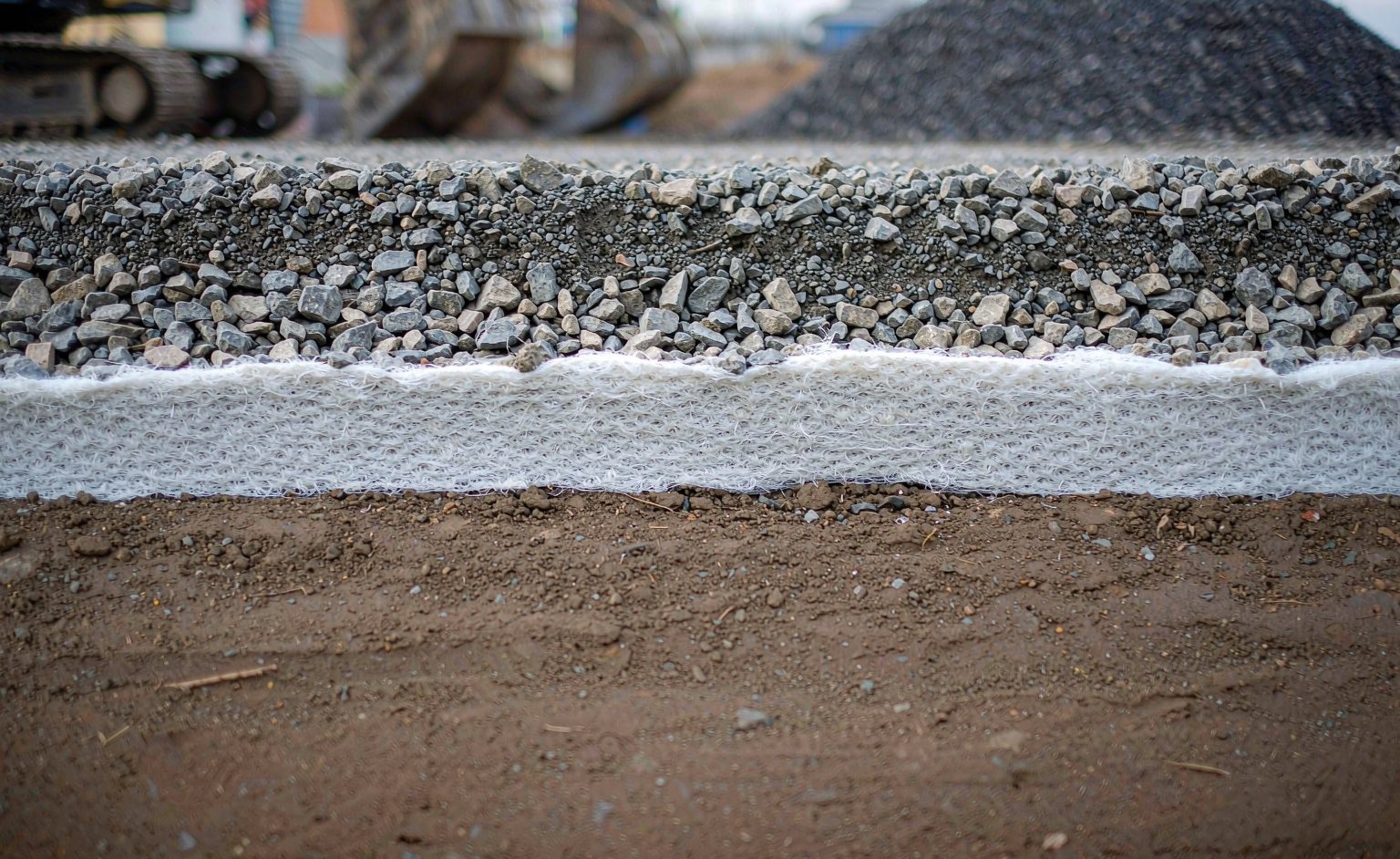
Most road failures on soft ground begin at one interface: the line between the subgrade and the granular base. A geotextile for road construction placed on that interface costs a fraction of the pavement above it, yet it decides whether the base stays clean, drains freely and keeps its design thickness. Omit it and the subgrade fines will migrate upward into the aggregate until the structure is neither a base nor a subgrade.
This guide explains the three functions the geotextile performs, the specification values that control each one, and the installation rules that keep the material intact long enough to do its job.
Three Jobs, One Layer: What Geotextile Does in a Road
A single nonwoven geotextile functions simultaneously as a separator, a filter and a drainage medium. These are not three products — they are three consequences of the same physical property set.
- Separation — keeps two dissimilar materials apart so the aggregate does not punch into the subgrade and the fines do not rise into the base.
- Filtration — allows water to pass while retaining soil particles, so pore pressures can dissipate instead of softening the formation.
- Drainage — provides an in-plane flow path within the plane of the fabric, a minor benefit in a nonwoven and a major one in a purpose-made drainage geocomposite.
All three depend on the fabric surviving installation. That is why survivability, not strength of the soil, is usually the governing requirement in road works — a punctured or torn geotextile separates nothing.
Separation: Stopping Subgrade Fines from Pumping Up
When a wheel load passes over a saturated subgrade, it creates a momentary excess pore pressure under the wheel path. Water moves, carrying suspended fines with it, and if there is no barrier those fines migrate upward into the base course. The consequences accumulate quickly:
- The base aggregate becomes contaminated and loses its drainage capacity
- Effective base thickness is progressively reduced
- Ruts deepen in a self-reinforcing cycle, because a thinner base delivers more pressure to the subgrade
A separating geotextile interrupts this cycle. It does not make the subgrade stronger — it keeps the designed structure intact so the design assumptions continue to hold.
Our Geotextile Range for Road Works
Four constructions cover the separation and filtration duties in a road structure. Mass per unit area and roll width are Customizable on all of them, which is what lets a single product serve both a 3 m rural road and a 12 m dual carriageway without a factory seam along the wheel path.
| Product | Material | Roll Width | Unit Weight | Road duty |
|---|---|---|---|---|
| Nonwoven geotextile | Needle-punched nonwoven (PET / PP) | Customizable | Customizable | Separation, filtration, drainage |
| Woven geotextile | Woven PP slit film / PET yarn | Customizable | Customizable | Reinforcement-focused separation, unpaved roads |
| PET geotextile | Polyester (PET) continuous filament | Customizable | Customizable | High-strength separation, alkaline soils |
| PP geotextile | Polypropylene (PP) | Customizable | Customizable | General separation, chemical inertness |
Where the subgrade also needs tensile reinforcement — CBR below about 3, or a haul road carrying loaded trucks — the geotextile alone is not enough. Pair it with a steel-plastic biaxial geogrid rated 30–150 kN/m; the fabric separates, the grid reinforces, and the two functions are not interchangeable.
Filtration and Drainage: Matching AOS to Your Soil
For the filter function, two classic criteria govern selection and both must be satisfied.
Retention criterion — the geotextile must be fine enough to hold the soil. In practice specifications require the Apparent Opening Size (AOS, tested to ASTM D4751) to be finer than the D85 of the soil being retained. AOS is expressed in millimetres: a smaller figure means a finer fabric.
Permeability criterion — the geotextile must be far more permeable than the soil, conventionally at least an order of magnitude greater (typically 10× or more) so that water can pass through the fabric under the hydraulic gradients present. Where the soil is fine and graded, a clogging criterion is also applied, because a fabric that meets both of the above can still blind if its pore structure traps soil internally.
Typical AOS values for road separation work fall in the range 0.15–0.5 mm, with the specific value driven by the gradation of the subgrade, not by the aggregate. The full worked selection is set out in geotextile filter fabric: AOS and permeability.
How to Specify a Geotextile for Road Construction
The internationally recognised framework is AASHTO M288, which classifies geotextiles by application and by survivability class, and specifies minimum values for each mechanical property.
| Property | Standard | Why it matters |
|---|---|---|
| Mass per unit area | ASTM D5261 | Baseline for strength; 200–300 g/m² typical for separation |
| Grab tensile strength | ASTM D4632 | Resistance to tensile stress during placement |
| CBR puncture | ASTM D6241 | Resistance to stone penetration under compaction |
| Trapezoidal tear | ASTM D4533 | Resistance to tearing once nicked |
| AOS | ASTM D4751 | Retention of soil particles |
| Permittivity / water flow | ASTM D4491 | Drainage and filtration capacity |
| UV resistance | ASTM D4355 | Relevant only if left exposed; cover promptly |
Survivability classes in AASHTO M288 run from Class 1 (most severe conditions — soft subgrade, high ground-pressure equipment, angular aggregate) to Class 3 (least severe). The correct class is driven by installation conditions, not by traffic. Assuming a light class because the road is lightly trafficked is one of the most common specification errors we are asked to review — the full class thresholds are tabulated in AASHTO M288 geotextile classes.
Woven or Nonwoven for Road Works?
| Criterion | Nonwoven geotextile | Woven geotextile |
|---|---|---|
| Structure | Random continuous filaments, needle-punched | Uniform interlaced tapes or monofilaments |
| Filtration and drainage | Excellent — high permittivity, low clogging risk | Good, but lower in-plane flow in slit-film products |
| Separation under aggregate | Excellent | Excellent |
| Tensile strength at low strain | Lower | Higher |
| Typical road use | Separation, filtration, drainage, liner protection | Reinforcement-focused separation, unpaved roads |
| Typical mass | 200–600 g/m² | 100–400 g/m² |
As a working rule: if the layer must let water through and hold fines back, specify a nonwoven; if it must also carry tensile load over a soft formation, look at a woven product or pair the nonwoven with a biaxial geogrid. For a full comparison of the two families, see the nonwoven vs woven geotextile guide.
Installation Rules for Geotextile in Road Construction
Installation damage is the single largest cause of underperformance, and nearly all of it is avoidable.
- Prepare the formation first. Strip organic material, proof-roll, and fill soft spots. A geotextile laid over ruts will simply mirror them.
- Lay with 300–600 mm overlaps, and stagger the overlaps so a continuous joint does not run along the wheel path.
- Keep the roll under tension and free of wrinkles; folds become stress concentrations that tear under compaction.
- Place and spread at least 150–200 mm of cover material before compaction plant arrives. Do not let tracked equipment run on the bare fabric.
- Dump and spread, do not drop. Aggregate dropped from height punctures even heavy fabric.
- Turn slowly and avoid sharp braking on the first lift; these are the loads that initiate puncture.
- Cover as you go. Extended UV exposure degrades polypropylene fabric more quickly than most specifications assume.
Where to Go Next
- Product range and data sheets — see the nonwoven geotextile and woven geotextile ranges for mass per unit area, AOS, permittivity and mechanical values, and the geogrid installation guide for the layer that follows.
- Talk to an engineer directly — message us on WhatsApp for a same-day technical answer, or email cn8978688@gmail.com.
- Related reading — the biaxial geogrid road base guide covers the reinforcement layer that goes above this separation layer.
GeoTexGrid supplies nonwoven geotextile in PP and PET, woven geotextile in slit-film and monofilament constructions, and geotextile filter fabric cut to project width. Tell us your subgrade gradation, application and required survivability class — our engineering team will recommend the correct product and issue a quotation, normally within one working day.
Related Articles
Fiberglass Geogrid China Supplier: Mesh and Coat
How to vet a fiberglass geogrid China supplier: mesh size, bitumen vs polymer coating, and the rib-count arithmetic that proves a 30-100 kN/m datasheet.
Woven Geotextile China Manufacturer: Slit Film
A woven geotextile China manufacturer explains slit film tapes, the grab-versus-wide-width trap, and how roll width changes the area you pay for.
Geocell China Manufacturer: Perforation Surface
Perforated or textured walls decide how a geocell drains and grips. A geocell China manufacturer explains wall options, weld QC and checks before order.