
Geocell China Manufacturer: Perforation Surface
By GeoTexGrid Engineering Team
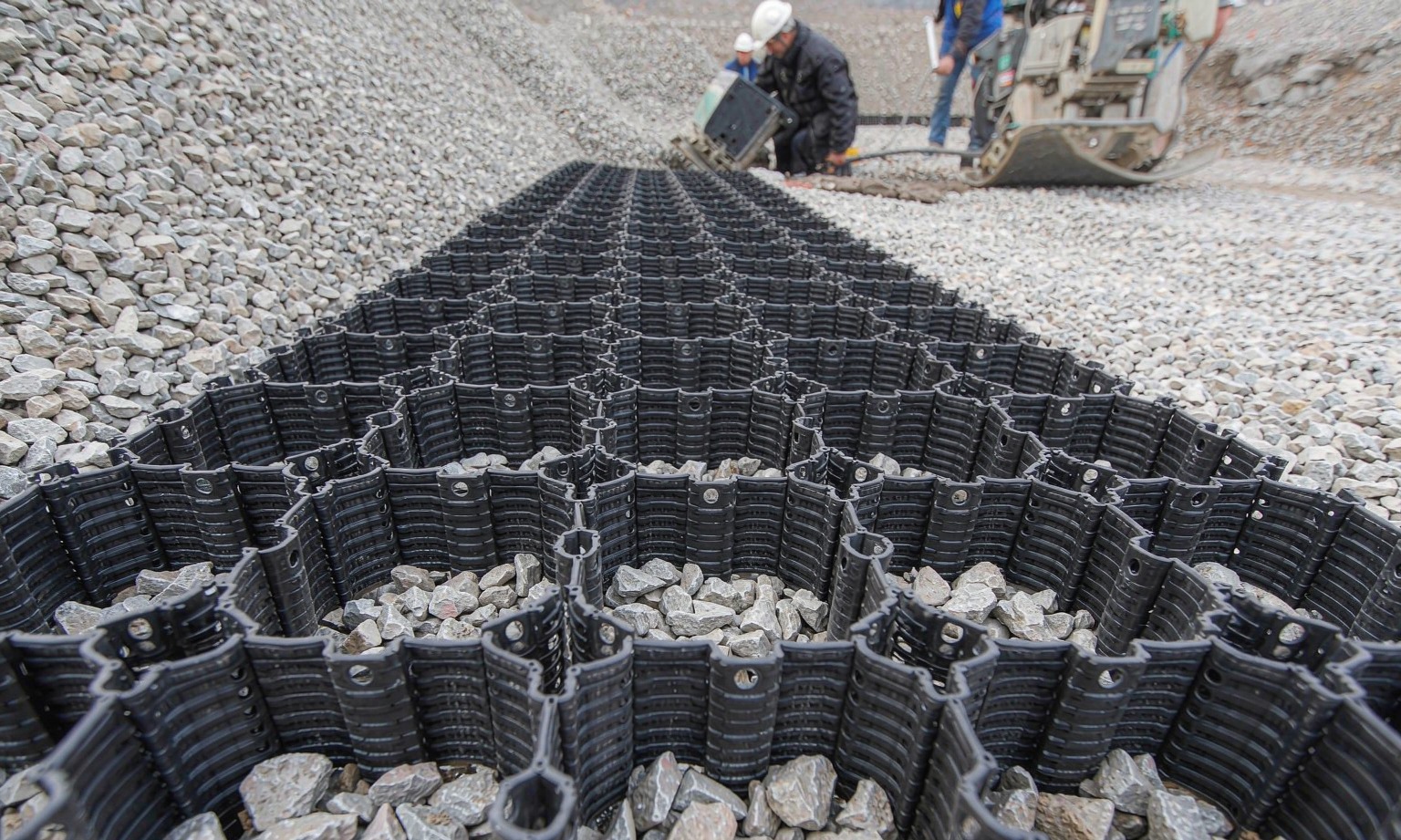
A tender landed in my inbox last month with one line under geocell: "HDPE, perforated, textured." No cell depth, no panel size, no word on where the water was supposed to go. The contractor had copied a phrase from somebody else's specification, and now he was about to pay for whatever showed up in the container. The wall is the most-skimmed line on a geocell data sheet, and it is the first thing a geocell China manufacturer will ask you to define before we cut a single HDPE sheet. This post walks through what those wall words actually control, the arithmetic I run before quoting, and the shop checks worth demanding before you confirm an order.
What the Wall Line on a Geocell Data Sheet Controls
On our own data sheet the wall options sit in one row: Perforated / Non-perforated, Textured / Smooth. Around it sit the rest of the specification — Material: HDPE (High-Density Polyethylene), Cell Depth: Customizable, Cell Size: Customizable, Panel Size (Expanded): Customizable. Buyers read that row as marketing filler. It is not. Those four words decide two physical behaviors of the finished panel:
- whether water can pass through the cell wall (perforation), and
- how much friction the wall offers the infill (texture).
Everything else — depth, size, panel footprint — is geometry you can measure with a tape. The wall spec is a drainage and stability decision. Get it wrong and the confinement still looks fine on the day of handover, then quietly underperforms for the next five years.
Perforated or Non-Perforated: Where the Water Goes
Perforations are through-holes punched into the cell wall before welding. Their job is drainage. When water can move through the wall, pore pressure behind the wall dissipates instead of building up, and a wet infill column keeps its coherence instead of turning into soup. On channel linings, slope faces with seepage, and road sections over moist subgrade, perforated walls earn their keep.
Non-perforated walls are the right answer somewhere too. A heavy load platform on firm, dry ground does not need through-wall drainage — it needs every square centimeter of wall doing structural work, because perforations slightly reduce wall stiffness. On those jobs I would rather keep the walls solid and handle drainage with a properly chosen geotextile separator underneath the panel. Water leaves the system downward; the walls stay dry and stiff.
One more practical note: perforated sheet weighs less per panel, which shaves freight. That is a side benefit, not a reason. Choose the wall for the water, then enjoy the freight saving.
Textured or Smooth: Friction Where the Slope Gets Steep
Texture is the second half of the choice. A textured wall grips angular infill mechanically — on a slope face, where the gravel column is always trying to slide toward the toe, that grip is the difference between a face that vegetates and a face that sloughs. Smooth walls rely on confinement geometry alone. They are perfectly adequate on flat, engineered bases where the infill sits level and compaction does the work.
My shorthand, which has survived a lot of jobs: flat and dry goes smooth; steep or wet goes textured. Combine the two axes and you get the four wall specs in the selection table further down.
Wall Math: Why the Perforation Pattern Matters More Than It Looks
Before I quote a wall spec I run one piece of geometry. Take a nominal cell size of 0.25 m × 0.25 m and a cell depth of 0.10 m — both are Customizable on our line, so treat these as a worked example and confirm the final dimensions for your own panel.
- Cells per square metre: 1 ÷ (0.25 × 0.25) = 16 cells/m²
- Infill volume: 16 cells × (0.25 × 0.25 × 0.10) = 0.10 m³ of infill per m² of covered surface
- Total wall length per m²: 2 ÷ 0.25 + 2 ÷ 0.25 = 16 metres of wall per m²
- Wall area: 16 m × 0.10 m depth = 1.6 m² of wall for every 1 m² of surface
That last number is the point. There is 60% more wall than surface in a geocell layer. When a buyer treats the wall as a detail, he is ignoring the majority of the polymer he is paying for. It is also why the perforation pattern deserves a spec line of its own: holes too small and the wall will not drain; holes too close to a weld seam and the weld lands on nothing.
How a Geocell China Manufacturer Builds and Tests the Wall
The shop sequence is short. HDPE sheet is slit into strips, the strips are ultrasonically welded edge-to-edge into the cell body, and the finished panels are folded flat for shipping. Perforations are punched before welding, so the weld tool always lands on solid sheet — a weld that overlaps a hole is a defect, full stop.
This is where buying factory direct from a source factory changes what you can ask for. Through a trader you get a catalog page. Through the mill you get:
- the perforation pattern specified to your drainage requirement, not to whatever stock we are holding;
- welded wall samples from the actual production run, pulled and couriered before the container sails;
- transparency on price and MOQ, because there is no middle margin hiding in the unit rate — and LCL quantities are negotiable when the job is small;
- one production plan across the container, so geocell panels, separation geotextile and anything else on the order arrive as one matched set, shipped factory direct.
Before the balance payment I ask buyers to put five checks in writing. They cost the factory nothing if the batch is good, and they cost you a season if they are skipped.
| Check | Method | What good looks like |
|---|---|---|
| Sheet tensile | Wide-strip tensile per GB/T 15788 or ISO 10319 | Batch test report matching the ordered sheet grade |
| Weld integrity | Peel test on sampled seams | Seam peels the sheet, not the weld line |
| Perforation | Count and sight check on a sampled wall | Clean holes, no torn edges, welds clear of holes |
| Geometry | Measure cell depth and expanded panel size | Matches the confirmed drawing, panel opens square |
| Wall surface | Visual check across the panel | Texture consistent, no shiny patches from cold welding |
Which Wall Spec for Which Job
| Wall spec (our data sheet) | Water path | Wall friction | Where it belongs |
|---|---|---|---|
| Perforated + textured | Through-wall drainage | High grip | Slope faces, channels, wet seeping cut slopes |
| Perforated + smooth | Through-wall drainage | Moderate | Drainage-friendly sections under level roads |
| Non-perforated + textured | No through-flow | High grip | Steep but dry faces where infill retention dominates |
| Non-perforated + smooth | No through-flow | Low | Load platforms on firm, dry, engineered ground |
If your site gives you water and slope at the same time, that is the perforated-plus-textured corner of the table, and it is the combination I quote most for riverbank and channel work.
Where to Go Next
- Product range and wall options — the full HDPE geocell range lists depth, cell size and surface options you can mix on one order.
- Confinement design first — if you have not yet sized the layer, Geocell China: How to Specify HDPE Cells for Load Support walks the stress-spread check that decides cell depth.
- Talk to an engineer — message us on WhatsApp for a same-day answer on perforation and texture, or email cn8978688@gmail.com.
GeoTexGrid manufactures HDPE geocell panels factory direct — perforation pattern, cell depth and panel size set to your drawing, welded samples couriered before shipment. Send the cross-section and the water condition; you will get a confirmed wall specification and quotation, usually within one working day.
Related Articles
Fiberglass Geogrid China Supplier: Mesh and Coat
How to vet a fiberglass geogrid China supplier: mesh size, bitumen vs polymer coating, and the rib-count arithmetic that proves a 30-100 kN/m datasheet.
Woven Geotextile China Manufacturer: Slit Film
A woven geotextile China manufacturer explains slit film tapes, the grab-versus-wide-width trap, and how roll width changes the area you pay for.
HDPE Geomembrane Welding China: Seam QC Checklist
HDPE geomembrane welding in China: dual-track vs extrusion, lap and seam-length arithmetic, sample frequency, and the defects that actually leak.