
Geotextile Filter Fabric: Matching AOS and Permeability
By GeoTexGrid Engineering Team
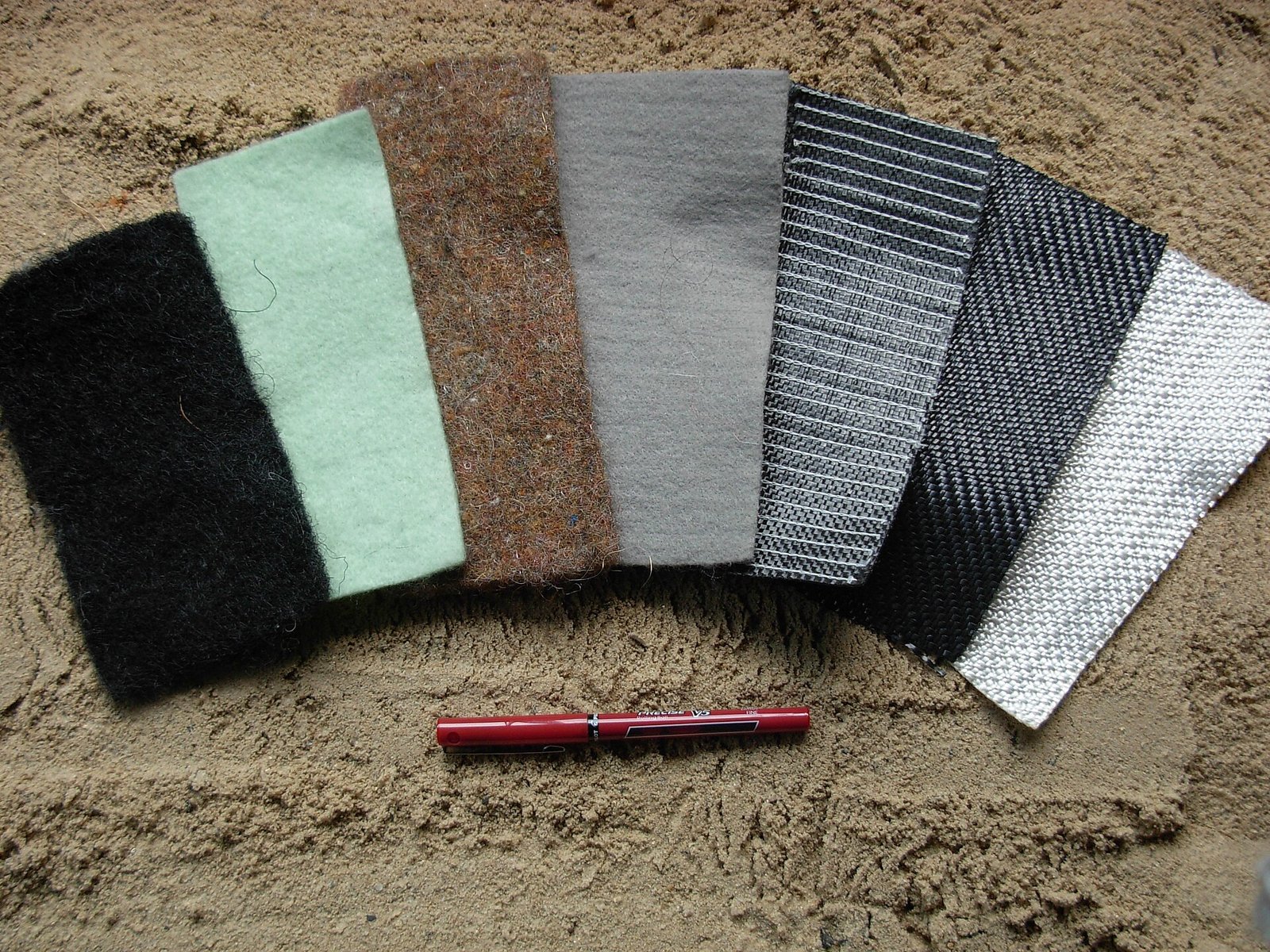
A filter fails in one of two ways: soil particles wash straight through it (piping), or particles lodge inside the fabric until no water can pass (clogging). Both are specification errors, not product defects — and both are prevented by checking two numbers on the data sheet: the AOS and the permittivity.
What AOS on a Geotextile Filter Fabric Actually Means
AOS (Apparent Opening Size) is the pore size of the fabric, measured by wet-sieving glass beads through the geotextile under ASTM D4751. The reported value is the O95 — the opening size that 95% of pores are smaller than — in millimetres or as the nearest US standard sieve number.
| US Sieve No. | Opening Size (mm) |
|---|---|
| No. 40 | 0.425 |
| No. 50 | 0.300 |
| No. 70 | 0.212 |
| No. 100 | 0.150 |
| No. 140 | 0.106 |
| No. 200 | 0.075 |
So "AOS = US No. 70 sieve" means an O95 of 0.212 mm; the smaller the sieve number, the coarser the filter. Two cautions: AOS says nothing about how much water passes — only the largest pores — and it is measured unconfined, so effective openings shrink slightly under burial load, which helps retention but reduces flow.
Permittivity vs Permeability: The Number That Matters
Permeability (k) is the intrinsic conductivity of the fabric in cm/s; it depends only on the material. Permittivity (ψ) = k / t, where t is fabric thickness, measured in s⁻¹, describes flow through the actual fabric. Two fabrics can share a k and have very different thicknesses, so permittivity is the value to compare — it reflects the real flow rate through the roll you are buying. A needle-punched nonwoven at 200–300 g/m² typically lists 0.5–2.0 s⁻¹ unloaded, and that number falls under compressive stress, which is why reputable suppliers publish permittivity at several normal loads. A slit-film woven is far less open: wovens are chosen for strength and separation, not for conveying water.
Matching AOS to Your Soil: The D85 Rule
The soil side is characterised by D85 — the sieve opening through which 85% of the soil passes, taken from a particle-size distribution of the actual backfill. The classic retention criterion used in FHWA and USFS filter guidance is O95 ≤ 2 to 3 × D85 for granular soils: if the largest pores are no more than about two to three times D85, particles bridging against the fabric form a stable filter cake that does the fine filtration itself.
| Soil Being Filtered | Typical D85 | Recommended O95 (AOS) |
|---|---|---|
| Coarse sand / gravelly sand | 0.5–1.0 mm | 0.425 mm (No. 40) or coarser |
| Medium sand | 0.25–0.5 mm | 0.300 mm (No. 50) |
| Fine sand | 0.10–0.25 mm | 0.150–0.212 mm (No. 100–70) |
| Silty sand / silt | < 0.10 mm | ≤ 0.150 mm, verify with permeability |
AASHTO M288 caps AOS at 0.30 mm (US No. 50) where no soil data is available, and grades it by fines content where it is. For silts and clays (more than 50% passing 0.075 mm) the retention rule alone is unreliable — control the flow side instead:
| Soil fines (passing 0.075 mm) | Minimum permittivity (AASHTO M288) |
|---|---|
| Less than 15% | 0.5 s⁻¹ |
| 15% – 50% | 0.2 s⁻¹ |
| More than 50% | 0.1 s⁻¹ |
Which of Our Geotextiles Fits the Filter
The structural choice narrows the family, and the material descriptions below are exactly what we publish on the product pages:
| Our geotextile | Material as published | Where it sits in a filter design |
|---|---|---|
| Nonwoven Geotextile | Needle-punched nonwoven (PET / PP) | Default for filtration: three-dimensional pore network, higher permittivity |
| Woven Geotextile | Woven PP slit film / PET yarn | Separation and reinforcement first; filtration secondary |
| PET Geotextile | Polyester (PET) continuous filament | Where the polymer basis is specified as polyester |
| PP Geotextile | Polypropylene (PP) | Where the polymer basis is specified as polyolefin |
Read the second column against AASHTO M288's polymer floor — at least 95% by weight polyester or polyolefin. All four meet it, but the tender clause decides which one you name, so state the polymer and the structure together rather than ordering "a filter fabric".
A Worked Filter Selection
Take a trench drain beside a road where the backfill sample gives D85 = 0.30 mm and 25% passing the 0.075 mm sieve:
- Retention: O95 ≤ 2–3 × D85 gives 0.6–0.9 mm, which is looser than the M288 default cap — so the cap governs: O95 ≤ 0.30 mm (US No. 50).
- Flow: fines are 15–50%, so M288 requires ψ ≥ 0.2 s⁻¹. In a dynamic flow case, designers commonly target 0.7 s⁻¹ instead.
- Structure: the job is to pass water while holding soil, so a needle-punched nonwoven is indicated — Nonwoven Geotextile (PET / PP) or PP Geotextile, depending on the polymer clause.
- Clogging check: at 25% fines the soil is not a silt, but if it were above 50% the gradient ratio test would come into play before the fabric is fixed.
Note what never entered the decision: grams per square metre. Mass is a practical proxy for thickness and porosity, not a filter property.
Woven or Nonwoven for Filtration?
| Property | Nonwoven (needle-punched) | Woven (slit-film) |
|---|---|---|
| Permittivity | High (≈ 0.5–2.0 s⁻¹ unloaded) | Low |
| Filtration behaviour | 3-D pore network, forgiving | 2-D openings, less forgiving |
| Tensile strength | Moderate | High |
| Elongation at break | High (absorbs settlement) | Low |
| Best filtration use | Underdrains, trench drains, toe drains, erosion control | Temporary separation where filtration is secondary |
Rule of thumb: if the fabric's job is to pass water while holding soil — trench drains, drainage blankets, riprap underlayers, retaining-wall drainage — specify a needle-punched nonwoven. Wovens belong where separation and reinforcement come first, as in the geotextile for road construction application. The full structural comparison is in our nonwoven vs woven geotextile guide.
How to Avoid Clogging on Fine-Grained Soils
Retention is easy; clogging is the failure that actually happens on fine soils. Choose a heavier nonwoven rather than a tighter one — on silty soils a 300–400 g/m² fabric with more open pores outperforms a thin fabric with tiny pores, because water finds many paths and blockages stay local. Respect the permittivity minimums above; they already build in a safety factor for fine soils. On marginal soils verify with the gradient ratio (GR ≤ 3) criterion. And remember the counter-intuitive point worth repeating to clients: the biggest clogging risk is an AOS that is too fine, not too coarse. An over-tight fabric blinds at its face; a slightly coarser one lets a stable filter cake form inside the soil.
A Five-Line Filter Fabric Specification
- Function — e.g. trench-drain filtration around a perforated pipe.
- Soil — particle-size distribution, or at minimum D85 and % passing 0.075 mm.
- AOS / O95 — from the D85 rule and the M288 cap, e.g. "O95 ≤ 0.30 mm".
- Minimum permittivity — e.g. "ψ ≥ 0.2 s⁻¹ (M288, 15–50% fines)".
- Fabric and polymer — e.g. "needle-punched nonwoven PP, 300 g/m², UV-stabilised".
Where to Go Next
- Product range and data sheets — Nonwoven Geotextile for filtration duty, Woven Geotextile where strength governs, PET Geotextile and PP Geotextile where the polymer basis is specified — or browse the full geotextile product range.
- Talk to an engineer — message us on WhatsApp for a same-day AOS and permittivity recommendation against your soil report, or email cn8978688@gmail.com.
- Related reading — AASHTO M288 Geotextile Classes Explained shows how these hydraulic limits map onto Class 1, 2 and 3.
GeoTexGrid manufactures needle-punched nonwoven and woven geotextiles in PP and PET, with AOS, permittivity and tensile values tested to ASTM standards on every production batch. Send your soil gradation and flow requirement — you will get a confirmed filter specification and quotation, usually within one working day.
Related Articles
Fiberglass Geogrid China Supplier: Mesh and Coat
How to vet a fiberglass geogrid China supplier: mesh size, bitumen vs polymer coating, and the rib-count arithmetic that proves a 30-100 kN/m datasheet.
Woven Geotextile China Manufacturer: Slit Film
A woven geotextile China manufacturer explains slit film tapes, the grab-versus-wide-width trap, and how roll width changes the area you pay for.
Geocell China Manufacturer: Perforation Surface
Perforated or textured walls decide how a geocell drains and grips. A geocell China manufacturer explains wall options, weld QC and checks before order.