
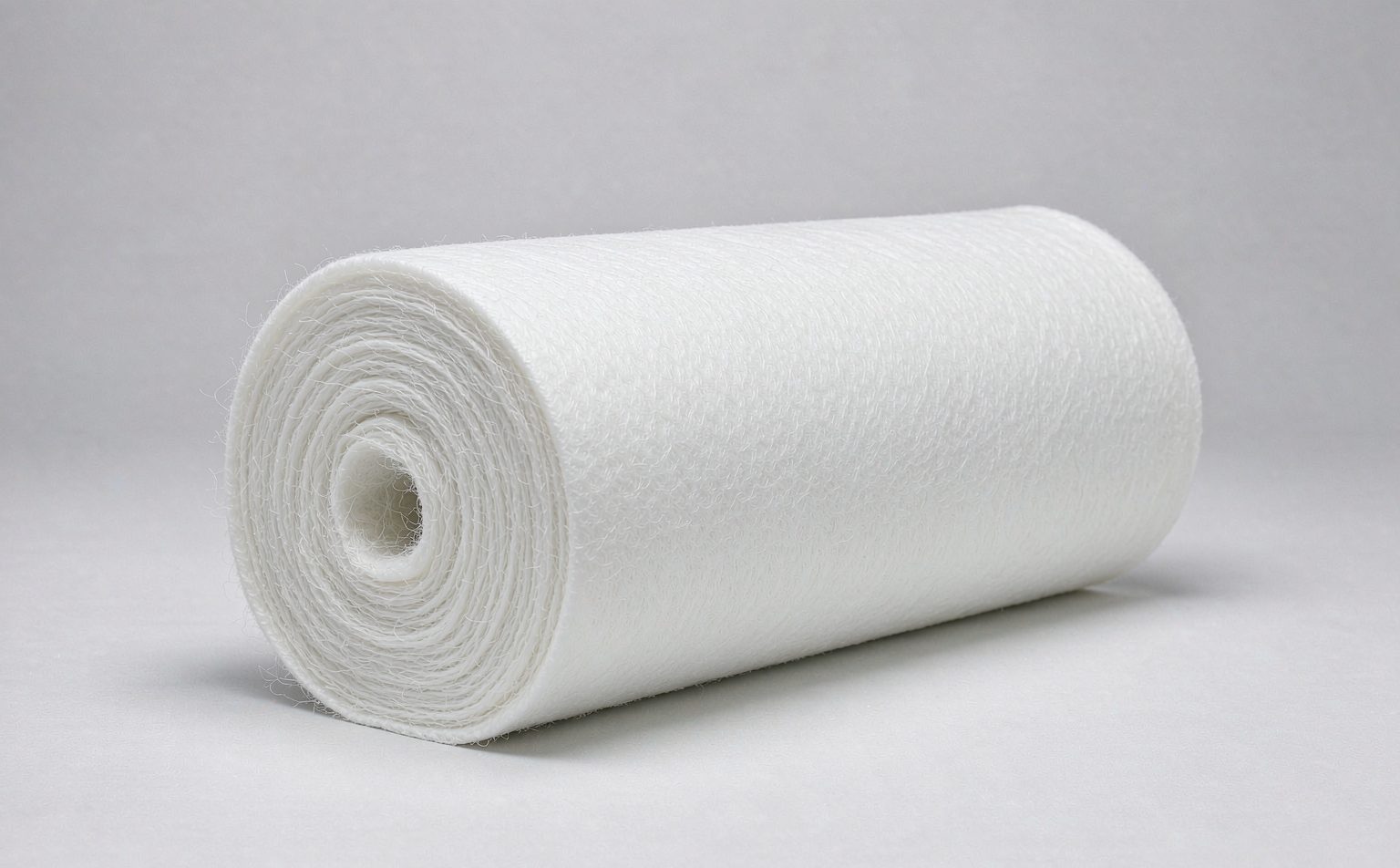
Polyester (PET) Geotextile
Polyester continuous-filament nonwoven geotextile with high strength and creep resistance for demanding filtration and separation.
Indicative Price Range
USD 0.60 - 1.60 / m²
Indicative factory range per m2. Final price depends on thickness or unit weight, roll width and order volume. Send us your specification and we will return a firm factory-direct quote within 24 hours.
Product Description
PET geotextile is a needle-punched nonwoven made from polyester continuous filaments. The long filaments give it higher strength and better creep behaviour than staple-fibre fabric of the same weight, keeping its filtering function stable through years of service.
PET or PP? This is the decision most buyers get wrong. Choose PET when the design is governed by strength and long-term creep - railway track beds, high-load port pavements, reinforcement under heavy embankments - because polyester continuous filament carries load with far less long-term stretch than polypropylene. Choose PP instead when the soil or pore water is strongly alkaline (pH above roughly 9), because polyester hydrolyses in high-pH environments while polypropylene does not. If your site has both high load and high pH, tell us and we will discuss a composite or an alternative build rather than let you discover it in service.
How to specify the grade. Nonwoven geotextiles are bought by unit weight and by the hydraulic and mechanical properties that follow from it. Common weights run 150 g/m2 for light separation under paving, 200-300 g/m2 for road and drainage duty, and 400-800 g/m2 where puncture resistance and cushioning matter, such as under a geomembrane or in landfill and tailings works. The two properties to specify alongside weight are apparent opening size (AOS), which controls what soil particles the fabric will retain, and permittivity, which controls how freely water passes. Send us the soil grading and the drainage requirement and we will size both.
Installation notes. Nonwoven geotextiles are joined by overlap rather than welding: a minimum 300 mm overlap is typical on prepared subgrade, increased on soft ground where the fabric will deform, and panels can be spot-welded or sewn where wind or placement sequence makes overlaps unreliable. Avoid trafficking the fabric directly with tracked plant - place a 150 mm cushion lift of fill before equipment runs over it. Fabric left exposed should be covered within the UV exposure window stated for the grade, since even UV-stabilized nonwovens lose strength under prolonged sun.
Standards and documentation. Our PET geotextile is tested to the standard geotextile test methods buyers ask for: grab tensile strength and elongation (ASTM D4632), trapezoidal tear (ASTM D4533), puncture (ASTM D4833 / D6241), apparent opening size (ASTM D4751) and permittivity (ASTM D4491), with UV retention reported where relevant. Certificates are issued per production lot with roll traceability, and third-party inspection before shipment can be arranged through SGS, BV or Intertek.
It performs well against the acids and common chemicals found in natural soils, which makes it a reliable choice for landfill, tailings and other long-service filtration and separation duties.
As the manufacturer we can supply PET geotextile matched to your specified unit weight, roll width and property set - contact us with your specification and we will confirm supply within 24 hours.
Key Features
- High strength-to-weight ratio from continuous filaments
- Excellent creep resistance for long-term performance
- Resistant to acids and common soil chemicals
- Consistent pore structure for stable filtration
- Durable in buried, long-service conditions
- Lower long-term stretch than polypropylene under sustained load
- Wide rolls reduce overlaps and installation time
- Per-lot test certificates, third-party inspection available
Applications
- •Railway track bed filtration and separation
- •High-load road and port pavement layers
- •Landfill and tailings facilities
- •Retaining wall and basement drainage
- •Coastal and hydraulic engineering
- •Cushion layer beneath geomembrane liners
- •Embankment reinforcement over soft ground
- •Subsurface drainage and french drain wraps
Technical Specifications
- Material
- Polyester (PET) continuous filament
- Structure
- Needle-punched nonwoven
- Unit Weight
- 150 - 800 g/m2
- Tensile Strength
- Grab tensile tested, ASTM D4632
- Apparent Opening Size
- AOS tested, ASTM D4751
- Permittivity
- Tested, ASTM D4491
- Roll Width
- Up to 6 m, custom slit on request
- Standard
- ASTM D4632 / D4533 / D4751 / D4491
Related Products
Nonwoven Geotextile
Needle-punched nonwoven geotextile rolls in PET or PP for filtration, separation and protection, cut to project width.
Woven Geotextile
High-tensile woven geotextile for separation and reinforcement where strength at low elongation matters.
Polypropylene (PP) Geotextile
Polypropylene geotextile with excellent alkali resistance and low density - a durable choice for filtration in alkaline conditions.
Related Technical Articles
PET vs PP Geotextile: Which Polymer Fits Your Project?
Compare PET and PP geotextile polymers by strength, creep, chemical resistance and cost, and learn which one suits reinforcement, filtration or separation.
Nonwoven vs Woven Geotextile: A Complete Selection Guide
Compare nonwoven and woven geotextiles by strength, permeability and filtration, and learn which fabric fits separation, drainage or reinforcement.
Geotextile China: How to Spec Nonwoven and Woven Fabric
Sourcing geotextile China? Here is how to write an RFQ a source factory can quote — polymer, AASHTO M288 class, roll plan and the tests to demand.