
PET vs PP Geotextile: Which Polymer Fits Your Project?
By GeoTexGrid Engineering Team
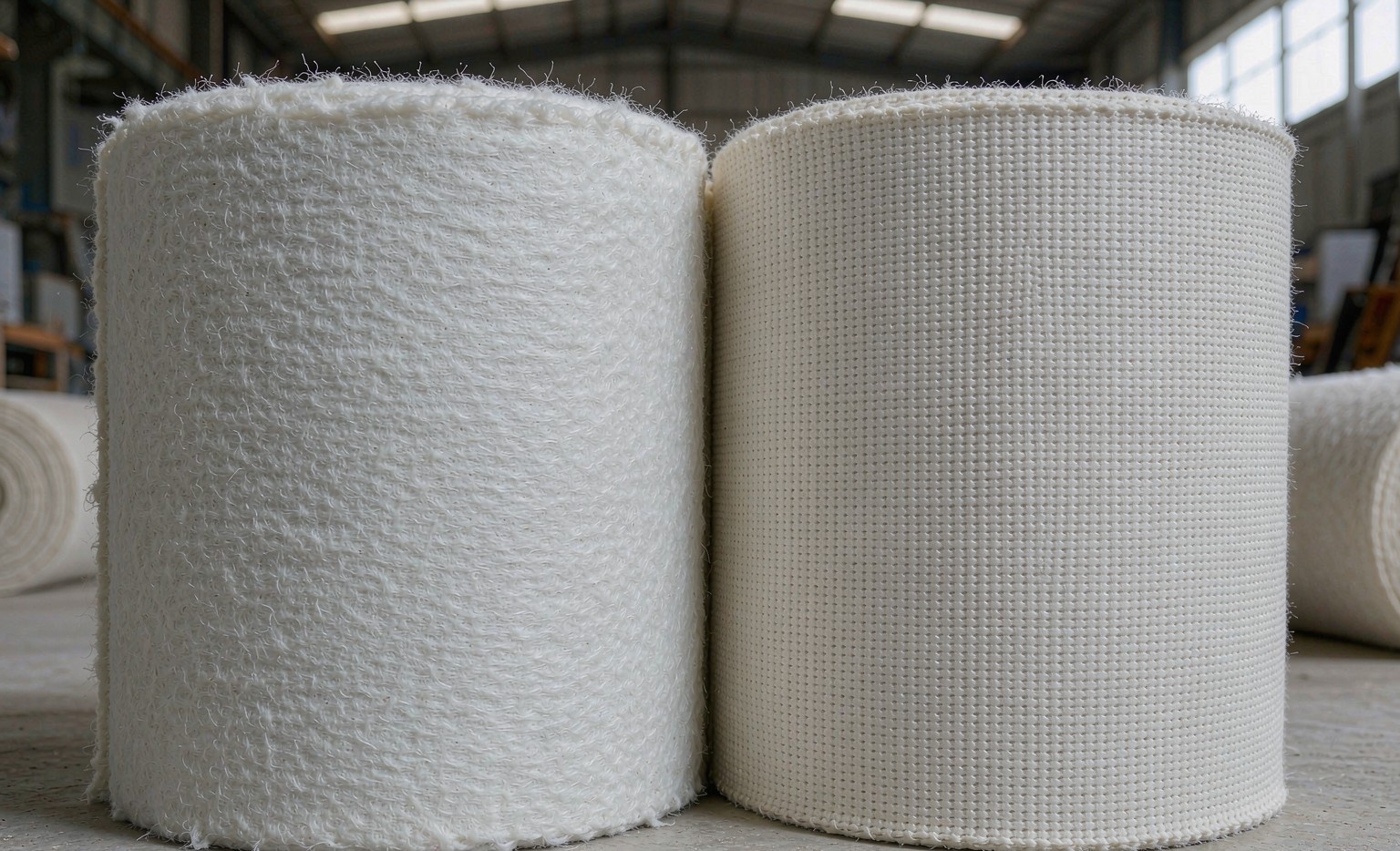
When buyers compare quotes and see one roll specified as polyester and another as polypropylene, the price gap often looks like pure margin. It is not. PET geotextile and PP geotextile behave differently under load, in chemical environments and over a 50-year service life, and choosing the wrong polymer is one of the most expensive mistakes in geosynthetics procurement. This guide breaks the decision down by the properties that actually matter on site.
Why Polymer Choice Matters in Geotextiles
A geotextile is a designed engineering material, not just a fabric. The polymer it is made from controls four things that no amount of extra weight can fully compensate for:
- Tensile strength per unit weight — how much fabric you need to hit a specification.
- Creep behavior — how much the material stretches and loses strength under sustained load.
- Chemical durability — resistance to soil chemistry, pH extremes and hydrocarbons.
- Temperature tolerance — performance during hot asphalt paving or in warm, wet ground.
Two fabrics can carry the same gram weight (say 300 g/m²) and the same roll width, yet deliver very different strength, creep and service life simply because one is polyester and the other is polypropylene. Before comparing prices per square meter, compare the polymer.
PET Geotextile: Strength, Creep and Heat Performance
Polyester (PET) geotextiles — usually woven from high-tenacity PET filaments, sometimes needle-punched as heavy nonwovens — are the reinforcement polymer. Their advantages:
- Higher tenacity. High-strength PET wovens routinely reach tensile strengths above 400 kN/m in standard widths; premium reinforcement grades go well beyond. A PP woven of the same weight simply cannot match this.
- Low creep. PET has a low creep reduction factor, which is why it dominates sustained-load applications: embankments over soft soil, basal reinforcement, geotextile-reinforced walls and steep slopes where the fabric carries load for decades. Under long-term load, PET retains a much larger share of its short-term strength than PP.
- Heat resistance. PET melts at roughly 260 °C versus about 165 °C for PP, so polyester survives contact with hot asphalt and warmer ground conditions far better.
- Higher density. PET's density is about 1.38 g/cm³ (it sinks), which also makes woven PET fabrics dimensionally stable and easy to install in wind.
The classic use cases: high-strength woven reinforcement geotextiles, geotextile-geogrid composites, and any structure where the fabric is a permanent load-carrying element.
PP Geotextile: Chemical Resistance and Cost Efficiency
Polypropylene (PP) geotextiles dominate the volume market — most nonwoven needle-punched fabrics and slit-film wovens are PP — for good reasons:
- Outstanding chemical inertness. PP is stable across roughly pH 2 to 13, resisting acids, alkalis and most solvents. In aggressive soils, industrial sludge caps or waste containment, PP is the default choice.
- No hydrolysis risk. PP does not absorb water and is immune to hydrolysis — the one durability mechanism that limits PET in some environments (more on that below).
- Lower cost. PP resin is cheaper, and for equal weight a PP geotextile is typically the more economical option per square meter.
- Light weight. At about 0.91 g/cm³, PP floats — which cuts both ways: easier handling in wet works, but lighter fabrics need care against wind during installation.
For separation, filtration and drainage — the functions where the geotextile works by hydraulics rather than by strength — PP nonwovens from 200 to 400 g/m² cover the majority of road and drainage applications at the lowest cost.
PET vs PP Geotextile: Side-by-Side Comparison
| Property | PET (Polyester) Geotextile | PP (Polypropylene) Geotextile |
|---|---|---|
| Density | ~1.38 g/cm³ (sinks) | ~0.91 g/cm³ (floats) |
| Melting point | ~260 °C | ~165 °C |
| Tensile strength | Highest; reinforcement grades 400+ kN/m | Moderate; typical wovens below ~200 kN/m |
| Creep under sustained load | Low; excellent long-term design strength | Higher; larger reduction factors needed |
| Chemical resistance | Good, but vulnerable in strong alkali (pH > 10) | Excellent across pH 2–13 |
| Hydrolysis risk | Yes, in hot, wet, alkaline conditions | None |
| UV resistance | Moderate; needs stabilizers | Lower without stabilizers; needs UV packages |
| Typical role | Reinforcement, walls, basal reinforcement | Separation, filtration, drainage, general use |
| Relative cost | Higher | Lower |
Where Each Polymer Sits in Our Range
Those properties translate into four products. This is literally which polymer reaches you in which form:
| Polymer | Construction supplied | Specified for |
|---|---|---|
| Polyester (PET) continuous filament | PET Geotextile | Reinforcement, low creep, long design life |
| Polypropylene (PP) | PP Geotextile | Separation, filtration, aggressive chemistry |
| Needle-punched nonwoven (PET / PP) | Nonwoven Geotextile | Drainage, filtration, geomembrane protection |
| Woven PP slit film / PET yarn | Woven Geotextile | Subgrade stabilization, base reinforcement |
Roll width and unit weight are made to order across the whole range, so the polymer decision is the one you have to get right first.
Choosing by Application, Not by Price
Match the polymer to the function the geotextile performs:
- Reinforcement (embankments over soft soil, reinforced walls, steep slopes): specify high-tenacity PET woven. Creep and strength-per-weight decide the design, and PET wins both.
- Separation and stabilization under roads: PP woven or nonwoven is the standard answer — the fabric works as a separator and stress-relief layer, not as the main reinforcement. If you are unsure how the fabric interacts with the aggregate layer, see our nonwoven vs woven geotextile selection guide.
- Filtration and drainage: PP nonwoven covers most cases, including aggressive chemistry. Get the opening size right first — our guide to geotextile filter fabric AOS and permeability walks through matching the fabric to your soil's D50.
- Hot climates or contact with asphalt: prefer PET, or at minimum verify the PP product's thermal ratings before paving over it.
Durability Limits: What Each Polymer Cannot Do
Honest specification means knowing the failure modes:
- PET's weakness is hydrolysis. In hot, permanently wet and alkaline environments (pH above roughly 10 — think lime-treated soils, fresh concrete contact, some industrial wastes), polyester gradually loses strength through hydrolytic chain scission. Standard guidance: avoid PET where long-term pH exceeds 9–10 at elevated temperature.
- PP's weaknesses are creep and UV. Under sustained load a PP geotextile stretches more and must be designed with larger strength reduction factors; and without a proper UV stabilization package it degrades faster in sunlight. Neither is a problem when the fabric is buried promptly and works under short-term or moderate loads — which describes most separation and filtration roles.
Both polymers also need antioxidants and UV stabilizers during storage and installation. Any supplier who cannot produce an independent test certificate for those additives is a supplier to avoid.
Site Conditions That Decide the Polymer
In practice the choice is usually forced by one site condition before price enters the conversation:
| Site condition | Polymer that survives | Reason |
|---|---|---|
| Permanently wet ground with pH above roughly 9–10 | PP | PET progressively loses strength to hydrolysis when hot, wet and alkaline |
| Precinct contact with asphalt at 160–180 °C during paving | PET | PET melts near 260 °C, PP near 165 °C |
| Sustained tensile load for decades (basal reinforcement, walls) | PET | Far lower creep, so a larger share of short-term strength is retained |
| Acid mine drainage, industrial sludge, waste containment | PP | Stable across roughly pH 2–13 |
| Temporary works and short exposure before burial | Either | Neither failure mechanism has time to act |
What to Demand in Test Certificates
Numbers on a quotation mean nothing without the method behind them. Require:
- Wide-width tensile strength and elongation to ASTM D4595 (ISO 10319 where the project follows European specs) — quote both MD and CMD.
- Creep-reduction data for anything carrying sustained load — where PET and PP diverge most.
- AOS / O95 to ASTM D4751, and CBR puncture to ASTM D6241, for filtration and survivability.
- Compliance statement to AASHTO M288 class on US state road jobs.
- Polymer identification and UV package disclosure — the cheapest way to catch a substituted resin before delivery.
Choosing the Right Geotextile Polymer for Your Project
- Product range and data sheets — see the full geotextile and geogrid product range for PET wovens, PP nonwovens, weights and roll dimensions.
- Talk to an engineer — message us on WhatsApp with your project conditions (soil pH, load, function) for a same-day polymer recommendation, or email cn8978688@gmail.com.
- Related reading — Geotextile for Road Construction explains how separation, filtration and drainage roles differ on real projects.
Send your specification or site conditions and you get a confirmed polymer recommendation with quotation — usually within one working day.
Related Articles
Fiberglass Geogrid China Supplier: Mesh and Coat
How to vet a fiberglass geogrid China supplier: mesh size, bitumen vs polymer coating, and the rib-count arithmetic that proves a 30-100 kN/m datasheet.
Woven Geotextile China Manufacturer: Slit Film
A woven geotextile China manufacturer explains slit film tapes, the grab-versus-wide-width trap, and how roll width changes the area you pay for.
Geocell China Manufacturer: Perforation Surface
Perforated or textured walls decide how a geocell drains and grips. A geocell China manufacturer explains wall options, weld QC and checks before order.