
Nonwoven vs Woven Geotextile: A Complete Selection Guide
By GeoTexGrid Engineering Team
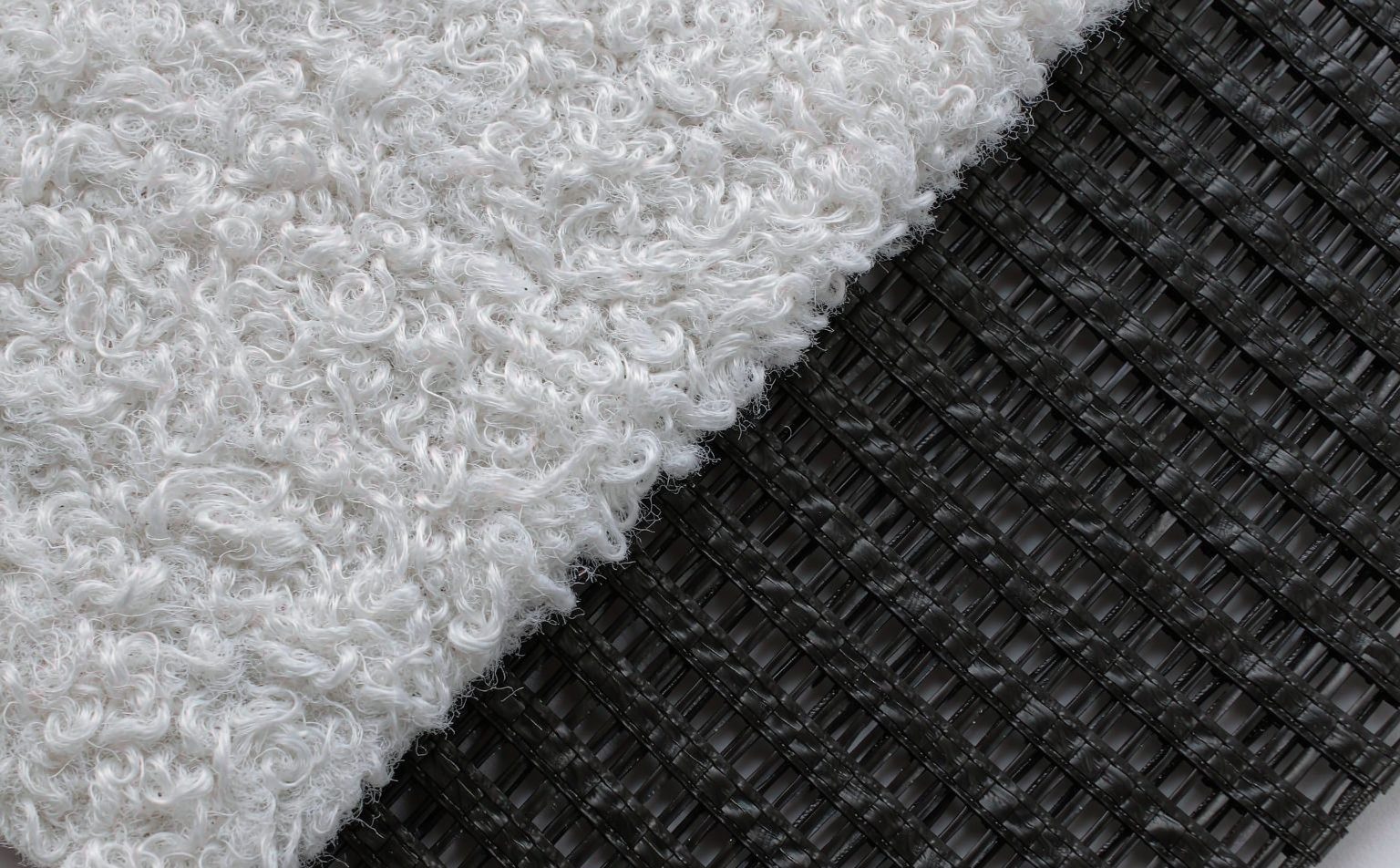
Ask two engineers what a "geotextile" should do and you will often get two different answers — one wants a filter, the other wants a reinforcement. Both are right, but they are describing nonwoven and woven geotextiles respectively. The two families share a name and a roll format, yet their internal structure, hydraulic behaviour, and mechanical limits are fundamentally different.
Choosing between them is not a matter of picking the stronger or the cheaper roll. It is a matter of matching the geotextile's structure to the mechanism your design depends on: filtration, drainage, separation, protection, or stabilization.
What Is a Nonwoven Geotextile?
A nonwoven geotextile is made from continuous filaments or staple fibres — usually polypropylene or polyester — that are laid into a web and bonded either mechanically (needle-punching), thermally, or chemically.
The result is a thick, three-dimensional, felt-like fabric with a tortuous pore structure. Water does not flow through a straight channel; it winds through the fibre matrix.
Key characteristics:
- High water permeability, typically 10–100+ l/m²/s
- High elongation at break (often 50–120%), which lets the fabric deform with the soil without tearing
- Excellent filtration and separation behaviour
- Good puncture and CBR resistance relative to its weight
- Fibre type matters: PP offers chemical resistance and UV stability at low cost; PET offers higher tensile strength and better performance at elevated temperatures
Nonwovens are the default choice wherever water must pass through while soil is retained.
Where Nonwoven Geotextile Belongs
- Subsurface drainage — trench drains, French drains, drainage blankets
- Separation between subgrade and granular fill on soft ground
- Filtration behind retaining walls, sea walls and revetments
- Protection of geomembranes in landfills, ponds and reservoirs
- Road and railway separation, especially where differential settlement occurs
- Erosion control under riprap and gabion systems
What Is a Woven Geotextile?
A woven geotextile is produced on a loom from slit-film, monofilament, or multifilament yarns, interlaced at right angles. The result is a thin, flat fabric with a regular, predictable pore structure and a very different mechanical profile.
Key characteristics:
- High tensile strength in the machine and cross directions
- Low elongation — the fabric mobilises strength quickly with very little strain
- Lower permeability than nonwoven of equivalent weight, particularly for slit-film products
- Thinner and often more economical per unit strength
Woven geotextiles behave more like a flexible reinforcement than a filter. The trade-off is that a stiff, low-elongation fabric will not conform as readily to an irregular subgrade, and slit-film wovens can clog more easily in fine-grained soils if the pore size is not matched correctly.
Where Woven Geotextile Belongs
- Subgrade stabilization over soft soils under haul roads and embankments
- Base reinforcement in unpaved roads
- Separation where high tensile demands and moderate drainage needs coincide
- Embankment and slope base reinforcement
- Gabion and rock-filled structure backing
Side-by-Side Comparison
| Property | Nonwoven Geotextile | Woven Geotextile |
|---|---|---|
| Structure | Needle-punched / thermally bonded fibre web | Interlaced yarns |
| Water permeability | High | Moderate to low |
| Elongation at break | High (50–120%) | Low (10–30%) |
| Tensile strength | Moderate | High |
| Puncture / CBR resistance | Good | Moderate |
| Filtration behaviour | Excellent, tortuous pores | Good, regular pores |
| Conformity to subgrade | Excellent | Limited |
| Primary role | Filtration, drainage, separation, protection | Stabilization, reinforcement |
| Typical polymers | PP, PET | PP, PET |
What We Actually Manufacture
Generic tables take you only so far. These are the four constructions we produce, with the material and supply options exactly as they appear in our product data:
| Product | Material | Roll width | Unit weight | Primary role |
|---|---|---|---|---|
| Nonwoven Geotextile | Needle-punched nonwoven (PET / PP) | Customizable | Customizable | Filtration, drainage, separation, protection |
| Woven Geotextile | Woven PP slit film / PET yarn | Customizable | Customizable | Stabilization, base reinforcement |
| PET Geotextile | Polyester (PET) continuous filament | Customizable | Customizable | High-strength reinforcement, low creep |
| PP Geotextile | Polypropylene (PP) | Customizable | Customizable | Separation, filtration in aggressive soils |
Specify the performance values you need and let the mill match them, rather than shopping on grams per square metre.
How to Choose: Match the Mechanism
Choose nonwoven when the design relies on water moving through the fabric. Filtration, drainage, and protection of a geomembrane are all hydraulic problems. A woven geotextile with low permeability will slow drainage and can cause pore water pressure to build behind it.
Choose woven when the design relies on the fabric carrying tension. Stabilization of a soft subgrade under repeated traffic loading is a mechanical problem. A high-elongation nonwoven will stretch before it develops useful resistance, allowing rutting to begin.
Choose both when both jobs exist. On many road projects the correct answer is a composite: a woven geotextile for base stabilization beneath the granular layer, and a nonwoven for drainage and separation elsewhere. There is no rule that says a project must standardise on one product.
Selecting Nonwoven vs Woven for Road Construction
On a typical road section the decision usually breaks down like this:
- Soft, wet subgrade with high fines → woven geotextile for stabilization, plus a nonwoven drainage layer if the water table is high
- Stable subgrade, need separation only → nonwoven geotextile
- Asphalt overlay on an existing cracked pavement → paving fabric or fiberglass geogrid, not a standard nonwoven
- Edge drains and filter drains → nonwoven, selected on AOS and flow rate
- Paved shoulder and ditch lining → nonwoven under riprap
Specification Checklist
Do not specify by weight alone — "200 g/m² nonwoven" tells you almost nothing about performance. Check:
- Wide-width tensile strength by ASTM D4595 (or ISO 10319 on European, AASHTO-governed projects), MD and CMD, quoted with elongation at failure.
- Grab tensile strength by ASTM D4632 — often what specifiers quote, and not interchangeable with wide-width values.
- CBR puncture resistance by ASTM D6241 — critical for installation survivability. Typical specified minimums run from about 2 kN for light separation duties up to roughly 6 kN for heavy stabilization under coarse angular aggregate.
- Apparent opening size (AOS / O95) by ASTM D4751 — must be matched to the soil gradation, typically O95 ≤ D85 of the soil for filtration.
- Water flow rate / permittivity by ASTM D4491 — must be adequate for the design discharge.
Two Checks That Settle Most Arguments
Check 1 — does the fabric have to let water through, or carry load? Put numbers on it. For a filtration duty against fine silty sand with D85 ≈ 0.15 mm, retention and permeability rules push you towards an O95 in the 0.15–0.4 mm band measured to ASTM D4751. A needle-punched nonwoven reaches that easily. A slit-film woven, with its regular but comparatively large pore geometry, is much harder to match to that grading and tends to blind over time.
Check 2 — how much strain will the fabric see before it mobilises? On soft ground under repeated wheel loads the fabric must engage early. A woven that develops strength at 10–25% elongation starts working almost immediately; a nonwoven needing 50%+ strain lets rutting begin first. Conversely, where differential settlement is expected, that high elongation is a feature — it lets the fabric deform without tearing.
| Observed symptom | Likely family error | Value to re-check |
|---|---|---|
| Subgrade pumping fine material into the base | Woven used where filtration governed | O95 vs. D85 (ASTM D4751) |
| Pore pressure behind a wall or abutment | Nonwoven permeability too low for the inflow | Permittivity (ASTM D4491) |
| Rutting under a stabilised haul road | Nonwoven used where early modulus was needed | Load at 5% strain, wide-width (ASTM D4595) |
| Fabric punctured during placement | CBR puncture below the aggregate duty class | ASTM D6241 result vs. specified minimum |
Summary
Nonwoven is the filtration, drainage, separation and protection product. Woven is the stabilization and reinforcement product. Getting the family right is the single most important geotextile decision on a project — weight, polymer and strength grade all follow from it.
Tell us the application, soil gradation and required AOS, and our engineers will name the construction and quote — normally within one working day.
Where to Go Next
- Product range and data sheets — see the full geotextile product range for mass per unit area, AOS values and tensile grades.
- Talk to an engineer directly — message us on WhatsApp for a same-day technical answer, or email cn8978688@gmail.com.
- Related reading — Steel-Plastic Geogrid vs Fiberglass Geogrid explains how the reinforcement layer above a geotextile is specified, and the biaxial and uniaxial geogrid guide covers load direction in base layers. You can also contact our team directly.
Related Articles
Fiberglass Geogrid China Supplier: Mesh and Coat
How to vet a fiberglass geogrid China supplier: mesh size, bitumen vs polymer coating, and the rib-count arithmetic that proves a 30-100 kN/m datasheet.
Woven Geotextile China Manufacturer: Slit Film
A woven geotextile China manufacturer explains slit film tapes, the grab-versus-wide-width trap, and how roll width changes the area you pay for.
Geocell China Manufacturer: Perforation Surface
Perforated or textured walls decide how a geocell drains and grips. A geocell China manufacturer explains wall options, weld QC and checks before order.