
الشبكة الأرضية أم النسيج الأرضي: ما الفرق
بقلم GeoTexGrid Engineering Team
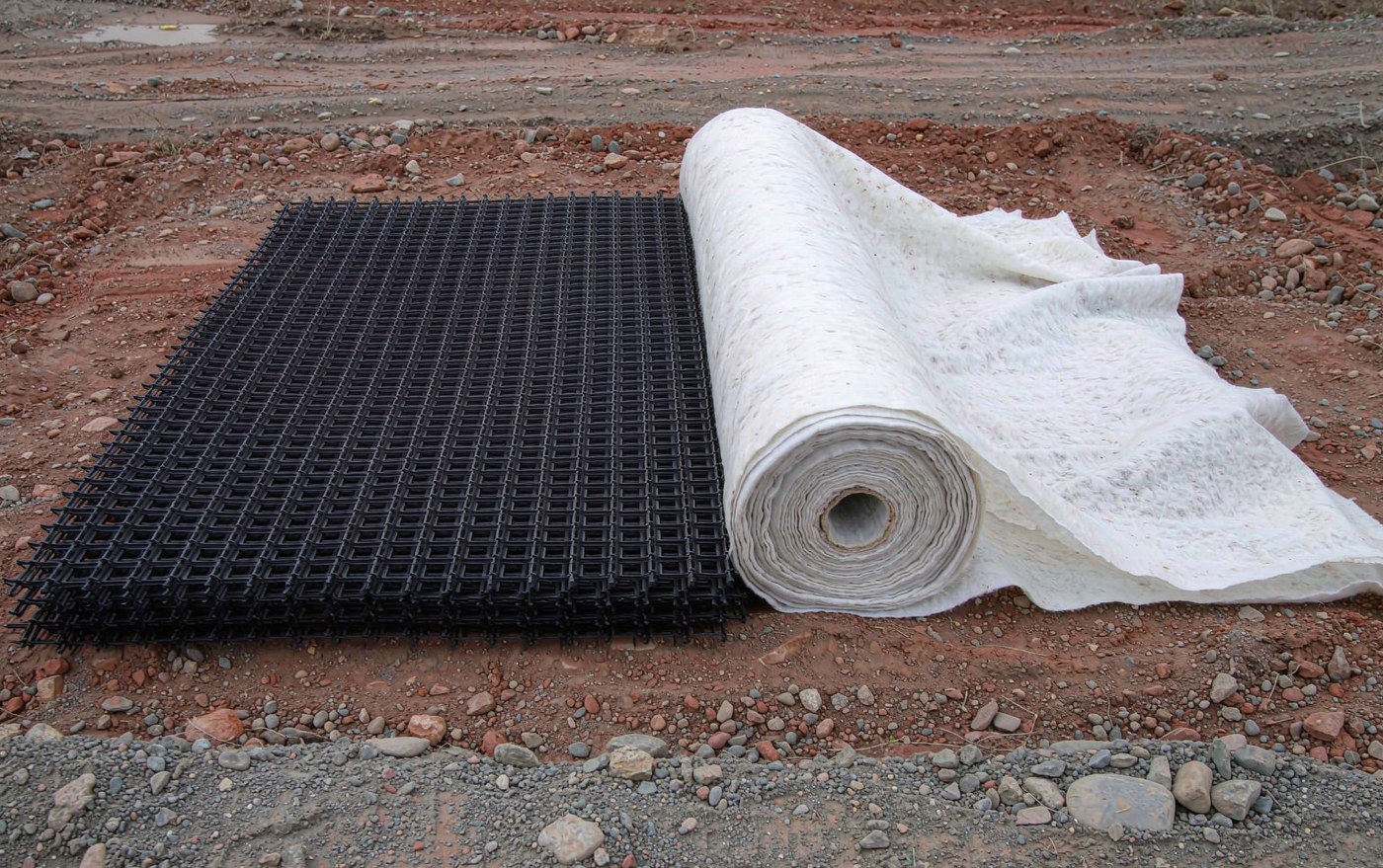
They arrive on the same truck, they both come in rolls, and on a construction site people call both of them "the fabric" — but geogrid and geotextile do completely different jobs. Putting the wrong one in the ground is not a minor mix-up: a geotextile where a geogrid belongs gives you a base course that rutts within one winter, and a geogrid where a filter belongs gives you a drainage layer that silts shut.
This guide separates the two cleanly: what each one physically does, how to tell them apart on site, when a project needs both, and a quick selection table for the situations that come up most often — driveways, retaining walls, drains and asphalt overlays.
The Short Answer
A geogrid reinforces. A geotextile filters and separates.
- A geogrid is a rigid, open grid with large apertures. It has one job: interlock with aggregate or soil and add tensile stiffness, so the fill layer behaves like a semi-rigid slab instead of a loose pile of stones. It is a skeleton.
- A geotextile is a fabric — woven or needle-punched nonwoven — with fine, controlled pores. Its jobs are filtration (let water pass, hold soil), separation (keep two soil layers from mixing) and protection (cushion a geomembrane). It is a skin.
The confusion exists because both are "geosynthetics", both are sold by the roll, and because the industry nickname "geogrid fabric" blurs the line. If you remember only one sentence: if the problem is soil or aggregate moving sideways, you need geogrid; if the problem is water or soil migration, you need geotextile.
What a Geogrid Actually Does
A geogrid works through mechanical interlock. Aggregate particles punch partially into the apertures and lock against the ribs, so loads that would normally shove stones sideways are transferred into the grid's tensile ribs instead. That does three measurable things on a road or working platform: it confines the base course, it spreads the load footprint, and it lets you either build thinner or carry heavier.
The three families you will quote against differ in where their strength sits:
- Biaxial geogrid carries load equally in both directions — the right choice for road bases, gravel driveways and working platforms where traffic rolls in every direction. See steel-plastic biaxial geogrid.
- Uniaxial geogrid concentrates nearly all its strength in one direction, which matches the pull of a reinforced soil mass — that is why MSE retaining walls and steep slopes use it, and why using biaxial there is a design error. See steel-plastic uniaxial geogrid.
- Fiberglass geogrid goes inside asphalt layers, where its high modulus and bitumen coating arrest reflective cracks. See fiberglass geogrid.
For choosing between the first two, our biaxial vs uniaxial geogrid guide covers the directionality logic in detail. If you are deciding whether the section needs a grid at all, the aggregate thickness reduction guide shows where reinforcement actually pays for itself.
What a Geotextile Actually Does
A geotextile works through pore structure. Water moves through it; soil particles either stop at its surface or (in the case of woven slit-film) are held by tight apertures. On site it performs four roles, often two at once:
- Filtration — the classic geotextile filter fabric job behind a retaining wall, around a French drain or under riprap: water out, soil stays.
- Separation — keeping a soft subgrade from pumping up into a fresh aggregate base. This is the single biggest quality-of-road issue geotextiles solve, covered in our road construction separation guide.
- Protection — a cushion layer that stops sharp aggregate from puncturing the geomembrane in a landfill or pond liner system.
- Drainage (in-plane) — thick needle-punched nonwovens carry water along their own thickness in leachate collections and wall drains.
Woven geotextiles bring high tensile strength at low elongation; nonwovens bring permeability and elongation. The choice between them is its own topic — see nonwoven vs woven geotextile.
Geogrid vs Geotextile Side by Side
| Aspect | Geogrid | Geotextile |
|---|---|---|
| Primary function | Reinforcement / confinement | Filtration / separation / protection |
| How it works | Aggregate interlock in open apertures | Pore structure passes water, holds soil |
| Structure | Rigid grid, large openings, no filtration | Fabric, fine pores, flexible sheet |
| Key spec | Tensile strength (kN/m) + junction efficiency | AOS + permittivity + CBR puncture |
| Typical layer | At the base or within the reinforced fill | At the filter/separation interface |
The key specification difference matters when you order: a geogrid quote turns on kN/m ratings and junction strength; a geotextile quote turns on AOS and permittivity, because a filter that clogs or pipes has failed no matter how strong it is.
When You Need Both in the Same Section
On weak subgrades the two products are not competitors — they are a team, and the classic section looks like this:
- Geotextile on the subgrade — separates soft soil from the aggregate and stops pumping.
- Geogrid at the base of the aggregate — confines the stone and spreads load.
- Fill and compact — the aggregate interlocks with the grid above the separated subgrade.
Neither layer alone does the whole job: grid alone lets fines pump into its open apertures and lose interlock over time; geotextile alone has no ribs to confine the stone. This geogrid-plus-geotextile combination is also why our composite drainage net and geocell systems exist — prefabricating the layered functions into one product where installation conditions demand it.
Common Mix-Ups on Site
"Geogrid fabric" — which is it? The nickname covers both. If the drawing says geogrid, the deliverable is an open grid with measurable apertures; if it says filter fabric or separator, it is a sheet of woven or nonwoven geotextile.
Woven geotextiles that look like grids. Some coarse wovens have a visible open pattern and get mistaken for grids. Check the aperture-to-ribbon ratio: a geotextile's openings are small relative to its strands (its job is pores), while a geogrid's ribs are thin relative to big apertures (its job is interlock).
Substituting by price. On a low-volume road, geotextile is typically the cheaper roll — and it cannot do the geogrid's job. The reverse substitution silently buys stiffness nobody specified. Match the product to the function in the drawing first, then compare prices within that product.
Quick Selection Scenarios
- Gravel driveway over soft ground — biaxial geogrid at the base of the gravel, nonwoven geotextile on the subgrade below it. For thin granular sections on very soft ground, a geocell confinement layer is the heavier-duty alternative.
- MSE retaining wall or steep slope — uniaxial geogrid in the reinforced fill, nonwoven geotextile as the drain/filter behind the facing.
- French drain or leachate layer — geotextile filter around the aggregate or a geonet composite; no geogrid involved.
- Asphalt overlay with cracking — fiberglass geogrid in the overlay; a geotextile membrane interlayer is a moisture-barrier option, not a crack arrester.
- Installation — laying and lapping rules differ per product; our geogrid installation guide covers overlaps, tensioning and fill placement.
FAQ
Can I use geotextile instead of geogrid to save money?
Only if the design function is separation or filtration. A geotextile has no ribs for aggregate interlock; it cannot confine a base course the way a geogrid does, and no fabric weight compensates for that.
Is geogrid stronger than geotextile?
They are strong for different things. Geogrids win on tensile modulus in the plane of the grid; geotextiles win on anything involving water flow and puncture cushioning. Strength comparisons between the two are category errors.
What comes first, geogrid or geotextile?
On weak subgrade, geotextile directly on the soil, geogrid within or at the bottom of the aggregate above it. The grid must end up interlocked with stone, not buried against mud.
Do geogrid and geotextile need the same overlap?
No. Geogrid overlaps follow the load direction and are often tied or clipped; geotextile overlaps follow permeability and seam strength requirements. Mixing up lap rules is one of the most common installation errors on combined sections.
Tell Us the Problem, Not the Product
Send GeoTexGrid your cross-section or even a photo of the site — we will tell you honestly whether the section needs a geogrid, a geotextile or both, and quote exactly that. Our range covers steel-plastic biaxial and uniaxial geogrids, nonwoven and woven geotextiles and the combined drainage products in between, all with batch test certificates.
Get a recommendation on the contact page, message WhatsApp, or email cn8978688@gmail.com. Most projects need steel-plastic geogrid for reinforcement and nonwoven geotextile for filtration — tell us which problem you have and we will confirm the section.
مقالات ذات صلة
Fiberglass Geogrid China Supplier: Mesh and Coat
How to vet a fiberglass geogrid China supplier: mesh size, bitumen vs polymer coating, and the rib-count arithmetic that proves a 30-100 kN/m datasheet.
Woven Geotextile China Manufacturer: Slit Film
A woven geotextile China manufacturer explains slit film tapes, the grab-versus-wide-width trap, and how roll width changes the area you pay for.
Geocell China Manufacturer: Perforation Surface
Perforated or textured walls decide how a geocell drains and grips. A geocell China manufacturer explains wall options, weld QC and checks before order.