
Woven Geotextile China Manufacturer: Slit Film
بقلم GeoTexGrid Engineering Team
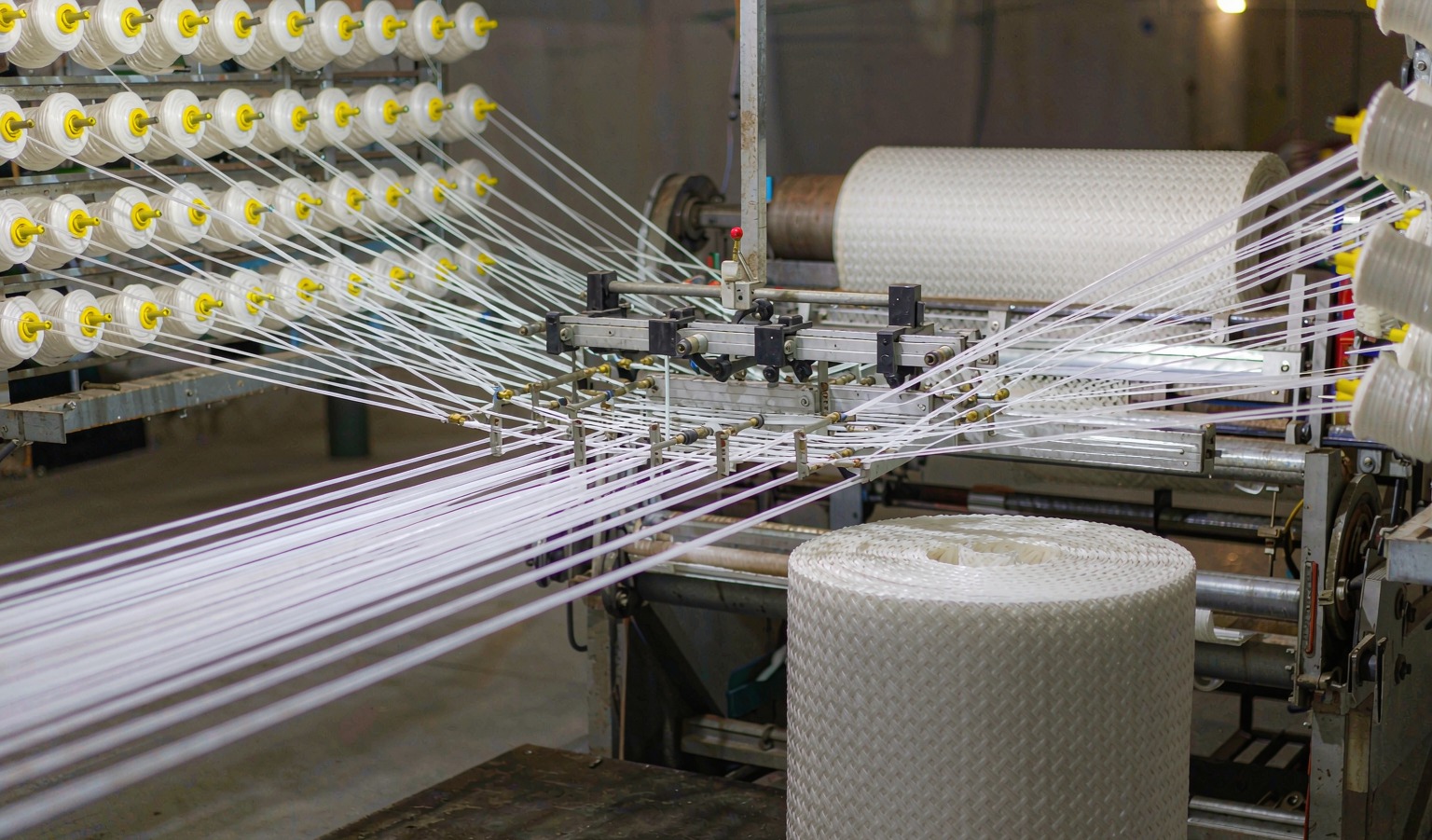
Three numbers arrive in almost every enquiry for woven fabric: roll width, weight per square metre, price. None tells you what the cloth will do when a loader tracks over it. A woven geotextile China manufacturer can sell you two 200 g/m² rolls from the same plant, on the same day, at strength levels that differ by half.
I have walked buyers through our weaving hall enough times to know where that confusion starts. It starts with the word on the data sheet.
What "Slit Film" Means on a Woven Geotextile Data Sheet
Slit film describes how the yarn was made. Nothing else. A flat polypropylene film is extruded, slit into narrow tapes, then drawn hot so the polymer chains orient along the tape. The oriented tape carries the load. Weave the tapes and you have a woven geotextile.
Two mills can print "PP slit film" on a certificate and still differ by a factor of two in tensile strength, because the strength lives in the draw ratio and the weave density, not in the label. Our woven line is listed as Woven PP slit film / PET yarn, with roll width and unit weight both made to order. A quote that lists only grams per square metre is not a quote you can compare: weight says how much polymer is in the roll, not how well it is oriented.
What a Woven Geotextile China Manufacturer Controls
Four process steps decide the finished number.
Extrusion. Granules go through a die into a flat film, slit into tapes typically 2–3 mm wide. Wider tapes weave faster and give a coarser, more open cloth.
Drawing. The tape is stretched hot between rollers. This is where tenacity is made. A tape drawn at a low ratio is cheap and weak; draw it properly and the same gram of PP carries several times the load.
Weaving. Ends and picks per 10 cm set both strength and opening size. Fine tapes in a dense weave give strength with small openings; wide tapes in a coarse weave give the opposite.
Heat setting. Calendering stops the fabric shrinking or creeping on the roll. Skip it and the cloth passes a lab tensile test, then elongates under a plate compactor.
When you audit a mill, ask for tape tenacity and weave density before you ask for finished kN/m. A supplier who can answer both is running a weaving plant. One who cannot is usually buying greige fabric and printing a label on it — and you are paying factory direct prices for a trader's margin.
The Spec Trap: Grab Strength vs Wide-Width Tensile
North American highway work specifies grab strength per ASTM D4632, or CBR puncture per ASTM D6241. Chinese mills, and most of Europe, quote wide-width tensile per ASTM D4595 or GB/T 15788, in kN/m. The two are not the same quantity and were never meant to be — and the gap between them has cost buyers more than any quality issue.
Wide-width converts directly. The specimen is 200 mm wide and the result is reported per metre of width:
- 20 kN/m × 0.200 m = 4.0 kN carried by the test strip.
Grab grips a much smaller area between 25 mm jaws, so the same fabric reports far less — typically about a fifth of the strip load. A cloth quoted at 20 kN/m wide-width often comes back near 800 N grab.
Set those figures beside AASHTO M288 and the trap closes. Class 3 separation calls for 800 N grab and 1.8 kN CBR — an ordinary woven fabric. A buyer holding that clause and a mill quoting 20 kN/m wide-width can argue for a week about a roll they already agree on.
Three questions end the argument: which test produced the number (D4632, D4595 or D6241); machine direction or cross direction, since woven strength is not symmetric; and wet or dry conditioning, because the certificate should say.
If your project follows US practice, the AASHTO M288 geotextile classes give the grab and CBR thresholds directly, and you can ask the mill to test against them.
Which Fabric Belongs in Which Layer
Woven and nonwoven are not competitors. Nonwoven filters and cushions; woven separates and stabilises.
| Fabric in our range | Structure | Where it earns its place | What to verify |
|---|---|---|---|
| Woven slit-film | Woven PP slit film / PET yarn, roll width and unit weight to order | Separation and stabilisation where strength must arrive with low elongation | Wide-width tensile, ASTM D4595 / GB/T 15788 |
| Needle-punched nonwoven | Needle-punched nonwoven (PET / PP), weight to order | Filtration, drainage, cushion over a liner | AOS per ASTM D4751, permittivity per ASTM D4491 |
| PET filament nonwoven | Polyester (PET) continuous filament | Reinforced soil and permanently loaded layers where creep matters | Wide-width tensile plus creep data, ISO 10319 |
| PP nonwoven | Polypropylene (PP) | Chemical resistance and cost-driven separation | ASTM D4595 tensile, ASTM D6241 puncture |
Polymer choice follows the same logic. PP handles alkalis and leachate and is the cheaper tape, but it is more UV-sensitive and creeps under sustained load. PET is stronger per gram and creeps less, and it hydrolyses in strongly alkaline ground — a real consideration beside fresh concrete. The PET vs PP comparison covers the chemistry; a permanently loaded layer should not be chosen on price per square metre.
Seams, Laps and the Area You Pay For
A 30 m wide formation, 300 m long: 9,000 m² before any lap. The roll width you order decides how much of that 9,000 m² you actually buy, because every joint eats a strip.
| Roll width | Strips across 30 m | Longitudinal joints | Lap area at 300 mm | Extra over 9,000 m² |
|---|---|---|---|---|
| 2.0 m | 15 | 14 × 300 m | 1,260 m² | +14.0% |
| 4.0 m | 8 | 7 × 300 m | 630 m² | +7.0% |
| 5.0 m | 6 | 5 × 300 m | 450 m² | +5.0% |
Double the width and you halve the lap waste: 630 m² on this job, more than the freight difference between narrow and wide rolls on one container.
Sewn seams need their own check. Most specifications call for seam strength of at least 60% of the parent fabric, tested on a seamed specimen rather than assumed from the thread. A 20 kN/m fabric therefore needs a seam holding about 12 kN/m. The two things that break that number on site are the wrong thread for PP tape, and a seam sewn through a dusty lap.
What Fails in Service
Complaints rarely trace back to the tensile figure.
| What you see | Real cause | What catches it |
|---|---|---|
| Fabric intact, seam split open | Seam efficiency below the 60% rule, or thread incompatible with PP tape | Seam tensile test on a seamed specimen |
| Tapes fibrillate and fray under traffic | Tape under-drawn at the mill, low tenacity for the weight | Tape tenacity and draw ratio on the certificate |
| Cloth brittle and cracking after a season in sun | UV stabiliser dosed for a shorter exposure than the site allows | Retained strength after UV exposure |
| Joints open during fill placement | Lap too short for the subgrade, or laid across the slope instead of down it | Construction detail, not the fabric |
| Water ponds on top, soil washes through | Woven specified where a filter was needed | AOS per ASTM D4751, permittivity per ASTM D4491 |
That last row costs the most and gets blamed on the material least. A woven fabric is a separator, not a filter: if the layer has to filter, extra grams will not fix the wrong family.
Where to Go Next
- Specifications and roll options — the woven geotextile product page lists the PP slit film and PET yarn constructions, with width and weight cut to your order.
- Talk to an engineer — send the soil type, the layer function and your test method. Message us on WhatsApp or email cn8978688@gmail.com for a written confirmation, usually within one working day.
- Related reading — Nonwoven vs Woven Geotextile covers where each family belongs.
We are a source factory, not a trading desk: tapes are extruded and woven in our plant, widths are cut to your panel layout, and every batch ships with a mill test certificate. Small trial orders can travel as LCL, so you can test the fabric before committing to a container. Email cn8978688@gmail.com with your roll schedule and we will quote the width that wastes least.
GeoTexGrid Materials Co., Ltd. supplies geotextiles, geogrids, geomembranes and geocells to contractors and distributors worldwide.
مقالات ذات صلة
Fiberglass Geogrid China Supplier: Mesh and Coat
How to vet a fiberglass geogrid China supplier: mesh size, bitumen vs polymer coating, and the rib-count arithmetic that proves a 30-100 kN/m datasheet.
Geocell China Manufacturer: Perforation Surface
Perforated or textured walls decide how a geocell drains and grips. A geocell China manufacturer explains wall options, weld QC and checks before order.
HDPE Geomembrane Welding China: Seam QC Checklist
HDPE geomembrane welding in China: dual-track vs extrusion, lap and seam-length arithmetic, sample frequency, and the defects that actually leak.