
الشبكة الأرضية للممرات: دليل للمقاولين
بقلم GeoTexGrid Engineering Team
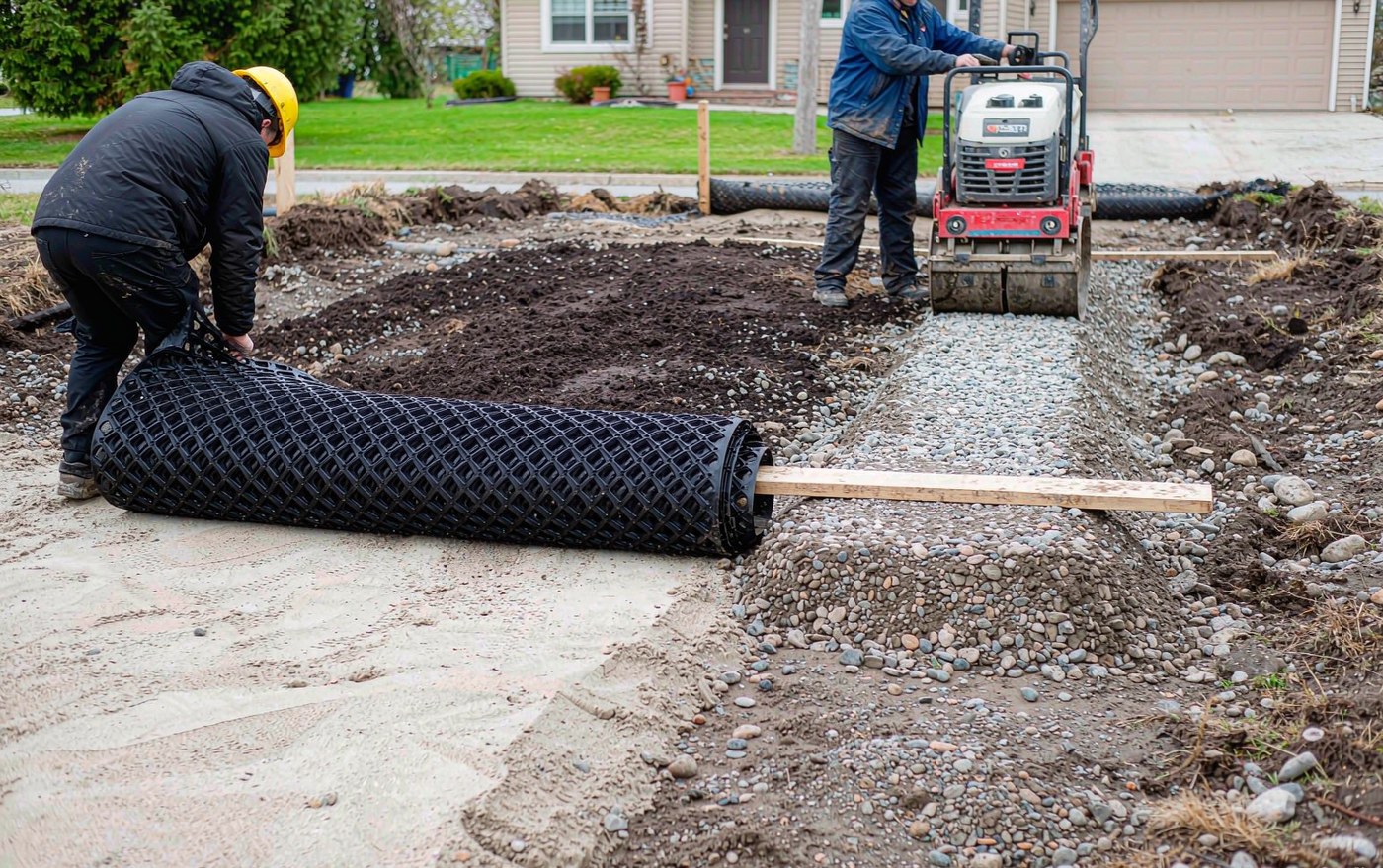
A geogrid driveway specification is normally written by the contractor or the groundworks engineer, not by the homeowner — and that difference changes the whole design basis. A residential approach is "lay some grid, spread some stone, hope for the best." A commercial or municipal driveway design has to survive delivery trucks, refuse vehicles, fire tenders and repeated seasonal cycles, and it has to be defensible when the surface ruts two winters after handover.
This guide is written for the people who specify and build those driveways: groundworks contractors, civil consultants, estate and facilities managers, and distributors quoting into those projects. It covers where a geogrid for driveway construction earns its cost, how to size it against real vehicle loading rather than guesswork, and how to build the section so the reinforcement is still doing its job in year ten.
Why a Driveway Is Harder on the Subgrade Than a Road
A public road spreads its load over a properly compacted, well-drained, deeply built formation. A driveway rarely gets that luxury. Four things make it the harder problem:
- The section is thin. There is no room for a conventional 400–600 mm pavement build-up. You are typically working with 200–350 mm of total construction, sometimes less.
- The loading is concentrated and brutally repetitive. A bin lorry or a concrete truck puts far more than a family car on a single axle, and it does it in the same wheelpath every collection day. Repetition in a fixed track is what initiates rutting.
- Drainage is often an afterthought. Driveways fall toward the house, toward the garage, or not at all. Water sits in the formation and destroys whatever bearing capacity the subgrade had.
- The subgrade is whatever was there. Clay, silt, made ground, an old soakaway, a filled trench from a utility diversion. There is rarely a geotechnical report for a driveway — and that is exactly why the design has to be robust to uncertainty rather than finely tuned.
That combination — thin section, heavy repetitive loading, poor drainage, unknown subgrade — is the classic case where reinforcement outperforms simply adding more stone.
What Geogrid Actually Does in a Driveway Section
There are three distinct mechanisms, and a well-specified driveway uses at least the first two:
Interlock and lateral confinement. Crushed angular stone wedges into the geogrid apertures. When a wheel load pushes the stone down and outward, the tensioned ribs restrain it. The confined layer behaves as a stiffer, stronger composite, so the same wheel load spreads over a wider area and reaches the subgrade at lower stress. The practical effect is that the aggregate layer can be thinner, or the same thickness can carry more traffic before rutting.
Separation at the interface. Where the subgrade is soft or wet, aggregate punches into it and subgrade fines pump upward into the stone. Both processes destroy the section from the bottom. A geotextile separator — or a geogrid/geotextile composite — keeps the two materials apart so the stone keeps its grading and the subgrade keeps its strength. This is the mechanism that most often decides whether a driveway survives its third winter.
Tensioned membrane. Only relevant on genuinely soft ground (subgrade CBR below about 2%), where the geogrid can span local ruts and carry part of the load in tension.
For a driveway, order of importance is usually separation first, confinement second, membrane rarely. A common and correct specification is a nonwoven geotextile separator below a biaxial geogrid in the base course — two layers, two jobs, and the pairing costs far less than the extra stone it replaces.
Wheel load versus stone depth is the calculation at the heart of every driveway specification. If you want the numeric side — how much aggregate thickness a given subgrade CBR and traffic loading actually requires — that is worked through in geogrid for gravel: how much aggregate thickness can you save.
Classifying the Driveway Before You Specify
Do not specify a driveway by its appearance. Specify it by the vehicles that will use it. This table is a working starting point; adjust with local practice and any available ground information.
Driveway Classes and Typical Reinforcement
| Class | Typical users | Design vehicle (approx.) | Subgrade assumption | Base course | Reinforcement |
|---|---|---|---|---|---|
| A — Residential light | Cars, vans, occasional delivery | 3.5 t GVW, single rear axle | Firm, CBR 4–8% | 150–250 mm crushed stone | Geotextile separator; geogrid optional |
| B — Residential heavy / shared | Cars plus regular van and box-truck traffic, bin lorry | 7.5–12 t GVW | Medium, CBR 3–5% | 200–250 mm crushed stone | Biaxial geogrid 20–30 kN/m + separator |
| C — Commercial / estate access | Delivery trucks, refuse vehicles, coaches | 16–26 t GVW | Medium to weak, CBR 2–4% | 250–350 mm, often two lifts | Biaxial geogrid 30–40 kN/m + separator |
| D — Heavy / fire access route | Fire tenders, articulated delivery, plant | 26 t+ GVW, high axle loads | Weak, CBR 1–3% | 350 mm+ in defined lifts | Biaxial geogrid 40–50 kN/m + separator, drainage layer |
Two cautionary notes on reading this table. First, fire access routes are legally load-rated in many jurisdictions, and the driveway must be designed to the required appliance loading regardless of how little traffic it sees day to day. Second, the subgrade assumption is the weakest link. If you do not know the CBR, either test it or assume the weaker band — the cost of one grade of geogrid is trivial next to rebuilding the section after failure.
Specifying a Geogrid for Driveway Reinforcement
Once you know the class, the specification narrows to a handful of decisions.
Strength and direction. Residential and light commercial driveways are biaxial problems: loads arrive from every direction and the section needs stiffness in both axes. Specify biaxial geogrid at 20–40 kN/m for classes A–C. Uniaxial geogrid belongs in retaining walls and steepened slopes, not in a flat driveway sub-base — the strength is concentrated in one axis and the ribs are oriented for an entirely different failure mode. If your driveway includes a retained edge or a slope, that element is designed separately; see geogrid for retaining wall design.
Aperture against stone gradation. Interlock only works if the stone fits the grid. The general rule is that the aperture should be matched to the main body of the grading:
- 20–40 mm crushed stone → 25–40 mm aperture biaxial geogrid
- 10–20 mm stone → 15–25 mm aperture
- 0–32 mm crusher-run with high fines → larger apertures tend to blind; consider a stiffer geogrid or reduce fines content
Rounded river gravel is a poor partner for any geogrid. Interlock relies on angular particles wedging against the ribs; smooth rounded stone slides instead of locking. If rounded gravel is the only local material, put the budget into a geotextile separator and accept a thicker layer.
Polymer and durability. For an unbound base course, polypropylene (PP) biaxial geogrids are the normal choice — good chemical resistance in normal soils and economical per square meter. Steel-plastic (welded steel wire with HDPE coating) grids offer higher stiffness and are the standard where strength requirements climb or where the section will be subject to heavy, slow-moving plant. The choice should follow the class table, not the marketing sheet. For an overview of how the two polymers behave long-term, see PET vs PP geotextile.
Roll dimensions and jointing. Driveways are wide, short, and awkward — the wrong roll width means cutting, waste and more overlaps than the design assumed. Check the delivered roll width against the actual placement width before ordering, and confirm that the specified overlaps (typically 300–600 mm depending on subgrade strength) can be achieved within the section. Roll width and length are covered in the geogrid product range, and the per-square-meter cost of the different grades is set out in geogrid price per square meter.
Geotextile separator grading. If the subgrade is soft, wet or fine-grained, the separator matters as much as the grid. For a driveway, a needle-punched nonwoven geotextile, typically in the 200–400 g/m² range, is the practical choice; it filters, separates and does not clog as readily as a thin woven in variable ground. The selection logic is covered in nonwoven vs woven geotextile and the filtration design in geotextile filter fabric.
Building the Section So the Reinforcement Survives
Specification is half the job. Most driveway geogrid failures are construction failures, and they follow a predictable pattern:
- Prepare and proof-roll the formation. Strip topsoil and any organic material. Proof-roll and remove any soft spots, replacing them with suitable fill. A soft spot left under the grid is where the rut will start.
- Fix drainage before the grid goes down. Fall the formation, install any drainage or infiltration element, and confirm water has somewhere to go. Geogrid does not compensate for a saturated subgrade — it simply fails more slowly.
- Place the separator with proper overlaps. Roll the geotextile out, overlap joints by at least 300 mm in the direction of stone placement, and anchor it so it does not move as the first stone is pushed out.
- Place the geogrid flat, tensioned and anchored. No wrinkles. Wrinkles become slack zones and slack zones rut. Overlap adjacent panels per the specification and anchor the leading edge — for soil-filled driveway sections this is usually done by back-filling over the edge rather than driving pins.
- Place and compact the first lift carefully. Around 150–200 mm of well-graded stone above the grid is the usual minimum before compaction starts. Never let a loaded delivery truck run directly on exposed geogrid — the site's own deliveries are the classic cause of a pre-damaged grid.
- Compact in layers, to the specified density. Compaction is what develops the interlock the design assumed. A geogrid in loosely placed stone does almost nothing.
- Protect the finished formation during the build. Tracked plant turning on the geogrid, or stone tipped from height, will displace the grid. Sequence the work so the geogrid is covered as soon as it is laid.
The full site checklist, including overlap and anchoring detail, is in how to install geogrid for road reinforcement.
FAQ
Does a driveway really need a geogrid, or is a geotextile enough?
It depends on the subgrade and the traffic. On firm ground with car-only traffic, a geotextile separator alone is often sufficient and cheaper. Where the subgrade is weak, or where delivery vehicles and refuse lorries will use the driveway, the geogrid adds confinement that a separator cannot provide. On soft ground the correct answer is usually both, in the sequence described above.
What strength geogrid for a residential driveway?
For a car and van driveway on reasonable ground, a biaxial geogrid in the 20–30 kN/m range is normally appropriate, paired with a nonwoven separator if the subgrade is fine-grained or wet. Step up to 30–40 kN/m where regular box-truck or refuse-vehicle loading is expected.
Can geogrid be used under block paving, tarmac or resin-bound surfaces?
Yes, but its position changes. The geogrid belongs in the unbound sub-base, below the paving construction — not directly under the wearing course. For flexible asphalt surfacings, reflective cracking is a separate problem addressed by a bitumen-coated fiberglass geogrid within the bound layers; that is a different product and a different design, covered in fiberglass geogrid for reflective cracking.
How much stone can a geogrid save on a driveway?
On weak subgrade, reinforced driveway sections commonly achieve 25–40% reduction in aggregate thickness compared with an unreinforced design at the same performance criterion. On firm ground the saving is smaller and may not justify the reinforcement on cost alone — in that case specify the geotextile for separation and accept the unreinforced thickness. The percentage figures by subgrade strength are tabulated in the aggregate thickness guide.
Should I use geogrid for a gravel driveway that already exists and keeps rutting?
Reconstruction is usually the honest answer. Geogrid placed on top of an already-contaminated, already-rutted section will not fix the cause. The reliable approach is to dig out the failed material, correct the drainage and formation, and rebuild with a separator and geogrid in the base. If the existing stone is clean and the failure is confined to one or two wheelpaths, a localised rebuild may be enough.
What is the difference between geogrid and "gravel fabric"?
"Gravel fabric" almost always refers to a geotextile separator — it separates and filters, but it has no ribs to interlock with the stone. A geogrid is a reinforcement. They are different materials with different jobs, and they are frequently specified together for driveways. The distinction is set out in geogrid vs geotextile.
Does geogrid work with recycled concrete aggregate in a driveway?
Yes, if the material is angular and reasonably well graded. Crushed recycled concrete interlocks well and is a sound driveway base material. Material with a high fines content is a poorer partner, because the fines can blind the apertures and reduce the confinement that the design relies on.
Specifying a Driveway for a Client?
- Match the product to the class. Review the biaxial geogrid grades from 20–150 kN/m, together with the aperture options, so the grid matches your stone and your design vehicle.
- Pair it with a separator where the ground is soft. The nonwoven geotextile range covers the 200–400 g/m² grades normally used under driveways.
- Ask for a design check. Send your driveway cross-section, subgrade description or CBR, and the heaviest design vehicle — message us on WhatsApp or email cn8978688@gmail.com. We will return a reinforced-versus-unreinforced comparison together with pricing, usually within one working day.
- Working to a tender programme? Geogrid price per square meter gives the 2026 budgeting ranges by strength grade, and how to install geogrid for road reinforcement covers the site practice that protects the design.
GeoTexGrid manufactures biaxial and uniaxial geogrid, nonwoven and woven geotextile for driveway, access road and ground stabilisation projects, tested to ASTM standards on every production batch and supplied factory-direct with documentation suitable for submittal. Distributor and contractor pricing is available for repeat programme work — tell us your annual volume and typical driveway class and we will quote accordingly.
مقالات ذات صلة
Fiberglass Geogrid China Supplier: Mesh and Coat
How to vet a fiberglass geogrid China supplier: mesh size, bitumen vs polymer coating, and the rib-count arithmetic that proves a 30-100 kN/m datasheet.
Woven Geotextile China Manufacturer: Slit Film
A woven geotextile China manufacturer explains slit film tapes, the grab-versus-wide-width trap, and how roll width changes the area you pay for.
Geocell China Manufacturer: Perforation Surface
Perforated or textured walls decide how a geocell drains and grips. A geocell China manufacturer explains wall options, weld QC and checks before order.