
Fiberglass Geogrid: How to Stop Reflective Cracking
By GeoTexGrid Engineering Team
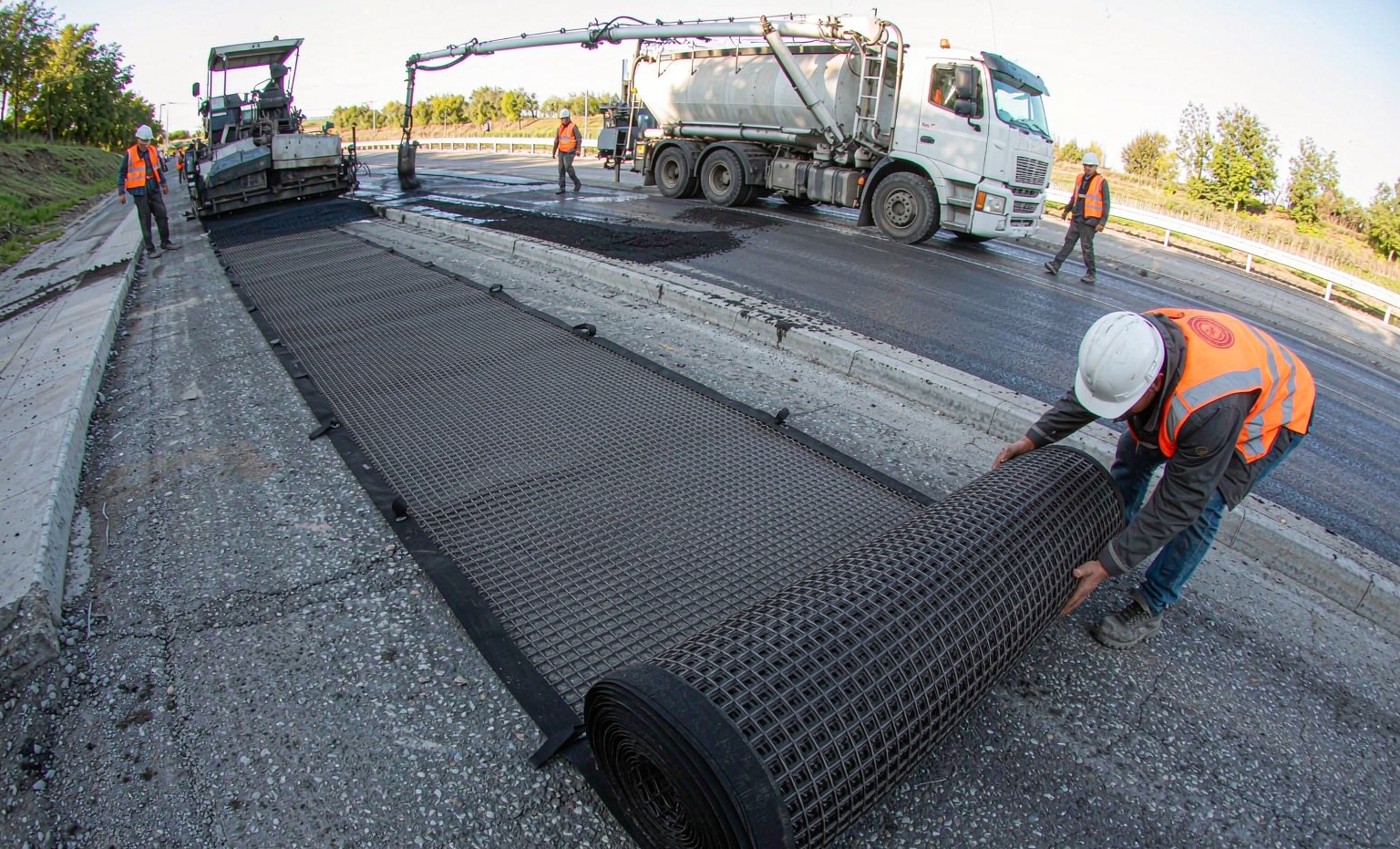
An asphalt overlay placed over a cracked pavement inherits every defect beneath it. Within one or two winters, the old joints and cracks "reflect" up through the new surface, and the overlay that was sold as a ten-year fix starts cracking in eighteen months. A fiberglass geogrid interlayer placed at the interface between the old pavement and the new overlay is the most direct structural answer to this failure mode — it arrests the upward propagation of cracks instead of letting the new asphalt fight the old one alone.
Why Reflective Cracking Happens in Asphalt Overlays
Reflective cracking is a strain-concentration problem, not a strength problem. The existing cracks and joints in the old pavement move horizontally — driven by daily and seasonal thermal cycling and by traffic-induced bending — while the overlay above tries to stay continuous. Right above each crack, that horizontal movement concentrates tensile strain in a very small zone of the new asphalt. The overlay cannot stretch that far, so it cracks vertically, directly above the old joint.
Three factors make it worse:
- Thin overlays. A 40–50 mm mill-and-fill course has little mass to dissipate strain energy.
- Wide temperature swings. The more the old slabs expand and contract, the more movement each joint sees every day.
- Deteriorated joints. Where load transfer across a joint is lost, differential vertical movement adds a second cracking mechanism on top of thermal pull.
Conventional answers — thicker overlays, stress-absorbing membrane interlayers, polymer-modified binders — each add cost or new risks. A grid interlayer attacks the mechanism itself.
How Fiberglass Geogrid Interrupts Crack Propagation
A crack growing from an old joint upward must break through every layer in its path. When a fiberglass geogrid is laminated into the interface — bonded with a tack coat and sandwiched between old surface and new asphalt — the crack tip meets a stiff, high-modulus mesh that behaves completely differently from the asphalt around it.
Three things happen at the grid level:
- Strain energy is dissipated. The vertical crack tip is forced to deflect and branch horizontally along the grid-asphalt interface instead of continuing straight up. This is the same crack-arrest principle used in reinforced concrete slabs.
- Horizontal movement is distributed. The grid — with tensile strength of 30–100 kN/m and elongation at break ≤ 4% — locks the two sides of the joint together, reducing the differential movement that feeds the crack.
- The mesh survives placement. Glass fibre does not soften at asphalt laying temperature (typically 150–165 °C) and does not absorb water, so the grid keeps its modulus for the life of the pavement rather than creeping like some polymer alternatives.
Because the grid's apertures — 12.7mm / 25.4mm on our standard grades — are filled with interlocking asphalt-aggregate mosaic, the grid and overlay act as one composite layer rather than a bond-breaking slip plane. That composite action is what separates a reinforcing grid from a simple paving fabric.
Our Fiberglass Geogrid Grades: What the Data Sheet Says
Two products cover almost every asphalt interlayer specification we supply. Both are tested to ASTM D6637, JTG E50, and both carry elongation at break of ≤ 4% — the property that decides whether the grid mobilises before the asphalt cracks.
| Parameter | Fiberglass Geogrid | Self-Adhesive Fiberglass Geogrid |
|---|---|---|
| Tensile Strength | 30–100 kN/m | 30–80 kN/m |
| Elongation | ≤ 4% | ≤ 4% |
| Mesh Size | 12.7mm / 25.4mm | 12.7mm / 25.4mm |
| Roll Width | 1.0 – 2.0 m | 1.0 – 2.0 m |
| Coating / Adhesive | Bitumen / Polymer | Pressure-sensitive |
| Standard | ASTM D6637, JTG E50 | ASTM D6637, JTG E50 |
| Best for | Full-width mill-and-fill, jointed concrete | Localised patches, bridge decks, hand-worked areas |
See the full data sheets for fiberglass geogrid and self-adhesive fiberglass geogrid. Where the same project also needs subgrade-level reinforcement, the steel-plastic biaxial geogrid covers 30–150 kN/m — but it belongs in the base course, not in the overlay interface.
Choosing Between Standard and Self-Adhesive
The decision is practical rather than structural:
- Standard bitumen-polymer coated grid is the default for full-lane overlays. It is laid onto a sprayed tack coat and held by the paver passing over it.
- Self-adhesive grid carries a pressure-sensitive backing that sticks to the prepared surface without a separate tack application. It is the right choice for patch repairs, narrow widenings, bridge decks and anywhere spraying tack coat is impractical — and it stays put under foot traffic before the paver arrives.
Installing Fiberglass Geogrid: Step-by-Step
Performance depends far more on installation discipline than on any data-sheet number. The sequence that works:
- Prepare the surface. Mill or sweep the old pavement, and crack-seal or patch the worst areas first. The grid bridges movement — it does not repair a pavement that has already failed structurally.
- Apply the tack coat. Spray a uniform bond coat at roughly 0.6–1.0 L/m² of residual bitumen (adjust to surface texture). The tack coat is structural: it is what lets strain transfer into the grid. Self-adhesive grades skip this step.
- Lay the grid. Unroll the fiberglass geogrid keeping it flat and wrinkle-free. Overlaps are typically 100–200 mm in the longitudinal direction and 75–150 mm transverse; traffic should not drive directly on exposed grid.
- Pave in one pass. Place the overlay on the same day. Paver tyres and the mat itself press the grid into the binder; avoid sharp turns and sudden braking on the uncovered grid.
- Compact normally. Standard rolling gives the best embedment. No special compaction equipment is required.
If wrinkles or folds appear, lift and re-lay that section — a folded grid creates a stress concentration that becomes a crack initiator itself.
Fiberglass Geogrid Overlay Specification Checklist
When you request quotations, these lines make offers comparable:
| Parameter | Required range | Why It Matters |
|---|---|---|
| Tensile strength (MD/CMD) | 30–100 kN/m | Governs how much joint movement the grid can restrain |
| Elongation at break | ≤ 4% | Low elongation = the grid works before the asphalt strains |
| Mesh (aperture) size | 12.7mm / 25.4mm | Allows aggregate interlock without punching |
| Coating | Bitumen / Polymer | Bonds grid to tack coat; protects the glass strands |
| Roll width | 1.0 – 2.0 m | Fewer joints = fewer potential reflection paths |
Two specification traps worth naming:
- Do not accept a "geogrid" with elongation above 5% for crack control — by the time it stretches enough to develop force, the overlay has already cracked.
- Do not substitute a nonwoven paving fabric for a grid in reflective-cracking applications. Fabrics are waterproofing membranes; only a stiff grid restrains horizontal movement.
Where to Go Next
- Product range and data sheets — compare fiberglass geogrid and self-adhesive fiberglass geogrid, or browse the full geogrid product range.
- Talk to an engineer — message us on WhatsApp for a same-day interlayer recommendation for your overlay project, or email cn8978688@gmail.com.
- Related reading — steel-plastic vs fiberglass geogrid covers which grid family belongs in which layer, and biaxial vs uniaxial geogrid explains the subgrade and base applications.
GeoTexGrid manufactures fiberglass geogrids from 30 to 100 kN/m with bitumen-polymer coating, tested to ASTM D6637 on every production batch. Send your pavement structure and crack survey — you will get a confirmed interlayer specification and quotation, usually within one working day.
Related Articles
Fiberglass Geogrid China Supplier: Mesh and Coat
How to vet a fiberglass geogrid China supplier: mesh size, bitumen vs polymer coating, and the rib-count arithmetic that proves a 30-100 kN/m datasheet.
Woven Geotextile China Manufacturer: Slit Film
A woven geotextile China manufacturer explains slit film tapes, the grab-versus-wide-width trap, and how roll width changes the area you pay for.
Geocell China Manufacturer: Perforation Surface
Perforated or textured walls decide how a geocell drains and grips. A geocell China manufacturer explains wall options, weld QC and checks before order.