
Geotextil para protección de geomembrana en rellenos: guía
Por GeoTexGrid Engineering Team
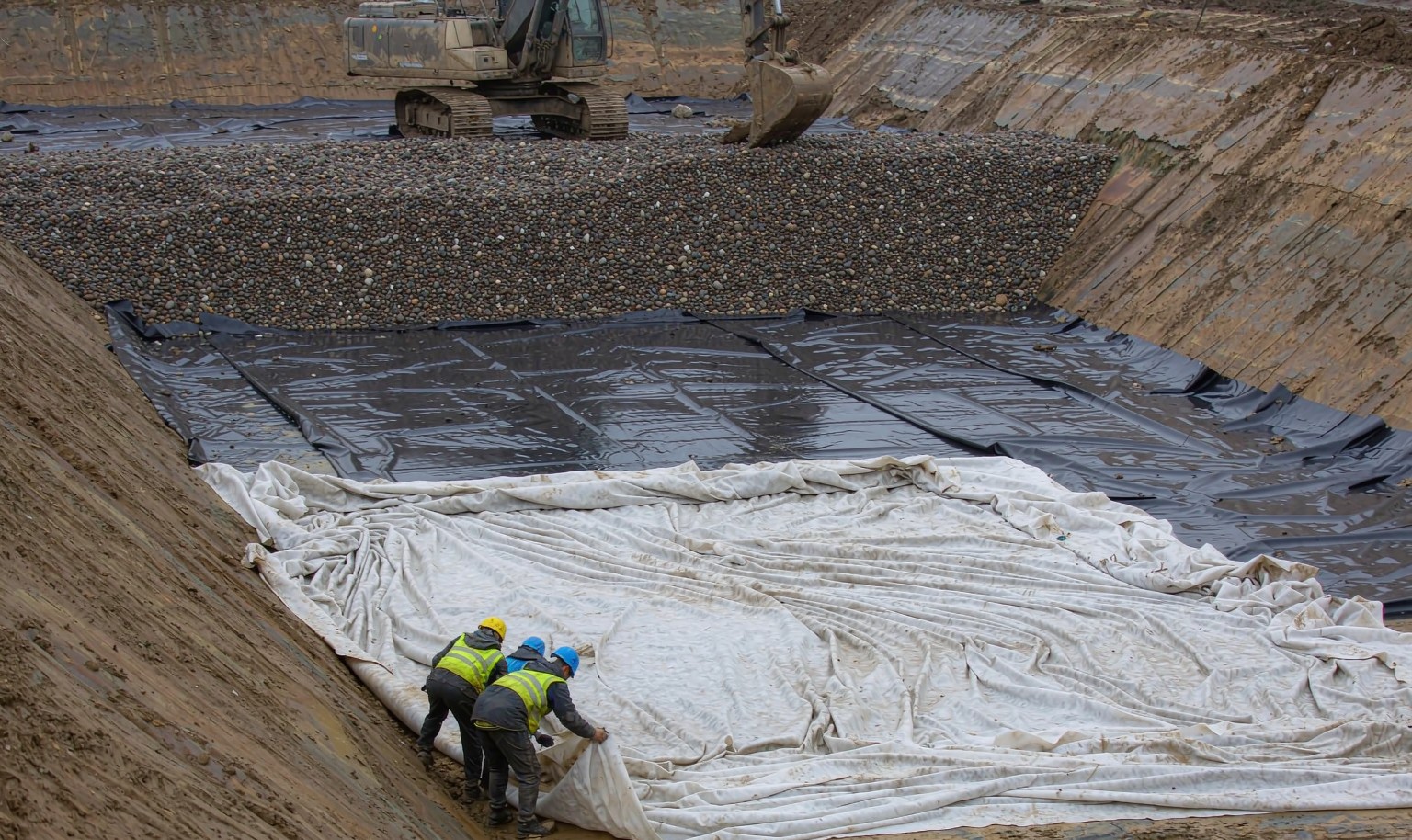
A landfill liner is only as good as its weakest layer, and the layer most often abused in practice is the geomembrane itself. That is why geotextile for landfill liner protection — a heavy needle-punched nonwoven cushion placed directly against the HDPE geomembrane — has become standard practice in modern waste containment. Instead of letting angular drainage gravel, construction traffic and thermal stress work directly on the barrier, the cushion spreads every point load over a far larger area. This guide covers what the protection layer actually does, which properties matter when you specify it, and the installation rules that keep the barrier intact for the design life of the cell.
Why Nonwoven Geotextile Matters Under a Landfill Liner
A typical composite base liner stacks up like this: compacted clay or GCL, then a 1.5–2.0 mm HDPE geomembrane, then a drainage gravel layer, then waste. The geomembrane is the only truly impermeable element, yet it is thinner than a coin and sits directly against stone.
HDPE has excellent chemical resistance and high tensile strength, but almost no cushioning. A single sharp piece of gravel pushed by a dozer track can strain it beyond its yield point, and a puncture does not announce itself — it becomes a leak that shows up years later in groundwater monitoring.
A heavy nonwoven geotextile between the gravel and the geomembrane changes the load path. The fibrous structure compresses locally and distributes a concentrated point force over a much larger contact area, keeping the strain in the geomembrane below its design limits. The principle is validated by index tests such as EN ISO 10722 (mechanical damage under repeated loading) and by long-term protection efficiency testing under EN 13719.
Assembling the Liner System: Which Layer Is Which
The protection geotextile is one component of a stack, and each element has a different job. This is the product set we supply for a composite base liner:
| Layer (top → bottom) | Product | Material / structure | Role in the system |
|---|---|---|---|
| Cushion over geomembrane | Nonwoven geotextile | Needle-punched nonwoven (PET / PP) | Puncture protection, filtration |
| Primary barrier | HDPE geomembrane | High-density polyethylene (HDPE) | Impermeable barrier |
| Barrier on high-friction slopes | Textured geomembrane | HDPE, textured surface | Barrier + interface friction |
| Barrier where flexibility matters | LLDPE geomembrane | Linear low-density polyethylene (LLDPE) | Barrier, higher elongation |
| Barrier with bonded cushion | Composite geomembrane | Membrane + nonwoven geotextile (1-side / 2-side) | Barrier + protection in one sheet |
| Secondary barrier / underliner | GCL bentonite liner | Sodium bentonite between woven and nonwoven geotextile | Low-permeability mineral layer |
Mass per unit area, roll width and roll length are Customizable on every one of these, which is what allows a cell to be detailed with factory widths matching the panel layout instead of stitching offcuts across the base.
Specifying Geotextile for Landfill Liner Protection
Mass per unit area is the most quoted number because cushion performance scales roughly with it, but mass alone is not a specification. A defensible spec sets ranges for:
Mass per unit area. Protection geotextiles for landfill service run from 400 to 1,200 g/m². Below about 400 g/m² the fabric is a separation layer, not a cushion. As a working rule, 600 g/m² is the common minimum beneath 20–40 mm drainage gravel, while angular crushed stone, heavy cover operations or steep slope service push the requirement to 1,000 g/m² and above.
Puncture resistance. CBR plunger puncture (EN ISO 12236) for protection grades typically falls between 2 and 8 kN, rising with mass. Pyramid puncture (EN 14574) is the better indicator for supported service against a geomembrane, and many liner specs now require it explicitly.
Tensile strength and elongation. Wide-width tensile strength (EN ISO 10319) of a 600 g/m² needle-punched nonwoven is typically 14–20 kN/m, with elongation at break of 50–80%. High elongation is a feature here, not a defect — the fabric is meant to deform and spread load, not to carry tension like a woven reinforcement.
Interface friction. This is the number most often forgotten. A smooth HDPE geomembrane against a nonwoven geotextile gives a peak interface friction angle of roughly 12–18°, while textured HDPE raises it to about 20–30°. On side slopes, the protection geotextile sits directly on this interface, so slope stability must be checked with project-specific interface shear testing — not with catalogue values. Where the friction requirement drives the design, specify a textured geomembrane rather than increasing the cushion mass.
Polymer. Both PP and PET nonwovens are used. PP is the default for protection layers because it is inert in the alkaline, wet environment against the geomembrane; the trade-offs are covered in PET vs PP geotextile.
Typical Protection Geotextile Specifications
The table below shows commonly used starting points. Always verify the final grade against EN 13719 long-term protection testing with your actual stone and geomembrane combination.
| Property | Light duty (cover / low load) | Standard base liner | Heavy duty (angular stone / traffic) |
|---|---|---|---|
| Mass per unit area | 400–600 g/m² | 600–900 g/m² | 1,000–1,200 g/m² |
| CBR puncture (EN ISO 12236) | 2–3 kN | 3–5 kN | 5–8 kN |
| Wide-width tensile (EN ISO 10319) | 10–15 kN/m | 14–25 kN/m | 25–40 kN/m |
| AOS O90 (EN ISO 12956) | 0.10–0.15 mm | 0.10–0.15 mm | 0.10–0.15 mm |
| Typical pairing | Smooth HDPE, shallow cover | 1.5 mm HDPE + 300 mm gravel | 2.0 mm HDPE, 40–60 mm stone |
Two cautions. First, AASHTO M288 class tables are written for separation and drainage geotextiles — quoting an M288 class in a liner spec does not demonstrate cushion performance. Second, heavier is not automatically better: past the required protection level you add cost and handling weight, and on slopes you may add destabilizing mass.
Geotextile Cushion vs Sand Cushion vs GCL
- Sand cushion (300–500 mm). Cheap per cubic meter, but it consumes void volume and its quality is hard to verify once buried. Most new cells use geotextile instead and recover the volume.
- GCL. A GCL is a barrier — sodium bentonite between two geotextiles. It adds low permeability, not puncture protection, and needs its own protection layer above it.
- Double protection. On steep slopes or under coarse stone, two geotextile layers — or one heavy layer over a textured geomembrane — are common. The extra cost is trivial against a liner repair, which on an operating cell is nearly impossible.
Installation Rules That Prevent Liner Puncture
Most liner damage traced back to "the geotextile failed" is actually a placement failure. The rules that matter:
- Prepare the subgrade first. The geomembrane rests on the subgrade, so stones, roots and protrusions above roughly 20 mm must be removed and the surface compacted. A protection geotextile over the geomembrane cannot fix a bad foundation beneath it.
- Deploy the geotextile directly over the geomembrane. The nonwoven goes down immediately after geomembrane welding and testing, before any gravel or traffic. No machine travels on a bare geomembrane at any time.
- Overlap or sew generously. Unsewn overlaps of 300 mm are typical on the base; slopes and heavy-service areas usually get sewn or heat-bonded joints so the cushion cannot gape while gravel is pushed across it.
- Place the first gravel lift carefully. Spread a minimum first lift of about 300 mm with low-ground-pressure equipment, tracking only on previously spread material. Dumping stone directly onto the cushion from height defeats the whole design.
- Watch the clock on UV exposure. PP nonwovens tolerate outdoor storage but degrade under months of direct sunlight. Cover the geotextile with the gravel layer within the manufacturer's exposure window — days, not months.
Where to Go Next
- Product range and data sheets — see the nonwoven geotextile range for protection grades, or the HDPE geomembrane and GCL pages for the barrier layers.
- Talk to an engineer — message us on WhatsApp with your liner cross-section and gravel gradation for a same-day protection-layer recommendation, or email cn8978688@gmail.com.
- Related reading — PET vs PP Geotextile explains the polymer choice, and geotextile filter fabric AOS and permeability covers the filtration side of the drainage layer.
GeoTexGrid manufactures needle-punched nonwoven geotextiles for liner protection, filtration and separation, and reviews customer cross-sections against EN 13719 as a free engineering service. Send your liner drawing and stone gradation — you will get a confirmed specification and quotation, usually within one working day.
Artículos relacionados
Fiberglass Geogrid China Supplier: Mesh and Coat
How to vet a fiberglass geogrid China supplier: mesh size, bitumen vs polymer coating, and the rib-count arithmetic that proves a 30-100 kN/m datasheet.
Woven Geotextile China Manufacturer: Slit Film
A woven geotextile China manufacturer explains slit film tapes, the grab-versus-wide-width trap, and how roll width changes the area you pay for.
Geocell China Manufacturer: Perforation Surface
Perforated or textured walls decide how a geocell drains and grips. A geocell China manufacturer explains wall options, weld QC and checks before order.