
Geotextile for Slope Protection: Erosion Control Guide
By GeoTexGrid Engineering Team
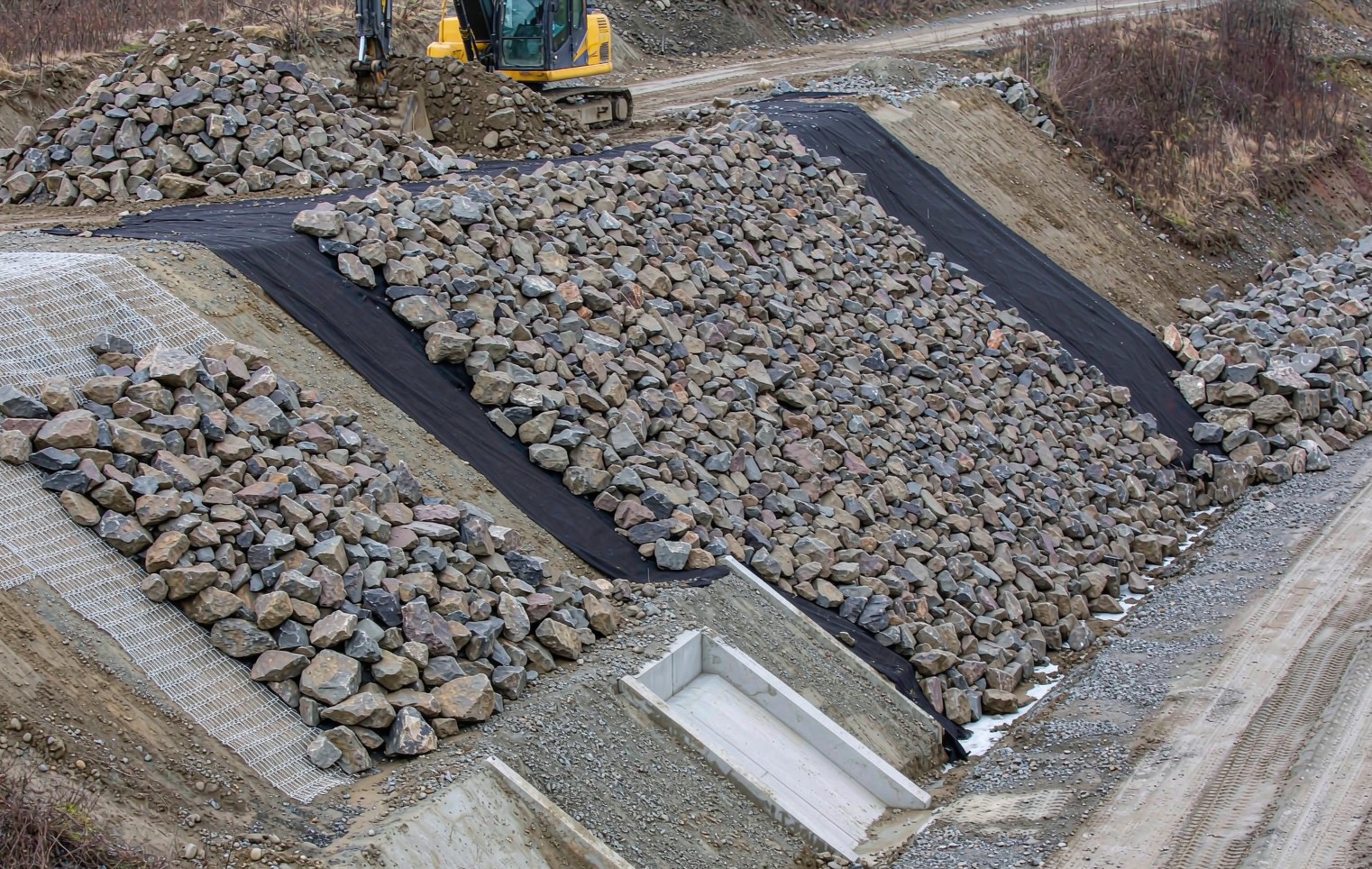
A slope fails from the surface inward. Rain detaches soil particles, water concentrates in rills, and the face ravels long before the embankment loses global stability — which is why geotextile for slope protection is specified as a filtration and separation layer, not as a cosmetic cover. Get the opening size and the puncture resistance wrong and the fabric either clogs or tears, and the erosion you were preventing simply starts underneath it.
What Geotextile for Slope Protection Does
On a slope face the geotextile usually performs three functions at once, and each one points at a different property:
- Filtration and drainage — water seeps out of the slope through the fabric while soil particles are retained behind it. This governs AOS and permittivity.
- Separation — it stops fine subgrade soil from migrating up into riprap, gabion fill or a drainage blanket, which would otherwise destroy the permeability of that layer.
- Protection and tensile support — under riprap, rock armour or a geomembrane, the fabric absorbs puncture loads and, in a reinforced design, carries part of the downslope tensile force.
Reinforcement is the one function people mix up. A nonwoven geotextile under riprap is not a structural reinforcement layer. If the slope needs tensile reinforcement across a potential slip surface, that work belongs to geogrids or high-strength woven geotextiles designed with a creep reduction factor, and the design is a stability calculation — not a filtration calculation.
Matching Products to the Slope Detail
Slope protection is a system, not a single roll. The table maps each element to the product we supply for it:
| Slope element | Product | Material / structure |
|---|---|---|
| Filter under riprap, gabions, drainage blanket | Nonwoven geotextile | Needle-punched nonwoven (PET / PP) |
| Higher-tensile separation, reinforced faces | Woven geotextile | Woven PP slit film / PET yarn |
| Exposed face, vegetation establishment | 3D erosion control mat | UV-stabilised polymer (3D structure) |
| Toe weighting, scour protection, channel edges | Geotextile bag | Woven / nonwoven geotextile |
| Confining surface layer on steep faces | Geocell | HDPE (High-Density Polyethylene) |
Mass per unit area and roll width are Customizable across the geotextile range, so a single slope can be detailed with one filter grade and one armour grade rather than forcing a compromise.
Slope Protection Geotextile Selection: AOS, Permittivity, Strength
Four numbers decide whether the fabric works on your slope. Take them from the gradation curve and the hydrology, not from a supplier's default sheet.
| Design requirement | Governing property | Typical specification | Test standard |
|---|---|---|---|
| Retain soil, pass water | AOS (O95) | 0.15–0.425 mm; target O95 ≤ D85 of the retained soil | ASTM D4751 |
| Drain seepage faster than the soil | Permittivity ψ | 0.5–1.5 s⁻¹; minimum ψ ≥ 10 × soil permeability | ASTM D4491 |
| Survive riprap placement | CBR puncture | 3.0–4.5 kN under 300–500 mm riprap | ASTM D6241 |
| Carry installation and slope loads | Wide-width tensile | 9 kN/m (270 g/m²) up to 20 kN/m (540 g/m²) | ASTM D4595 |
| Resist weathering while exposed | UV retained strength | ≥ 50–70% after 500 h | ASTM D4355 |
Read the table as a chain: a fine silty sand with a D85 of 0.12 mm needs an AOS of about 0.12–0.18 mm, which rules out most standard 0.425 mm woven fabrics and pushes you toward a needle-punched nonwoven. The same nonwoven must still be open enough to pass seepage — a permittivity of at least ten times the surrounding soil permeability is the usual working rule, and nonwovens in the 0.5–1.5 s⁻¹ range normally satisfy it comfortably.
Puncture resistance is where slope work differs from a simple separation layer. Angular riprap dropped from a bucket concentrates load on a small area, so CBR puncture resistance, not grab tensile strength, is the property that keeps the fabric intact during placement. As a practical floor, specify CBR puncture of 3.0 kN for 300 mm riprap and move toward 4.5 kN as stone size and drop height increase. Where the geotextile also protects a geomembrane, mass per unit area matters as well — 400–500 g/m² nonwoven with a CBR puncture above 3.5 kN is the common range.
Two further checks are often skipped and later regretted:
- Interface friction. The geotextile-to-soil friction angle on a slope is typically 24–30° for nonwovens on sands, and it is lower than the soil's own friction angle. On slopes steeper than about 1V:3H, run a sliding check on that interface rather than assuming the cover is stable.
- Clogging potential. Soils with a high fines content, and especially dispersive clays, can blind a fabric. Reducing the AOS within the retention band and increasing permittivity is the standard response.
Nonwoven, Woven or Erosion Control Mat?
The three families are not interchangeable on a slope:
| Product | Best use on slopes | Watch out for |
|---|---|---|
| Needle-punched nonwoven | Filter and separation under riprap, gabions, drainage blankets; geomembrane protection | Lower tensile strength; UV-sensitive if left exposed |
| Woven geotextile | Higher tensile applications, some reinforced slope faces, silt fences | AOS often too coarse for fine silty soils |
| Permanent erosion control mat | Exposed channel banks and steep faces above the water line | Not a filter layer; still needs a granular or soil cover for vegetation |
On vegetated slopes, a permanent erosion control mat gives immediate protection against raindrop impact and concentrated flow, and its three-dimensional structure keeps seed and root zone in place. It does not replace a filter geotextile where seepage must pass through a fine-grained slope; the two are commonly used together, mat above, geotextile below.
Design Checks Beyond the Fabric
- Seepage path. Where does water leave the slope? If seepage exits through the face, the fabric is a filter and its permittivity governs. If it exits at the toe, you need a drainage blanket or geocomposite drain designed for the flow, not a thicker fabric.
- Surface water control. Crest interception drains, downslope chutes and a toe drainage channel usually do more to stop erosion than any fabric product. Erosion starts where water concentrates.
- Anchorage. A face covering has to be held. Crest anchor trenches of roughly 300 × 300 mm, keyed toes, or a toe beam are standard, and the anchor must be below the depth of any expected scour.
- Cover gradation. Riprap with a D50 of 300–500 mm interlocks; single-size stone does not. A bedding layer between fabric and armour protects the fabric without sealing it.
- Global stability. Face protection does not fix a slope that is failing as a mass. Check the slip circle with pore pressures and the interface friction of every layer.
Installation: What Fails in the Field
Most slope geotextile failures are installation failures:
- Prepare the surface first. Roots, rock points and ruts puncture the fabric during placement. Trim and proof-roll the slope before unrolling anything.
- Shingle the laps downslope. Lap the upper panel over the lower one, 300–450 mm on slopes, so water runs off the seam instead of lifting it. Sewn seams are used where the fabric carries load; two rows of stitching with seam strength at least 90% of the fabric strength is a normal requirement.
- Do not drag the roll. Carry it into position and unroll downslope.
- Keep wrinkles out. Wrinkles become collection points for fines and localised tensile stress.
- Cover within the UV window. Cover or vegetate within about 30 days, or specify a UV-stabilised fabric for longer exposure.
- Inspect before covering. Overlaps, anchors, damaged panels and trapped debris are cheaper to fix before the riprap lands than after.
Where to Go Next
- Product range and data sheets — see the nonwoven geotextile, woven geotextile and 3D erosion control mat ranges for mass per unit area, AOS, permittivity and CBR puncture grades.
- Talk to an engineer — message us on WhatsApp for a same-day technical answer, or email cn8978688@gmail.com.
- Related reading — geotextile filter fabric AOS and permeability works through the retention and permeability criteria with numbers, and geogrid for retaining walls and steep slopes covers the reinforcement side when face protection alone is not enough.
GeoTexGrid manufactures needle-punched nonwoven and woven geotextiles for slope protection, filtration and drainage, with CBR puncture and wide-width tensile data reported per roll. Send your slope geometry, soil gradation and seepage condition — you will get a confirmed specification and quotation, usually within one working day.
Related Articles
Fiberglass Geogrid China Supplier: Mesh and Coat
How to vet a fiberglass geogrid China supplier: mesh size, bitumen vs polymer coating, and the rib-count arithmetic that proves a 30-100 kN/m datasheet.
Woven Geotextile China Manufacturer: Slit Film
A woven geotextile China manufacturer explains slit film tapes, the grab-versus-wide-width trap, and how roll width changes the area you pay for.
Geocell China Manufacturer: Perforation Surface
Perforated or textured walls decide how a geocell drains and grips. A geocell China manufacturer explains wall options, weld QC and checks before order.