
Geotextile for Coastal Protection: Revetment Design Guide
By GeoTexGrid Engineering Team
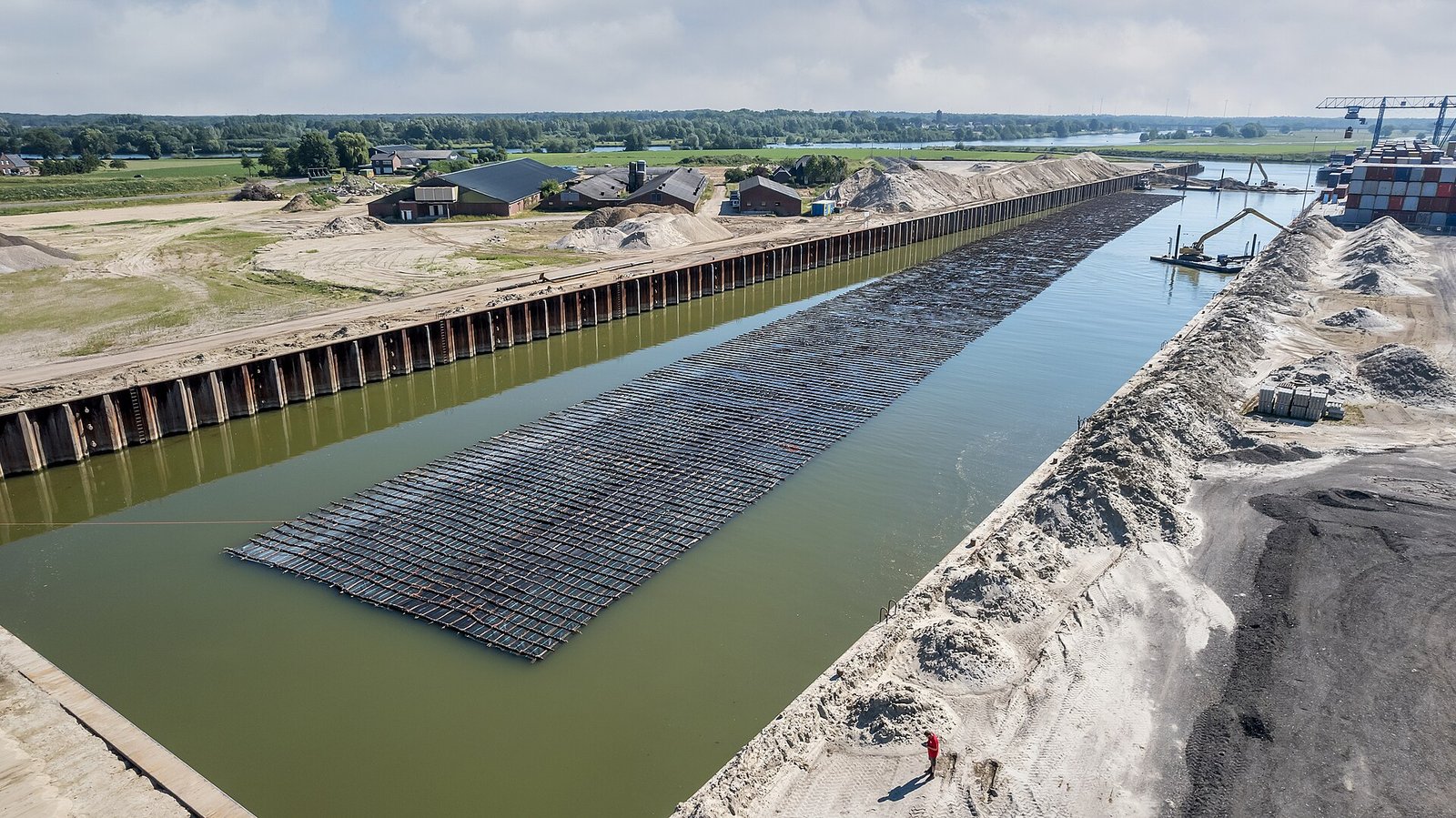
On a riverbank or a shoreline the stone gets the blame, but the geotextile underneath it does the engineering work. Waves, currents and tidal drawdown attack the soil behind the revetment face, and once fines start washing out, the armour above loses its foundation and slumps into the water. That is why geotextile for coastal protection is specified first as a filter, and only second as a separation and puncture layer. Get the retention and permeability numbers right and a riprap or gabion revetment stays serviceable for decades; get them wrong and the failure usually shows up in the first flood season, not the twentieth.
Photo: Wikimedia Commons contributor via Wikimedia Commons, CC BY-SA 4.0
What Coastal and Riverbank Works Ask of a Geotextile
A revetment is a three-part system: an armour layer — riprap, gabion mattresses or concrete blocks — that absorbs wave and current forces, a filter layer that holds the soil while letting water escape, and the subsoil itself. The geotextile is that filter layer, and it works under conditions land-side applications never see: permanently wet, saturated, with the flow direction reversing every time a wave draws down or the tide falls.
Three jobs, three different properties:
- Retention — the openings must hold back the coarser fraction of the bank soil while letting fines pass, so the filter does not clog or the bank pipe. Openings are measured as apparent opening size (AOS) under ASTM D4751.
- Permeability — water must leave the soil faster than waves and tides push it back in. Measured as permittivity under ASTM D4491.
- Durability — the fabric must survive armour placement and in-service puncture loads, verified with the CBR plunger test, ASTM D6241.
If the problem is rainfall-driven surface erosion on an exposed slope face above the waterline, the selection logic is different — that case is covered in our geotextile slope protection guide.
Filter Design: Matching AOS and Permeability to the Soil
Take a typical riverbank revetment on silty sand: D85 = 0.25 mm, saturated permeability k = 1×10⁻⁵ m/s.
Retention check. Standard filter practice (FHWA / Christopher–Holtz) keeps the fabric's O95 within roughly one to two times the soil's D85 for non-cohesive soils. With D85 = 0.25 mm, the limit is O95 ≤ 0.50 mm. A needle-punched nonwoven with AOS 0.12–0.18 mm passes with a wide margin; a woven monofilament at AOS 0.21–0.43 mm also passes. Now change one variable: if the fill is a uniform fine sand with D85 = 0.15 mm, the limit drops to 0.30 mm — and the coarsest woven monofilaments (AOS ≈ 0.43 mm) would let the bank pipe from the inside. Same revetment, different fabric. The soil gradation, not the armour size, drives the filter choice.
Permeability check. A conservative rule is that the fabric should be at least ten times more permeable than the soil it protects:
k_geotextile ≥ 10 × k_soil = 10 × 1×10⁻⁵ m/s = 1×10⁻⁴ m/s
Needle-punched nonwovens normally sit around 1×10⁻³–1×10⁻² m/s — a margin of 100 to 1000 times. Converted to permittivity (ASTM D4491), a typical 3 mm needle-punched fabric gives roughly 0.3–3 s⁻¹, comfortably above the 0.5 s⁻¹ minimum many highway specifications set for subsurface drainage filters. And because the hydraulic gradient reverses with every wave in a tidal zone, coastal designs keep this margin generous rather than exact — the cost of one extra grade of permeability is trivial next to rebuilding a collapsed revetment.
Surviving Rock Placement: Puncture and Tensile Strength
Armour stone is placed by excavator, often from a metre or more above the fabric, and a 100–300 kg block landing on an edge concentrates enormous force on a few square centimetres of cloth. Static puncture resistance is indexed with the CBR plunger test (ASTM D6241), and AASHTO M288 ties the minimum values to fabric class and elongation:
| AASHTO M288 class | CBR puncture, elongation < 50% (woven) | CBR puncture, elongation ≥ 50% (nonwoven) |
|---|---|---|
| Class 1 — severe subgrade, heavy armour | 2750 N | 1925 N |
| Class 2 — typical riprap on a firm bed | 2200 N | 1375 N |
Wide-width tensile strength and elongation at break are verified to ASTM D4595 or ISO 10319; European coastal projects normally specify the same properties through EN 13253, the harmonised standard for geotextiles in erosion control works — coastal protection and bank revetments are exactly its scope. Two placement rules beat any index number in the data sheet: place the first stone layer gently or from a floating plant, and never let dump trucks run directly on the exposed fabric.
Nonwoven vs Woven Geotextile for Waterfront Works
The filter role points at nonwovens; the handling and tensile role points at wovens. Most real projects use both:
| Product | Material / structure | Where it fits in coastal and riverbank works |
|---|---|---|
| Nonwoven geotextile | Needle-punched nonwoven (PET / PP) | Primary filter under riprap and gabion mattresses on fine-grained banks; highest permittivity margin |
| Woven geotextile | Woven PP slit film / PET yarn | Higher-tensile separation over soft mud, and the base fabric for bags and tubes |
| Geotextile bag | Woven / nonwoven geotextile | Underwater toe aprons and scour pockets where rock cannot be placed accurately by machine |
| 3D erosion control mat | UV-stabilised polymer (3D structure) | Vegetated upper banks above the wave and current zone, where the armour stops |
Unit weight and roll width are customisable across the geotextile range, so one revetment cross-section can pair a lightweight filter grade on the bank with a heavier woven grade in the toe, instead of forcing a single compromise grade to do both jobs.
Installation Details That Decide the Outcome
On a waterfront site, workmanship failures outnumber material failures:
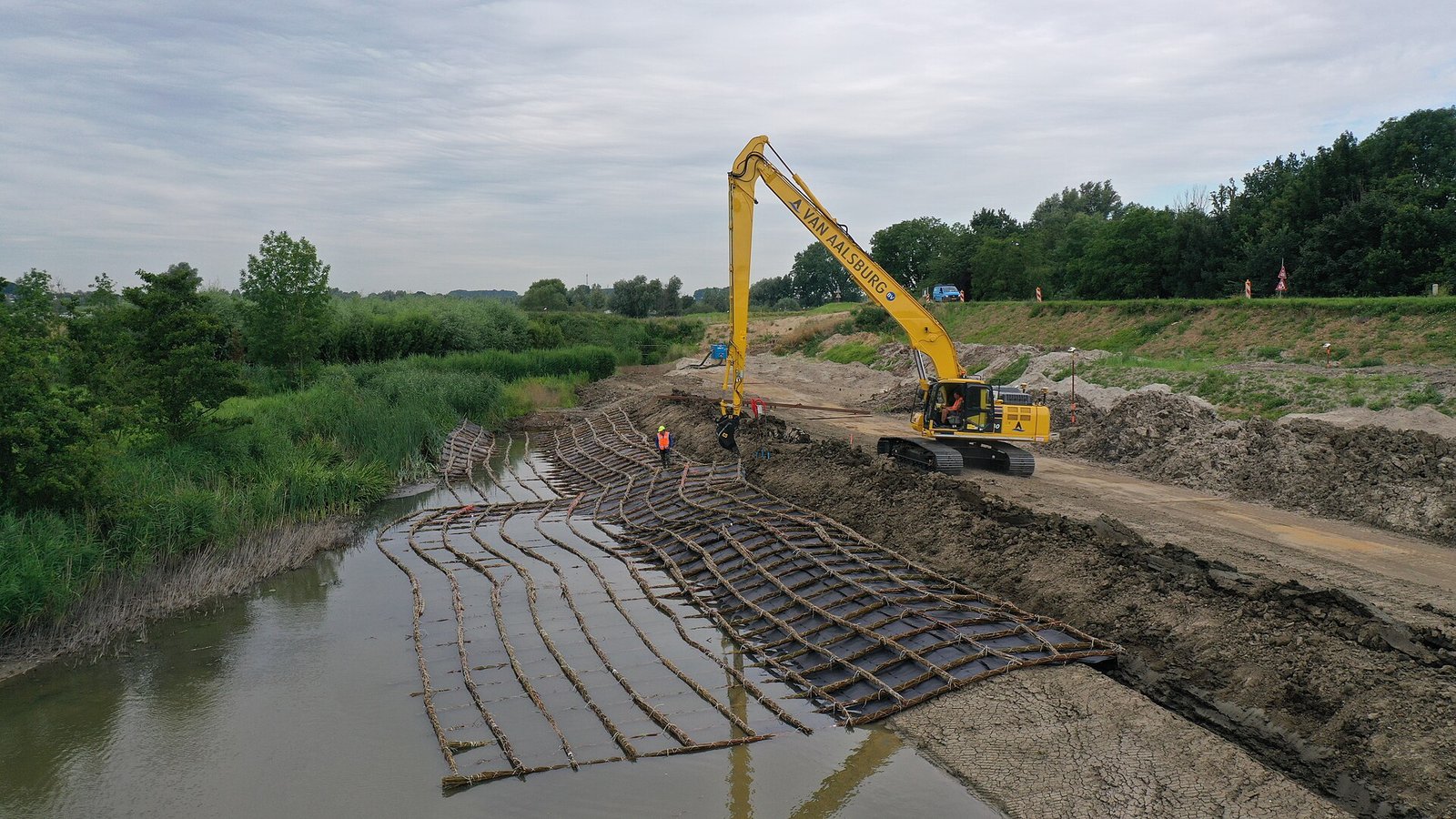
Photo: Wikimedia Commons contributor via Wikimedia Commons, CC BY-SA 4.0
- Overlaps — 300–450 mm on firm, dry ground; increase to 600–1000 mm where the bed is soft or the fabric is laid under water.
- Seams — sew the laps with compatible thread where current or wave action can fold an unseamed overlap; a folded lap under water is an uncontrolled variable.
- Toe anchorage — key the fabric into a trench below the expected scour depth, or close the toe with a geotextile-bag apron so the filter cannot unwind from the bottom.
- Cover promptly — polypropylene fabrics tolerate weeks, not months, of direct sunlight; schedule armour placement to follow each panel within days, and stock roll storage in the shade.
Waterfront Failure Modes and the Property Behind Them
Every visible revetment defect traces back to one property. Diagnose before you resupply:
| What you observe | Failure mechanism | Property to re-check |
|---|---|---|
| Armour section slumps after the first flood, fabric still intact | Fine soil piped through the filter openings | AOS vs D85 retention (ASTM D4751) |
| Fabric bulges; armour settles unevenly after wave drawdown | Pore pressure trapped under the revetment | Permittivity margin (ASTM D4491) |
| Pinholes and torn strips under individual stones | Puncture during rock placement | CBR puncture (ASTM D6241), placement method |
| Fabric brittle and faded after months uncovered | UV degradation before armouring | Cover scheduling, UV stabilisation |
| Fabric slides down the bank on soft mud | Low interface friction, no anchorage | Woven tensile (ASTM D4595), toe anchorage |
Where to Go Next
- Product data sheets — see the nonwoven geotextile, woven geotextile and geotextile bag pages for grades and roll formats, all customisable to the revetment design.
- Talk to an engineer — message us on WhatsApp with your soil gradation and armour stone size for a same-day filter recommendation, or email cn8978688@gmail.com.
- Related reading — Geotextile Filter Fabric: Matching AOS and Permeability goes deeper into filter criteria, and Geotextile for Slope Protection covers the land-side, rainfall-driven case.
GeoTexGrid manufactures nonwoven, woven and bag geotextiles for coastal and riverbank protection works and ships worldwide. Send the soil gradation, armour size and cross-section — you will get a confirmed filter specification and quotation, usually within one working day, at cn8978688@gmail.com or on WhatsApp.
Related Articles
Fiberglass Geogrid China Supplier: Mesh and Coat
How to vet a fiberglass geogrid China supplier: mesh size, bitumen vs polymer coating, and the rib-count arithmetic that proves a 30-100 kN/m datasheet.
Woven Geotextile China Manufacturer: Slit Film
A woven geotextile China manufacturer explains slit film tapes, the grab-versus-wide-width trap, and how roll width changes the area you pay for.
Geocell China Manufacturer: Perforation Surface
Perforated or textured walls decide how a geocell drains and grips. A geocell China manufacturer explains wall options, weld QC and checks before order.