
Геомембрана HDPE для рыбоводных прудов: толщина и стоимость
Автор GeoTexGrid Engineering Team
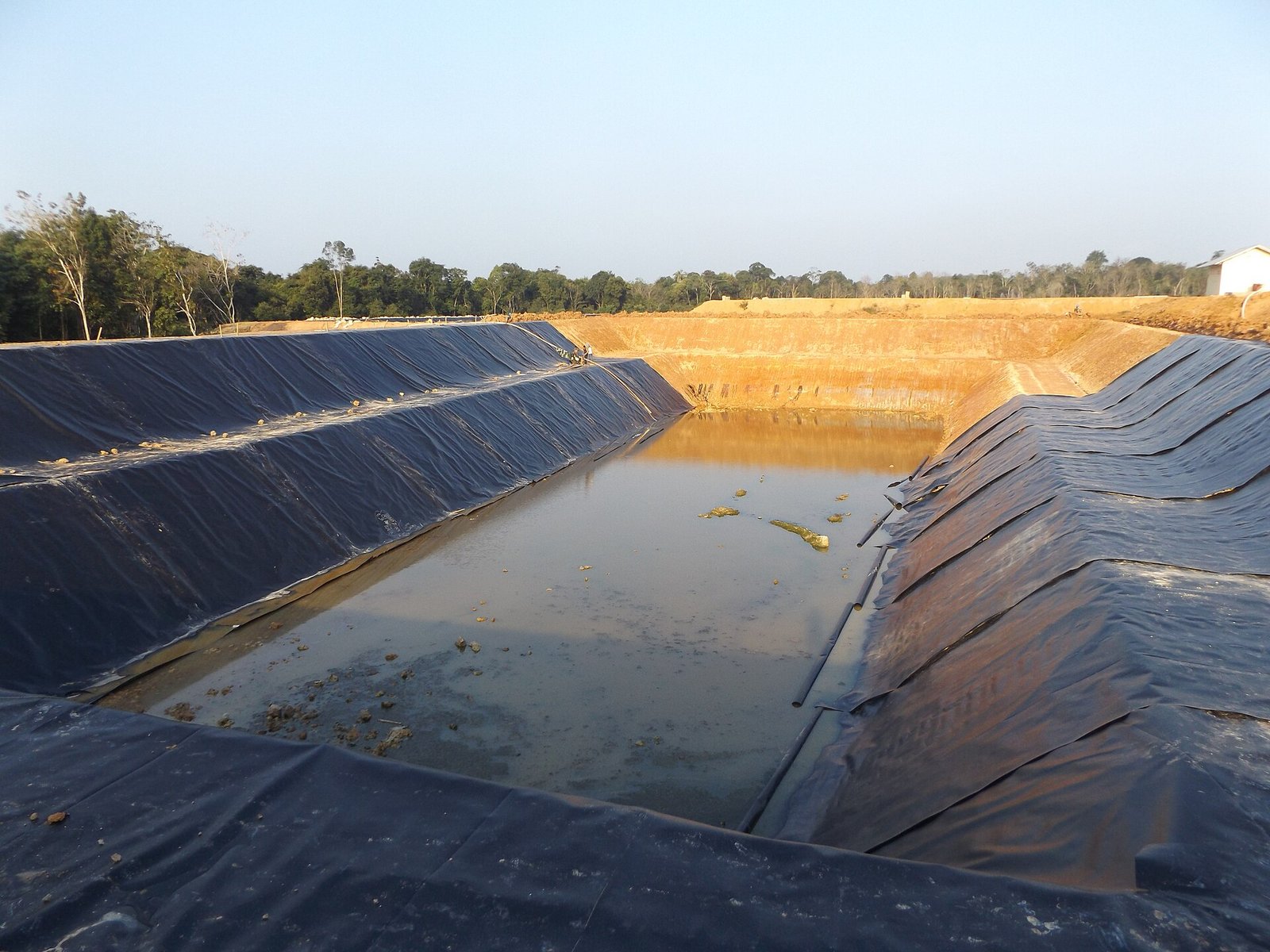
Water is the product in aquaculture, and the liner is what keeps it. An HDPE geomembrane for fish pond lining is an impermeable polyethylene sheet that turns a leaky earthen pond into a controllable production cell: seepage stops, water quality stabilises, and feed and fertiliser stay in the pond instead of feeding the groundwater. Most liner problems that appear in the second season were decided the day the thickness was chosen and the first panel was welded. This guide works through those decisions in order: thickness, sheet type, subgrade, seaming and cost.
Photo: Wikimedia Commons contributor via Wikimedia Commons, CC BY-SA 4.0
Choosing HDPE Geomembrane Thickness for a Fish Pond
A pond liner survives five loads at once: a 1.5–2.5 m water head pressing every seam, sunlight on the banks above the waterline, puncture from stones and roots in the subgrade, abrasion from nets, aerators and harvest foot traffic, and daily thermal expansion of a black sheet in the sun. Thickness is the single lever that buys margin against all five.
Pond-grade sheets come in standard nominal thicknesses — 0.75 mm (30 mil), 1.0 mm (40 mil) and 1.5 mm (60 mil) — verified to ASTM D5199. The sheet should also meet GRI-GM13, the reference specification for HDPE geomembranes, which fixes minimum density, melt flow, tensile yield, carbon black, oxidation induction time and stress-crack resistance for each class. Match the class to the site:
| Pond condition | Nominal thickness | Why this class |
|---|---|---|
| Small pond or tank, prepared sand bed, no machinery on the bank | 0.75 mm (30 mil) | Lowest puncture demand; easiest to handle in narrow, machine-free sites |
| Commercial production pond, machine access, water depth up to about 2.5 m | 1.0 mm (40 mil) | The default aquaculture grade — margin for foot traffic, nets and harvest gear |
| Gravelly or rocky subgrade, or trucks and loaders working the bank | 1.5 mm (60 mil), or 1.0 mm plus a cushion | Extra puncture margin where the bed cannot be perfectly cleaned |
Two rules beat any table. Subgrade quality governs more than water depth: a shallow pond on fresh rockfill needs more thickness than a deep pond on compacted clay. And when stuck between two classes, a geotextile cushion is usually cheaper than a full extra millimetre of polyethylene.
HDPE, LLDPE, Textured or Composite: Picking the Sheet
The alternatives to plain HDPE exist because pond geometry varies:
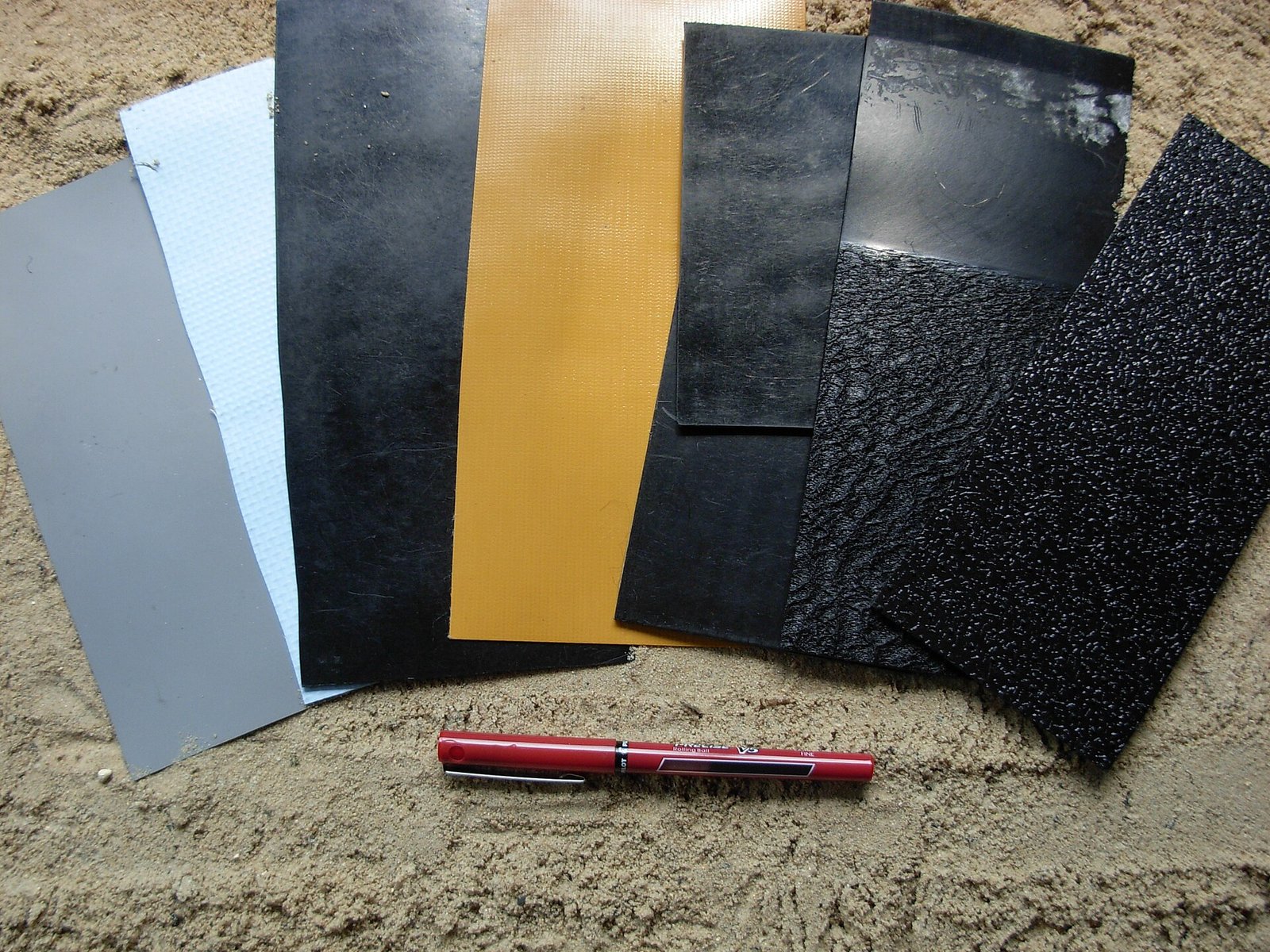
Geomembrane samples: smooth HDPE, textured HDPE and composite sheets (Public domain)
| Sheet | Material / structure | Where it fits a fish pond |
|---|---|---|
| HDPE geomembrane | High-density polyethylene (HDPE), Smooth / textured available | The default for production ponds: welds cleanly with a double hot wedge, best UV and chemical resistance, stiffer handling |
| LLDPE geomembrane | Linear low-density polyethylene (LLDPE) | Small or irregular ponds with many corners, where flexibility and elongation beat stiffness |
| Textured geomembrane | HDPE, textured surface, Single-side / double-side | Steep interior banks (steeper than about 1:2.5) where slope-parallel friction of a smooth sheet governs stability |
| Composite geomembrane | Membrane + nonwoven geotextile (1-side / 2-side) | Coarse subgrades where a separate cushion roll is impractical — protection is bonded to the barrier |
Roll width and unit weight are customisable across the range: wider panels mean fewer seams, and fewer seams mean fewer metres to weld, test and repair. For a standard rectangular production pond, smooth HDPE is almost always right.
Subgrade Preparation and Cushion Layers
No liner grade survives a bad bed. Before the first panel is unrolled:
- Clear and shape — remove vegetation, roots, burrows and any stone sharp enough to dent the sheet. Fill and compact soft spots so the bed is uniform.
- Compact and smooth — a drum-rolled surface removes puncture points and lets the sheet sit flat instead of bridging humps that stretch into stress concentrations.
- Cut the anchor trench — typically 300–500 mm deep and wide, set back about 0.5–1.0 m from the crest, sized for the sheet plus compacted backfill. It is what stops wind uplift and slope creep at the crest.
- Add a cushion where needed — a needle-punched nonwoven (Needle-punched nonwoven (PET / PP) construction) under the sheet converts a marginal subgrade into an acceptable one. Select it like any protection geotextile: opening size to ASTM D4751, CBR plunger puncture to ASTM D6241, class from AASHTO M288. Our guide to nonwoven geotextile as a liner protection layer works a cushion specification in detail; the same logic applies here.
Seaming, Welding and Testing the Liner
Seams are where a good sheet becomes a good liner. Production ponds are welded with a double hot-wedge welder on roughly 100 mm laps, leaving an air channel between the two weld tracks so every metre can be pressure-tested; extrusion welding covers patches and penetrations. Trial welds start each day, and destructive peel and shear samples taken from production seams are judged against ASTM D6392 (thermal fusion) and ASTM D4437 (field practice).
Before you order, run the take-off — it is where pond budgets go wrong:
Pond: 50 m × 30 m base, 2.5 m water depth, 1:2 side slopes.

1. Slope run = 2.5 m × 2            = 5.0 m of liner per side
2. Blank liner = (50 + 2×5.0) × (30 + 2×5.0) = 60 m × 40 m = 2,400 m²
3. Add 15% for laps, anchor-trench burial and offcuts → order ≈ 2,760 m²
4. 6 m panels laid up the 40 m length → 10 panels, 9 welds × 40 m = 360 m
   of double-wedge weld ≈ 0.15 m of seam per m² of liner
Re-run line 4 with 4 m rolls and the same pond needs 15 panels and 560 m of weld — 200 extra metres of welding, testing and inspection for exactly the same water. Panel width belongs in the quotation conversation, not just the price.
What Drives Fish Pond Liner Cost per Square Meter
Liner quotations vary for reasons that are all visible in the specification, so compare them line by line:
- Thickness — price tracks resin mass. A 1.0 mm sheet at about 0.95 g/cm³ weighs roughly 0.95 kg/m², so 1.5 mm carries half as much resin again — and that 2,760 m² order is about 2.6 t of sheet.
- Panel width — as the take-off shows, narrow rolls multiply seam length, and welding labour is charged per metre.
- Resin quality — GRI-GM13-compliant virgin resin costs more than reworked material. In aquaculture it is not the place to economise: stress cracking shows up exactly when the pond is full of fish.
- Surface — textured carries a premium over smooth; order it only where slope friction genuinely governs.
- Composite construction — a bonded nonwoven layer replaces a separate cushion roll, sometimes cheaper once site labour is counted.
- Order size and freight — about 2,600–2,800 kg of 1.0 mm sheet fills a shipping container; small one-pond orders pay proportionally more for logistics, so buyers often combine pond and canal orders.
The honest summary: cost per square meter is driven less by the grade than by the seam count and the shipped weight.
Fish Pond Liner Defects and What They Point To
When something goes wrong, diagnose before ordering material:
| What you see in the pond | Likely mechanism | What to re-check |
|---|---|---|
| Liner billows or lifts after filling | Air or biogas trapped under the sheet; groundwater uplift | Subgrade venting, anchor-trench depth |
| Deep wrinkles that trap debris and hide seam defects | Sheet laid in midday heat; uneven subgrade | Laying sequence (early morning), bed smoothness |
| Pinholes and tears near the bank | Sharp stones, or traffic on a bare sheet | Puncture index (ASTM D4833), thickness class, cushion |
| Seam fails a peel test | Dirty or damp weld surface, wrong wedge settings | ASTM D6392 peel and shear, ASTM D4437 field practice |
| Chalky, cracked surface after two dry seasons | UV exposure on uncovered banks | Carbon black content, ballast or water-cover scheduling |
| Water level drops with no visible damage | Leak at a seam, penetration or anchor trench | Leak-location survey, seam re-test |
Where to Go Next
- Product data sheets — see the HDPE geomembrane, LLDPE geomembrane, textured geomembrane and composite geomembrane pages for grades and roll formats, all customisable to your pond geometry.
- Talk to an engineer — message us on WhatsApp with your pond dimensions, water depth and subgrade description, or email cn8978688@gmail.com for a same-day thickness recommendation.
- Related reading — AASHTO M288 Geotextile Classes Explained covers cushion-grade selection in detail.
GeoTexGrid manufactures smooth, textured and composite geomembranes for aquaculture, irrigation and containment projects and ships worldwide. Send the pond dimensions and subgrade description — you will get a confirmed thickness, panel layout and quotation, usually within one working day, at cn8978688@gmail.com or on WhatsApp.
Похожие статьи
Fiberglass Geogrid China Supplier: Mesh and Coat
How to vet a fiberglass geogrid China supplier: mesh size, bitumen vs polymer coating, and the rib-count arithmetic that proves a 30-100 kN/m datasheet.
Woven Geotextile China Manufacturer: Slit Film
A woven geotextile China manufacturer explains slit film tapes, the grab-versus-wide-width trap, and how roll width changes the area you pay for.
Geocell China Manufacturer: Perforation Surface
Perforated or textured walls decide how a geocell drains and grips. A geocell China manufacturer explains wall options, weld QC and checks before order.