
Снижение толщины щебёночного слоя с георешёткой: расчёт
Автор GeoTexGrid Engineering Team
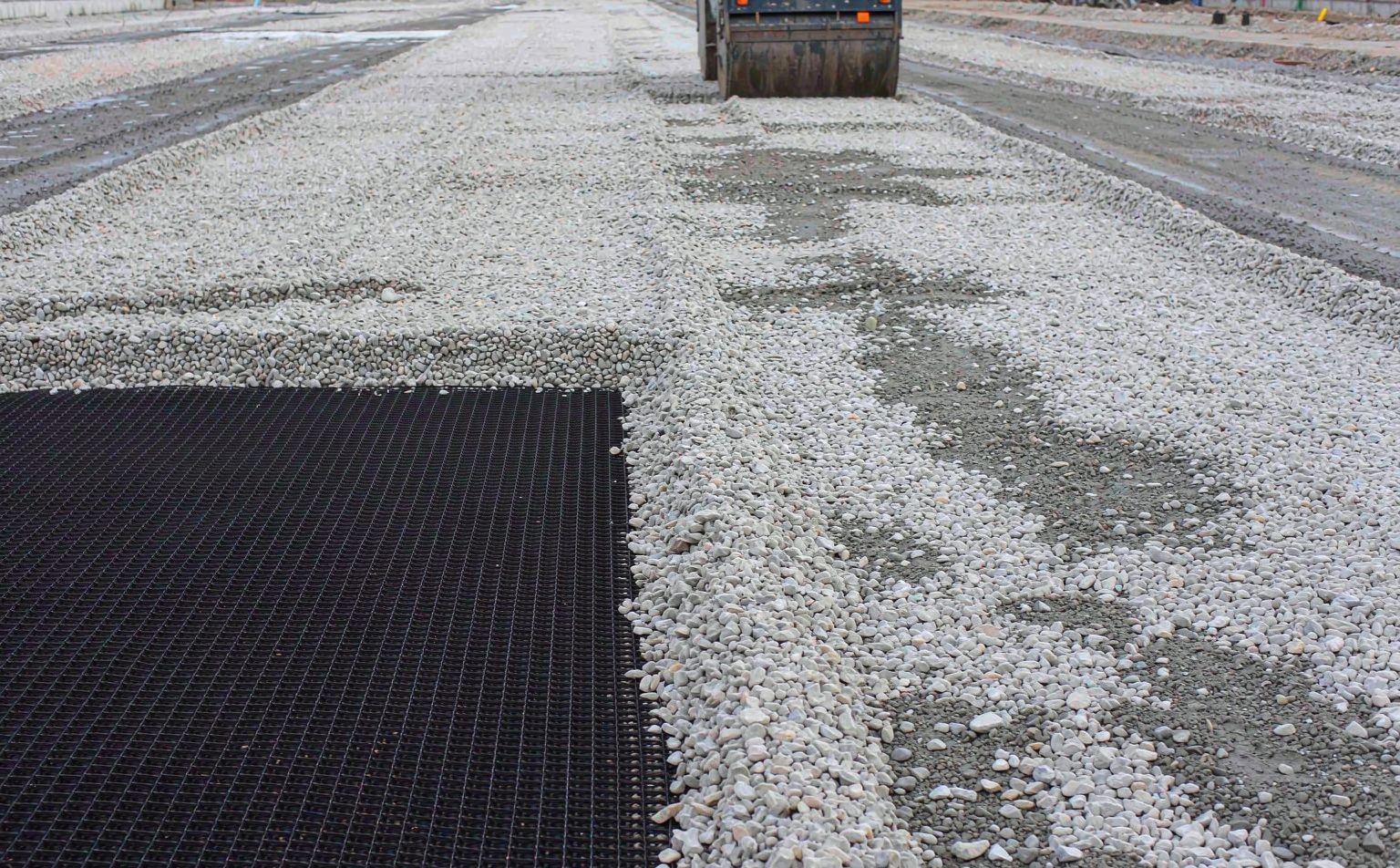
Every project manager asks the same question when a geogrid is proposed for a road: how much aggregate can this actually save? The honest answer is that geogrid aggregate thickness savings are real and measurable, but they depend on subgrade strength, traffic loading and how well the layer is built. On weak subgrades the base course can often be reduced by 30–50%; on firm ground the saving is smaller and sometimes not worth the extra layer.
Why Geogrid Reduces Aggregate Thickness
An unreinforced base course has only one way to carry traffic: mass. On soft ground the stone punches into the subgrade and disappears — into the soil and into the budget. A geogrid changes the mechanics. Aggregate locks into the apertures and the ribs confine the stone, so three things happen: load spreads at a wider angle, lowering the stress reaching the subgrade for the same thickness; the aggregate layer stiffens — studies on biaxial geogrid in compacted crushed stone commonly report a modulus improvement factor of 1.3–2.0; and rutting is delayed, because the grid keeps stone and soil separated at the interface instead of losing stone with every pass.
The Mechanics Behind the Savings
Two mechanisms drive the numbers, and it helps to know which dominates your project.
Confinement and lateral restraint. The ribs interlock with coarse aggregate; when a wheel load pushes stone outward, the tensioned ribs push back. This is why stone size matters — the grid size must match the gradation. Our biaxial grade is published at 12.7mm / 25.4mm / 38.1mm, and the uniaxial grade at a custom aperture (≥ 100mm), so the interlock can be sized to the stone rather than the other way round.
Tensioned membrane on very soft ground. Where subgrade CBR drops below about 2%, the geogrid acts like a tensioned membrane spanning ruts, and a separation geotextile underneath prevents pumping. This is the regime where the largest thickness reductions are justified. More detail on that case is in geogrid for soft soil stabilization.
What Our Geogrids Actually Publish
The specification is the starting point for any thickness comparison, and the test method behind it decides whether two offers are comparable:
| Product | Tensile strength | Grid size / aperture | Roll width | Roll length | Coating | Test standard |
|---|---|---|---|---|---|---|
| Steel-Plastic Biaxial Geogrid | 30–150 kN/m | 12.7mm / 25.4mm / 38.1mm | 1.0 – 3.0 m (custom) | 30 – 50 m | HDPE / LDPE | ASTM D6637, GB/T 19274 |
| Steel-Plastic Uniaxial Geogrid | 50–300 kN/m | Custom (≥ 100mm) | 1.0 – 2.0 m | 30 – 100 m | HDPE | ASTM D6637, GB/T 19274 |
| Fiberglass Geogrid | 30–100 kN/m | 12.7mm / 25.4mm | 1.0 – 2.0 m | by order | Bitumen / Polymer | ASTM D6637, JTG E50 |
Confirm the quoted strength comes from ASTM D6637 (multi-rib). ASTM D7737 tests a single rib and reads noticeably higher — a supplier quoting D7737 numbers into a D6637 design is not offering a stronger grid, just a more flattering test.
How Much Thickness Can You Actually Save?
| Subgrade condition | Typical unreinforced base | Base with biaxial geogrid | Aggregate saving |
|---|---|---|---|
| Very soft, CBR 0.5–1% | 500–700 mm (or soil replacement) | 350–450 mm | 30–50% |
| Soft, CBR 1–2% | 350–500 mm | 250–350 mm | 25–40% |
| Firm, CBR 3–5% | 250–350 mm | 200–300 mm | 10–25% |
| Stiff, CBR above 5% | 200–250 mm | Marginal saving | Often not economical |
Two patterns: the weaker the subgrade, the bigger the percentage saving, and the saving applies to the aggregate layer only — it does not reduce asphalt or surfacing, which are controlled by traffic and material quality.
What the Saving Looks Like in Tonnes
Percentages do not survive a budget meeting; tonnes do. Take 150 mm removed over 10,000 m² — a typical mid-size haul road:
| Step | Calculation | Result |
|---|---|---|
| Volume removed | 10,000 m² × 0.15 m | 1,500 m³ |
| Aggregate mass | 1,500 m³ × 2.2 t/m³ (compacted crushed stone) | ≈ 3,300 t |
| Truck movements | 3,300 t ÷ 25 t per truck | ≈ 132 fewer loads |
| In a replacement design | Same 1,500 m³ | Also 1,500 m³ less excavation and disposal |
Run that with your own haul distance and unit rates before you decide. It also explains why the last row of the savings table matters: at CBR above 5% the stone saved may not cover the cost of the grid, and the honest answer is to leave it out.
Geogrid Aggregate Thickness Design: A Practical Sequence
- Characterize the subgrade — a CBR or resilient modulus profile along the alignment, not a single test; the weakest 10% controls the design.
- Define traffic — convert axle passes into equivalent standard axles over the design life.
- Select the geogrid and check aperture compatibility — confirm strength in the 30–150 kN/m biaxial band suits the demand, and that the grid size matches your stone.
- Run the thickness calculation both ways — design unreinforced and reinforced sections at the same rutting criterion and compare. Never compare a reinforced section against an arbitrarily thinner unreinforced one.
- Verify constructability — 150–200 mm of well-graded stone cover before the first compaction pass.
For the construction side — overlap, tensioning and anchoring — see how to install geogrid for road reinforcement.
Where the Cost Savings Actually Come From
- Less aggregate to buy and haul. Aggregate is cheap per tonne until you price the trucks.
- Less excavation in weak ground. In a dig-out-and-replace design, every centimetre saved is also a centimetre of excavation and disposal.
- Faster construction. A thinner base places and compacts faster, and on soft sites the grid gives a working platform immediately.
- Fewer maintenance events. Confinement slows stone punching and base contamination after the first wet season.
One caution: a geogrid cannot rescue a subgrade with no bearing capacity, and it does not replace drainage. If water is the root problem, fix drainage first.
Common Mistakes That Erase the Savings
- Wrong grid size or wrong stone. Rounded river gravel in a grid sized for crushed angular stone gives poor interlock.
- Insufficient first lift. Dumping 300 mm directly onto an exposed grid and rutting it with a loaded truck destroys the benefit before compaction starts.
- Under-designed overlaps. Too-narrow overlaps unzip under traffic; follow the requirement for the CBR you actually have.
- Comparing apples to oranges. Demonstrate the saving against a properly designed unreinforced section at equal criteria.
Cutting Aggregate Thickness on Your Next Project
- Product range and data sheets — Steel-Plastic Biaxial Geogrid covers 30–150 kN/m at 12.7 / 25.4 / 38.1 mm grid sizes, Steel-Plastic Uniaxial Geogrid covers 50–300 kN/m, or browse the full geogrid product range.
- Talk to an engineer — message us on WhatsApp with your subgrade CBR and axle loads for a same-day thickness comparison, or email cn8978688@gmail.com.
- Related reading — Biaxial Geogrid for Road Base Reinforcement covers the design and specification side in depth.
GeoTexGrid manufactures biaxial and uniaxial geogrids for road bases, working platforms and haul roads, and runs thickness-comparison designs for customer projects as a free service. Send your cross-section, subgrade CBR and design traffic — you will get a reinforced-versus-unreinforced comparison and a quotation, usually within one working day.
Похожие статьи
Fiberglass Geogrid China Supplier: Mesh and Coat
How to vet a fiberglass geogrid China supplier: mesh size, bitumen vs polymer coating, and the rib-count arithmetic that proves a 30-100 kN/m datasheet.
Woven Geotextile China Manufacturer: Slit Film
A woven geotextile China manufacturer explains slit film tapes, the grab-versus-wide-width trap, and how roll width changes the area you pay for.
Geocell China Manufacturer: Perforation Surface
Perforated or textured walls decide how a geocell drains and grips. A geocell China manufacturer explains wall options, weld QC and checks before order.