
Спецификация георешётки: размер ячейки и прочность на разрыв
Автор GeoTexGrid Engineering Team
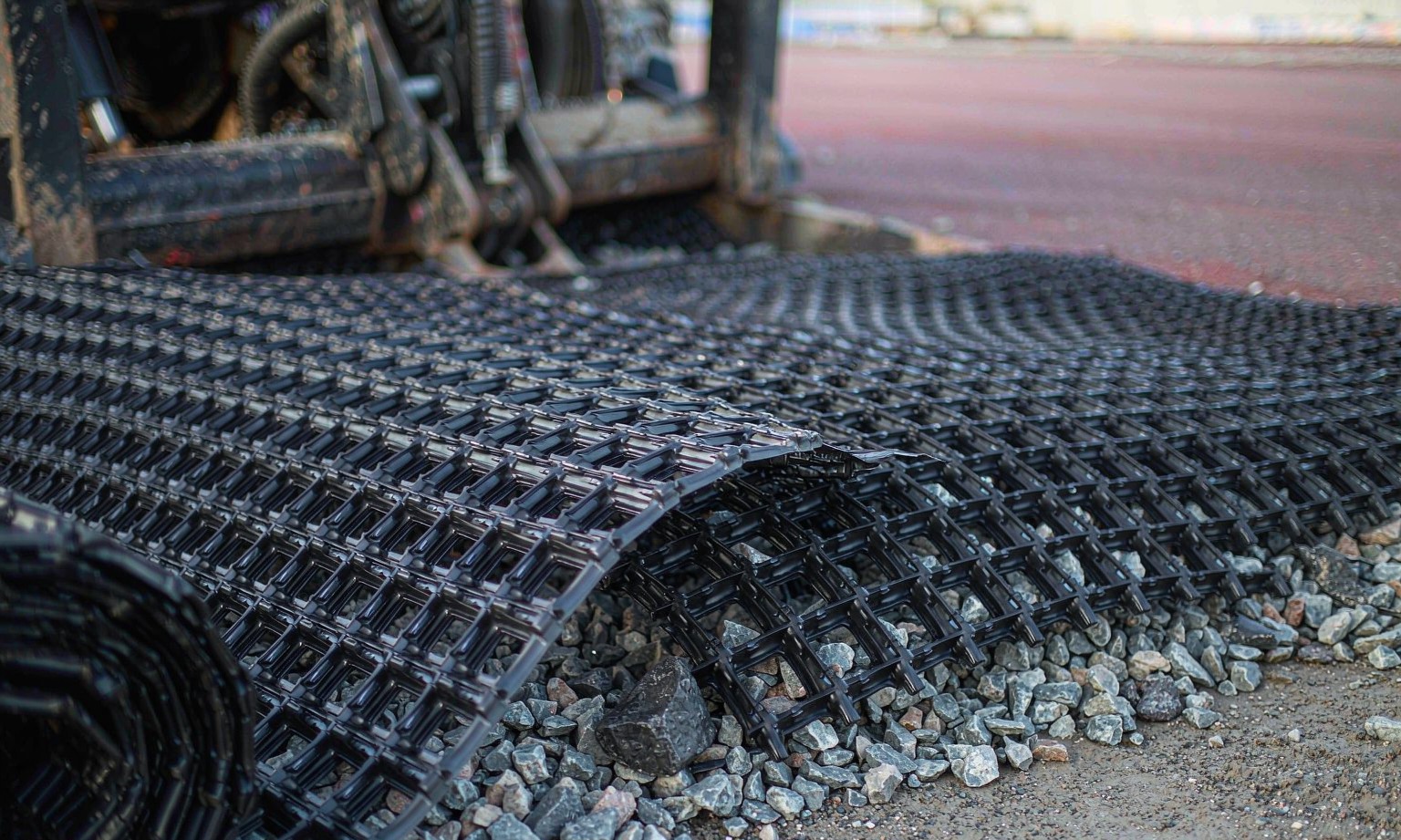
Two numbers do most of the work in any geogrid specification: aperture size and tensile strength. Get them right and the grid interlocks with your aggregate and carries the design load for decades. Get them wrong and even an expensive, high-strength product can add little more than the stone it was supposed to reinforce. This guide explains what each number means, how it is measured, and how to match both to your project.
Why Aperture Size Matters in a Geogrid Specification
A geogrid reinforces soil and aggregate through mechanical interlock, not through filtration or separation. The apertures — the open spaces between the ribs — exist so that aggregate particles can strike through them and wedge against the ribs. Once the stone is confined inside and between the apertures, the grid and the fill behave as one composite layer that resists lateral spreading under wheel loads.
Aperture geometry controls whether that interlock actually happens:
- Apertures too small for the aggregate — particles rest on top of the grid instead of striking through. The grid then behaves like a smooth separator sheet, and the benefit is limited to a small friction effect.
- Apertures too large for the aggregate — coarse particles sit loosely between the ribs without wedging, and fines can migrate through the openings under traffic and water.
- Apertures matched to the gradation — particles wedge partially into the openings, the ribs resist the punching force, and lateral restraint develops where it is needed: at the bottom of the base course.
This is why a geogrid specification should never state a tensile strength without also stating the aperture size and the intended aggregate gradation. The two values only mean something together.
Our Geogrid Range: Aperture and Strength by Product
The four families below cover virtually every reinforcement specification we supply. Note how the aperture and the strength move together — a wall grid needs both a large opening and a high MD strength; an asphalt grid needs the opposite.
| Product | Tensile Strength | Aperture / Grid Size | Roll Width | Standard | Suited to |
|---|---|---|---|---|---|
| Steel-plastic biaxial | 30–150 kN/m | 12.7mm / 25.4mm / 38.1mm | 1.0 – 3.0 m | ASTM D6637, GB/T 19274 | Road bases, haul roads, soft subgrade |
| Steel-plastic uniaxial | 50–300 kN/m | Custom (≥ 100mm) | 1.0 – 2.0 m | ASTM D6637, GB/T 19274 | MSE walls, steep slopes, embankments |
| Fiberglass geogrid | 30–100 kN/m | 12.7mm / 25.4mm | 1.0 – 2.0 m | ASTM D6637, JTG E50 | Asphalt overlays, reflective cracking |
| Self-adhesive fiberglass | 30–80 kN/m | 12.7mm / 25.4mm | 1.0 – 2.0 m | ASTM D6637, JTG E50 | Patch repair, bridge decks, localised areas |
Full data sheets: steel-plastic biaxial geogrid, steel-plastic uniaxial geogrid, fiberglass geogrid.
Matching Geogrid Aperture Size to Aggregate Gradation
The practical rule used by most designers: choose an aperture equal to or slightly smaller than the D50 of your compacted aggregate, so that the mean particle size wedges into the openings while the fine fraction fills the voids and stabilises the structure.
Two checks make this quick on site:
- Strike-through test. Spread a thin lift of the actual base material over the grid and look at it from a low angle. A meaningful share of the stones should sit partly inside the apertures, not on top of the ribs.
- Punch-through check. Press a representative stone into an aperture by hand or with the bucket of a loader. If the stone passes straight through without wedging, the aperture is too large for that gradation.
Applying the rule to the apertures above: a 12.7mm opening suits fine graded base course and asphalt mixtures, 25.4mm is the general-purpose road base size, and 38.1mm is chosen where coarse crushed rock is being placed. A uniaxial wall grid with Custom (≥ 100mm) openings is sized to the structural fill being compacted against it, not to a base gradation.
If your project combines very soft subgrade with a geogrid layer, remember that the geogrid itself does not filter water. Pairing it with a separation geotextile — as described in geogrid for soft soil stabilization — prevents fines from pumping up into the base and destroying the interlock you specified.
Geogrid Tensile Strength: What the Numbers Actually Mean
Tensile strength on a geogrid data sheet is measured in kN/m using a wide-width tensile test — ASTM D6637 in North America, ISO 10319 internationally — on a specimen several ribs wide. The result is reported per unit width, and always per direction: machine direction (MD) and cross-machine direction (CMD).
How to read the values:
- Biaxial geogrids carry similar strength in both directions — our steel-plastic biaxial range runs 30–150 kN/m. The 30–50 kN/m grades suit rural roads and driveways; 100 kN/m and above suit heavy truck and haul traffic.
- Uniaxial geogrids concentrate strength in one direction only — 50–300 kN/m in MD with much lower CMD values. They are designed for structures where the load path is one-directional: MSE walls, steep slopes, embankments over soft ground.
- Fiberglass asphalt grids provide 30–100 kN/m with elongation at break ≤ 4%, so the grid mobilises before the asphalt layer strains visibly.
One more detail matters as much as the strength figure itself: check whether the data sheet reports typical values or minimum average roll values (MARV). A "typical 30 kN/m" can vary roll to roll; a MARV is a statistical minimum that design calculations can rely on. On tenders, insist on MARV or a stated minimum.
Beyond the Two Numbers: Junctions, Creep and Installation Damage
A complete geogrid specification looks at three more properties:
- Junction strength. The ribs are only as good as their crossings. Junction efficiency is measured per GRI-GG2, and many project specifications require it at 90% or higher for biaxial products. A grid with strong ribs but weak welded junctions loses interlock under repeated loading.
- Creep. Polymer choice decides how much strength remains after decades under constant load. A steel-plastic grid with an HDPE coating behaves differently from a polyester grid, which is why design codes apply polymer-specific creep reduction factors rather than using the short-term tensile value directly.
- Installation damage. Dumping and compacting coarse rock directly on any grid reduces its strength; ISO 10722 and ASTM D5818 quantify this. On soft subgrades, install the grid flat and tensioned, and keep lifts thick enough that the compactor works stone, not grid — the sequence is laid out in geogrid installation best practices.
Common Geogrid Specification Mistakes
- Specifying tensile strength without an aperture requirement — the supplier is then free to deliver a grid that cannot interlock with your aggregate.
- Assuming MD strength applies everywhere — with uniaxial geogrids, placing the strong direction across the traffic or wall orientation wastes most of the product.
- Ignoring elongation compatibility — a high-elongation grid under a thin asphalt layer reflects nothing but allows the pavement to deform before the grid works.
- Forgetting overlaps and placement tolerance — even a correct specification fails if adjacent rolls are not overlapped correctly (typically 300–600 mm depending on subgrade strength) or are pushed into folds by the first lift.
Choosing the Right Geogrid for Your Project
- Product range and data sheets — see the full geogrid product range for aperture dimensions, tensile grades and roll sizes, from biaxial road grids to high-strength uniaxial and fiberglass products.
- Talk to an engineer — message us on WhatsApp for a same-day technical answer, or email cn8978688@gmail.com. Send your aggregate gradation and design load, and we will confirm the aperture and strength grade that fit.
- Related reading — steel-plastic geogrid data sheet explained walks through the full test report line by line, and how geogrid reduces aggregate thickness shows what a correct specification saves in tonnage.
GeoTexGrid manufactures biaxial, uniaxial, steel-plastic and fiberglass geogrids with full wide-width test data in MARV form. Send your drawing and design load — you will get a confirmed specification and quotation, usually within one working day.
Похожие статьи
Fiberglass Geogrid China Supplier: Mesh and Coat
How to vet a fiberglass geogrid China supplier: mesh size, bitumen vs polymer coating, and the rib-count arithmetic that proves a 30-100 kN/m datasheet.
Woven Geotextile China Manufacturer: Slit Film
A woven geotextile China manufacturer explains slit film tapes, the grab-versus-wide-width trap, and how roll width changes the area you pay for.
Geocell China Manufacturer: Perforation Surface
Perforated or textured walls decide how a geocell drains and grips. A geocell China manufacturer explains wall options, weld QC and checks before order.