
Biaxial Geogrid for Wind Farm Roads and Crane Pads
By GeoTexGrid Engineering Team
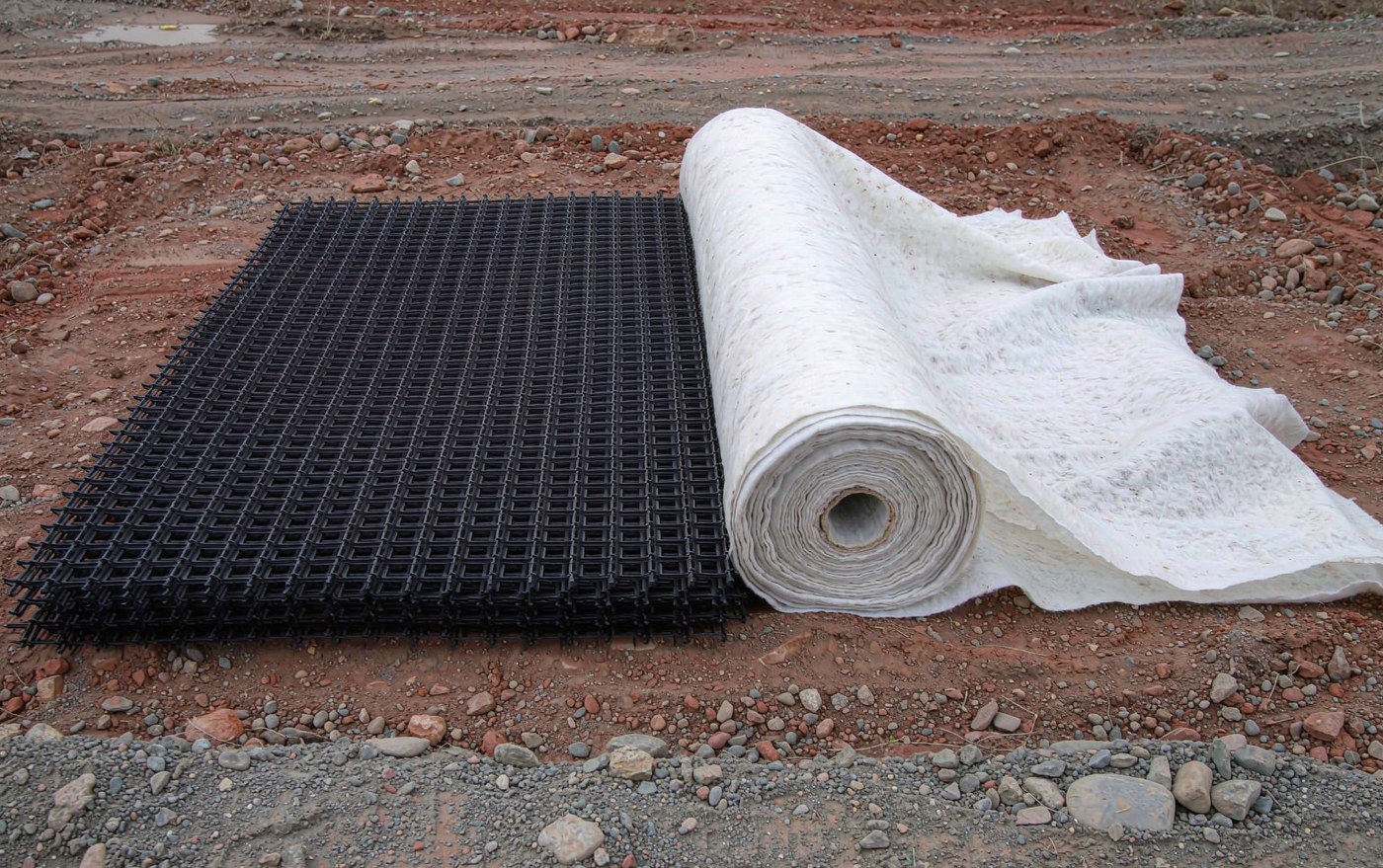
The first wind farm enquiry I priced was not really about turbines. The buyer had a simple question: could our geogrid keep a crawler crane sitting on a wet farm track for three days without punching through. Blade convoys, nacelle transports and crane pads do more damage to a site than five years of normal traffic, and they arrive on subgrade that was grazing land six months earlier. That is a different design problem from a highway, and it needs a different way of reading the data sheet.
Why Wind Farm Geogrid Loads Beat Normal Road Traffic
A public road sees thousands of light passes. A wind farm access road sees a handful of passes that each weigh more than everything else combined. Typical project conditions look like this: soft agricultural subgrade with a CBR of 1 to 3, no time for it to dry out, and construction scheduled around a turbine delivery date that cannot move.
So the design targets are inverted. You are not designing for fatigue over millions of axle passes; you are designing against a single gross foundation failure under one machine. Geogrid for soil stabilization China export orders almost always quote the same three numbers — tensile strength, aperture, roll width — but on a wind farm the third one matters more than buyers expect, because laps cost labour on a narrow farm track.
Geogrid Selection: Biaxial, Uniaxial or Fiberglass?
Three products, three jobs. On unpaved works the steel-plastic biaxial geogrid does nearly all of it; the other two have narrow but real roles.
| Product | Tensile strength (ASTM D6637) | Aperture / mesh | Role on a wind farm site |
|---|---|---|---|
| Steel-plastic biaxial geogrid | 30–150 kN/m | 12.7mm / 25.4mm / 38.1mm | Access roads, crane pads, hardstands — strength works in both directions under wheel loads |
| Steel-plastic uniaxial geogrid | 50–300 kN/m | Custom (≥ 100mm) | Embankment slopes and MSE zones around turbine bases, where load is one-directional |
| Fiberglass geogrid | 30–100 kN/m | 12.7mm / 25.4mm | Asphalt-surfaced permanent roads only — brittle on unpaved haul use |
The biaxial is the default because wheel loads spread in two directions and the square aperture locks crushed stone from every side. The HDPE / LDPE coating on steel-plastic cores also handles the wet, mildly alkaline farm soils that pit bare steel. Fiberglass is a different animal: its elongation at break is ≤ 4%, which is superb under an asphalt overlay and terrible in a muddy paddock, where a roll dropped off a truck can crack. Keep it for the paved sections.
Crane Pads: A Worked Bearing Check
Here is the arithmetic I run for a typical pad, with assumptions stated so you can swap in your own crane data.
Setup (typical values): 220 t all-terrain crane, maximum outrigger reaction 480 kN, outrigger float 0.6 m × 0.6 m bearing on a 2.0 m × 2.0 m timber mat, over a gravel working pad on subgrade of CBR 2.
- Pressure under the mat: 480 kN / 4.0 m² = 120 kPa.
- Spread through a 0.5 m gravel pad at 2:1: subgrade area = (2.0 + 0.5)² = 6.25 m², so q = 480 / 6.25 = 77 kPa.
- Capacity of the subgrade: a common field correlation gives cu ≈ 10 × CBR ≈ 20 kPa, so q_ult ≈ 5.14 × cu ≈ 103 kPa. Factor of safety = 103 / 77 ≈ 1.34 — not enough.
- Rebuild with 0.7 m of gravel: (2.0 + 0.7)² = 7.29 m², q = 66 kPa, FS ≈ 1.56. That passes.
Note what this calculation does not do: it gives no credit for the geogrid. The spread check sizes the stone as if the layer works by mass alone. The biaxial geogrid laid at the subgrade surface is what lets you hold that thickness in the rain — confinement stops the stone punching sideways into the mud, which is the failure the arithmetic above quietly assumes away. On the pads I have priced, skipping the grid "because the maths passed" is exactly how a pad ends up needing an extra 300 mm of stone mid-lift, bought at emergency local prices.
Access Road Build-Up: Aperture, Separator and Roll Math
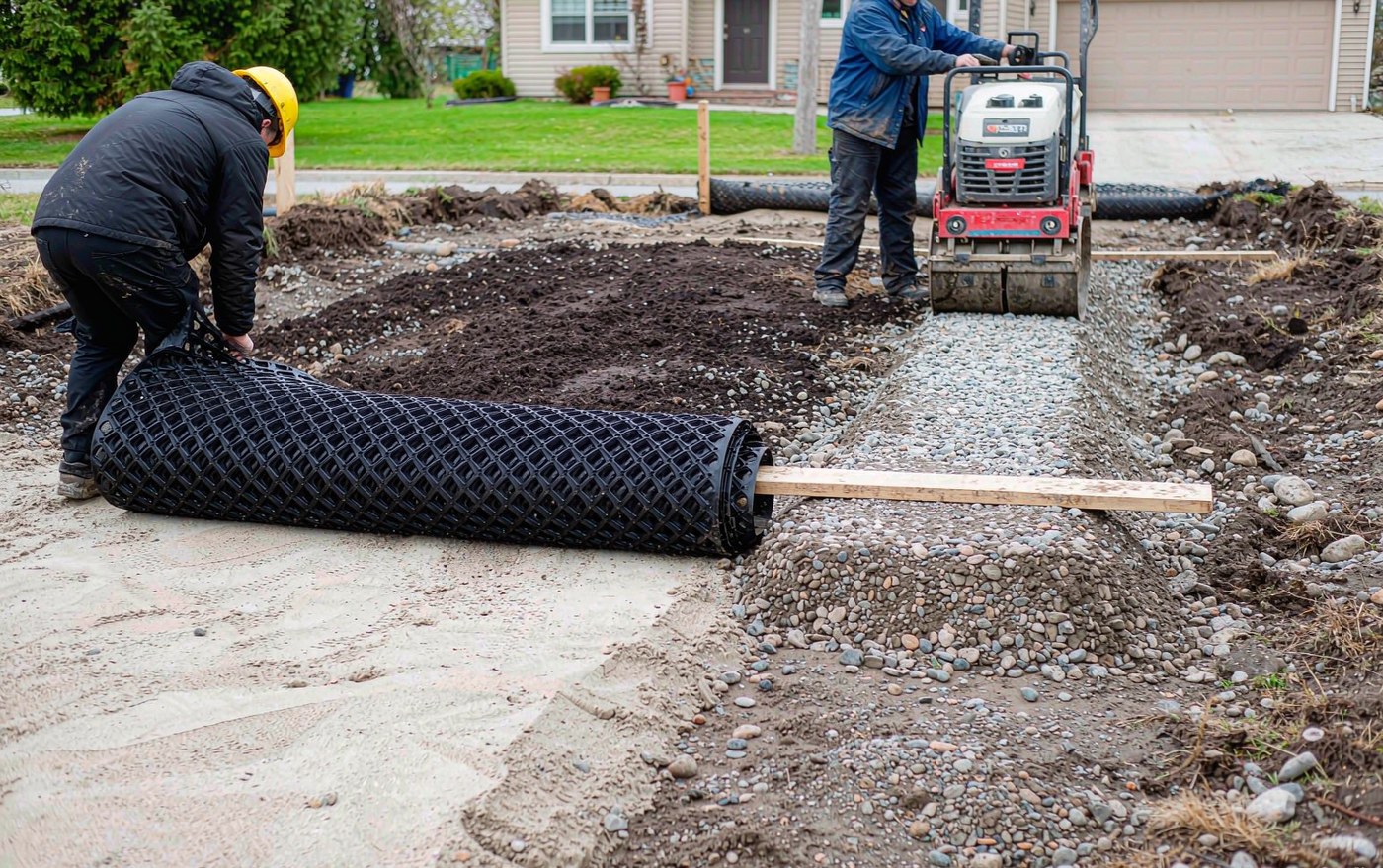
The build-up I quote most often, bottom to top:
- Separator: needle-punched nonwoven (PET / PP) geotextile directly on the subgrade. It stops fines pumping up into the stone; choose its AOS by ASTM D4751 and its class by AASHTO M288, and check CBR puncture resistance to ASTM D6241 where 40–70 mm stone is dropped from a grab.
- Biaxial geogrid at the base of the stone, aperture matched to the aggregate — 25.4 mm suits a 20–40 mm crushed stone, so ribs and stone interlock instead of the stone sliding across a flat sheet.
- Crushed stone pad, typically 300–450 mm on the roads, more under pads by the check above.
Now the roll math, which is where a wind farm budget quietly leaks. Take a 4 km access road at 5.5 m top width: 22,000 m² of grid. From a 3.0 m × 50 m roll with 0.3 m laps on width and end, effective coverage is 2.7 × 49.7 = 134 m², so 22,000 / 134 ≈ 165 rolls. Order 2.0 m rolls instead and coverage drops to 1.7 × 49.7 = 84.5 m² — about 260 rolls and roughly 58% more laps to nail, inspect and photograph for the contractor's records. Roll width is not a detail; it is labour.
This is also where buying factory direct changes the answer. A source factory like ours rolls biaxial geogrid China export orders at 1.0 – 3.0 m (custom) widths, so you can order 3.0 m for the long straights and 1.0 m for the pinch points at gate and culvert, instead of cutting a stock width to fit. Trading companies cannot offer that, because they do not own the line.
QC Tests to Demand from a Geogrid China Supplier
Paper numbers and batch numbers are not the same thing. For biaxial geogrid China shipments we are asked for, and I would demand anywhere:
- Tensile strength and elongation to ASTM D6637 (multi-rib), tested per production batch — the 30–150 kN/m range means nothing without the batch certificate behind it. European tenders usually want ISO 10319 instead; it is the same machine, different grip.
- Junction strength where ribs cross. A grid with strong ribs and weak junctions spreads load like parallel cables, not like a net.
- GRI-GG4 as the practice framework if the engineer wants a checklist rather than a single test.
- For the separator, AASHTO M288 class and ASTM D6241 CBR puncture, verified on delivered rolls, not datasheet copies.
Uniaxial geogrid China orders in 1.0 – 2.0 m widths need one more check at delivery: the heavier grades (50–300 kN/m) stiff, and apertures Custom (≥ 100mm) must be measured on site, because a wrong aperture on a slope wrap is invisible until it slips. Fiberglass rolls need dry storage and no re-dragging — the ≤ 4% elongation that makes them good under asphalt makes them snap when a labourer walks a roll across a corner.
Wind Farm Failure Modes and the Property That Fixes Each
| Symptom on site | Failure mode | Specification answer |
|---|---|---|
| Deep rutting under crane tracks | Stone laterally squeezing into soft subgrade | Raise the biaxial grade within the 30–150 kN/m range and re-run the spread check |
| Longitudinal cracks along wheel lines | Separator lost, subgrade fines pumping into stone | Nonwoven separator with AOS per ASTM D4751, classed per AASHTO M288 |
| Pad softens after rain despite gravel | Fines migrated up, stone contaminated | Free-draining crushed stone plus an intact separator; inspect laps before each lift |
| Fiberglass rolls cracked at delivery | Brittle product handled on unpaved site | Reserve fiberglass for paved sections; steel-plastic elsewhere |
| Edge settlement around hardstands | No confinement at the boundary | Overlap laps 0.3–0.5 m, anchor rolls, wrap edges with uniaxial 50–300 kN/m |
Where to Go Next
- Product data sheets — full tensile grades and roll options for the steel-plastic biaxial geogrid and the steel-plastic uniaxial geogrid, plus the nonwoven geotextile separator.
- Talk to an engineer — message us on WhatsApp for a same-day answer, or email cn8978688@gmail.com.
- Related reading — why mining haul roads are specced differently, and how AASHTO M288 classes the separator geotextile.
GeoTexGrid is a source factory for geosynthetics China buyers and export projects worldwide. Send your crane data, subgrade CBR and road widths — you will get a confirmed specification and a roll-by-roll quotation, usually within one working day.
Related Articles
Fiberglass Geogrid China Supplier: Mesh and Coat
How to vet a fiberglass geogrid China supplier: mesh size, bitumen vs polymer coating, and the rib-count arithmetic that proves a 30-100 kN/m datasheet.
Woven Geotextile China Manufacturer: Slit Film
A woven geotextile China manufacturer explains slit film tapes, the grab-versus-wide-width trap, and how roll width changes the area you pay for.
Geocell China Manufacturer: Perforation Surface
Perforated or textured walls decide how a geocell drains and grips. A geocell China manufacturer explains wall options, weld QC and checks before order.