
Non Woven Geotextile China: Drainage Wrap Spec Guide
作者 GeoTexGrid Engineering Team
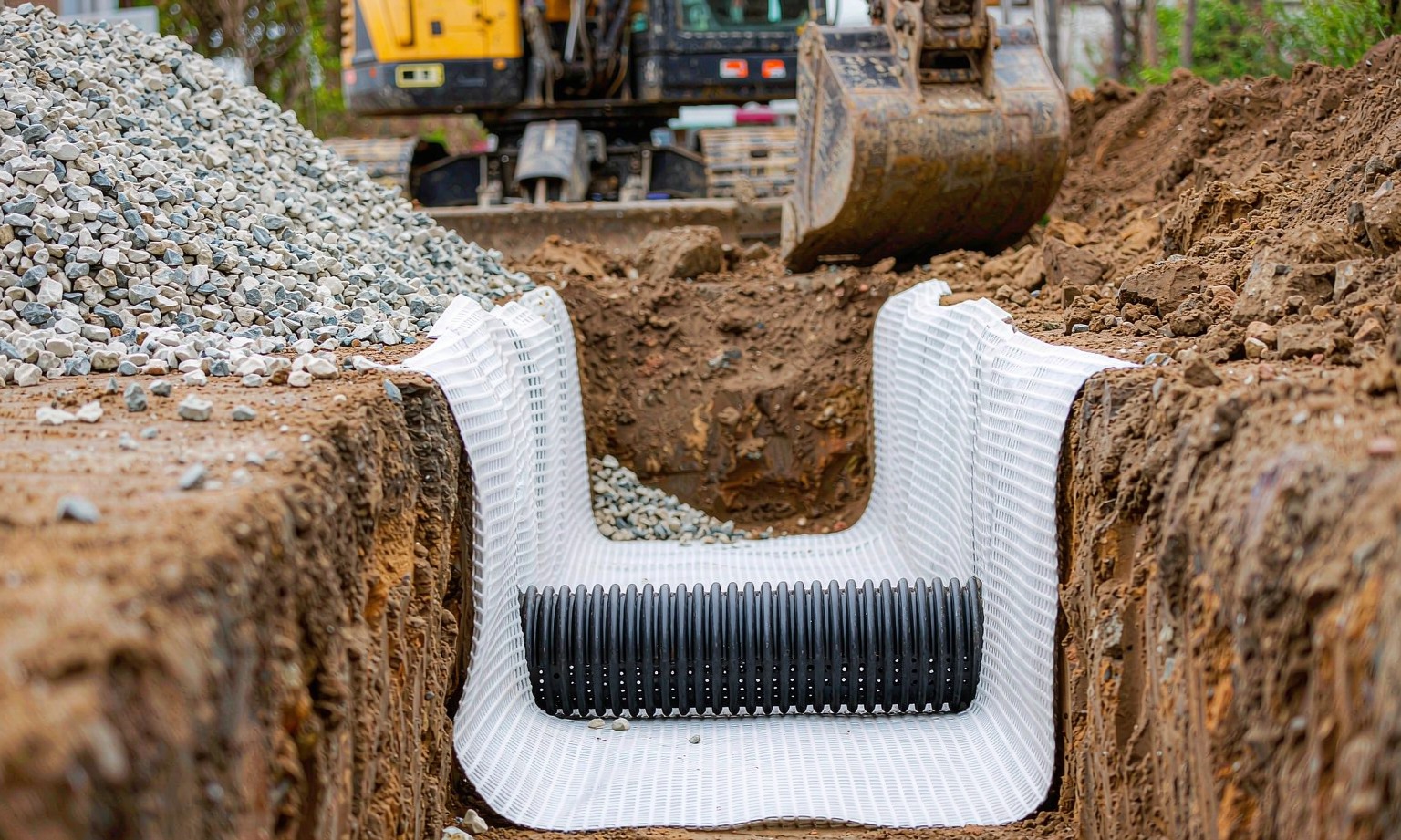
A drainage trench is the one place where non woven geotextile gets buried under wet gravel and forgotten, and the one place where the wrong fabric comes back to haunt a project within a year. The first time a contractor sent us photos of a silted-up French drain, the wrap was intact and the pipe was still round — the fabric itself had blinded. Its spec looked reasonable on a datasheet and made no sense against the soil in that trench. Here is the checklist we now walk buyers through: soil first, fabric second, quantity third.
What the Wrap Actually Does in a Drainage Trench
Three jobs, in order of how often they kill the trench: retention (an AOS question, ASTM D4751), permeability (permittivity, ASTM D4491) and survivability against angular stone and plate compaction (ASTM D4632, D6241). Most failed trenches we see failed on retention and survivability, rarely on permeability — run the numbers before paying for a tighter fabric than the soil demands.
Match AOS and Permittivity to the Soil, Not the Datasheet
AASHTO M288 indexes both hydraulic properties to one number you can get from any lab report: the percentage of in-situ soil passing the 0.075 mm sieve.
| Soil fines passing the 0.075 mm sieve | Minimum permittivity (D4491) | Maximum AOS (D4751) |
|---|---|---|
| More than 50% (clayey, plastic soils) | 0.1 s⁻¹ | 0.22 mm |
| 15–50% (silty, mixed soils) | 0.2 s⁻¹ | 0.25 mm |
| Less than 15% (sands, low-fines soils) | 0.5 s⁻¹ | 0.43 mm |
Cross-check retention with the classic gradation rule: keep the fabric's O95 at or below roughly 2 × D85 of the soil. A silty sand with D85 = 0.20 mm allows an O95 up to 0.40 mm, which the 0.43 mm cap for low-fines soils accommodates. Move to a 0.25 mm fabric if fines sit near the middle band, and you satisfy both criteria at once.
Now the honest part: how much water must the wrap pass? A Class 1 requirement of 0.5 s⁻¹ on a 2.0 mm needle-punched nonwoven corresponds to a cross-fabric permeability of about 1×10⁻³ m/s. A silty sand trench wall with k = 1×10⁻⁵ m/s, gradient 0.5 and 2.4 m² of wetted fabric per metre delivers roughly 1.2×10⁻⁵ m³/s per metre — about 43 litres per hour. The same square metre at ψ = 0.5 s⁻¹ under 0.3 m of head passes several hundred times that. The fabric is never the hydraulic bottleneck; retention and clogging are.
Non Woven Geotextile China: Picking Among Four Fabric Families
Not everything white and on a roll is the same product. These are the four families we manufacture and export, exactly as their material lines read on the product pages:
| Fabric | Material as published | Role in a drainage wrap | Roll width / unit weight |
|---|---|---|---|
| Nonwoven Geotextile | Needle-punched nonwoven (PET / PP) | The default wrap: high permittivity, good puncture cushioning | Customizable |
| Woven Geotextile | Woven PP slit film / PET yarn | Reinforcement and separation; slit-film wovens are excluded from M288 subsurface drainage applications | Customizable |
| PET Geotextile | Polyester (PET) continuous filament | Warmer, alkaline soils and long-design-life filters | Customizable |
| PP Geotextile | Polypropylene (PP) | Best chemical inertness; survives acidic groundwater | Customizable |
Two rules fall straight out of that table. First, a slit-film woven looks strong on grab tensile but is disqualified for drainage duty by M288 — buyers keep specifying it for trench wraps because the price per square metre is lower, then wonder why the trench silts. Second, needle-punched nonwoven wins on permittivity per dollar almost every time; the choice between PET and PP inside that family is a chemistry decision driven by soil pH, not a marketing one.
This is also where buying non woven geotextile from a China source factory changes the conversation. Trading companies quote a grammage and a price; a factory asks what your soil passes at 0.075 mm and quotes the AOS and CBR values to match. We produce to order rather than from stock, so roll width and unit weight stay customizable, and a 9-roll trench order ships as LCL alongside a container of geogrid instead of waiting to fill a full 40HQ.
How Much Non Woven Geotextile a 400 Metre Trench Eats
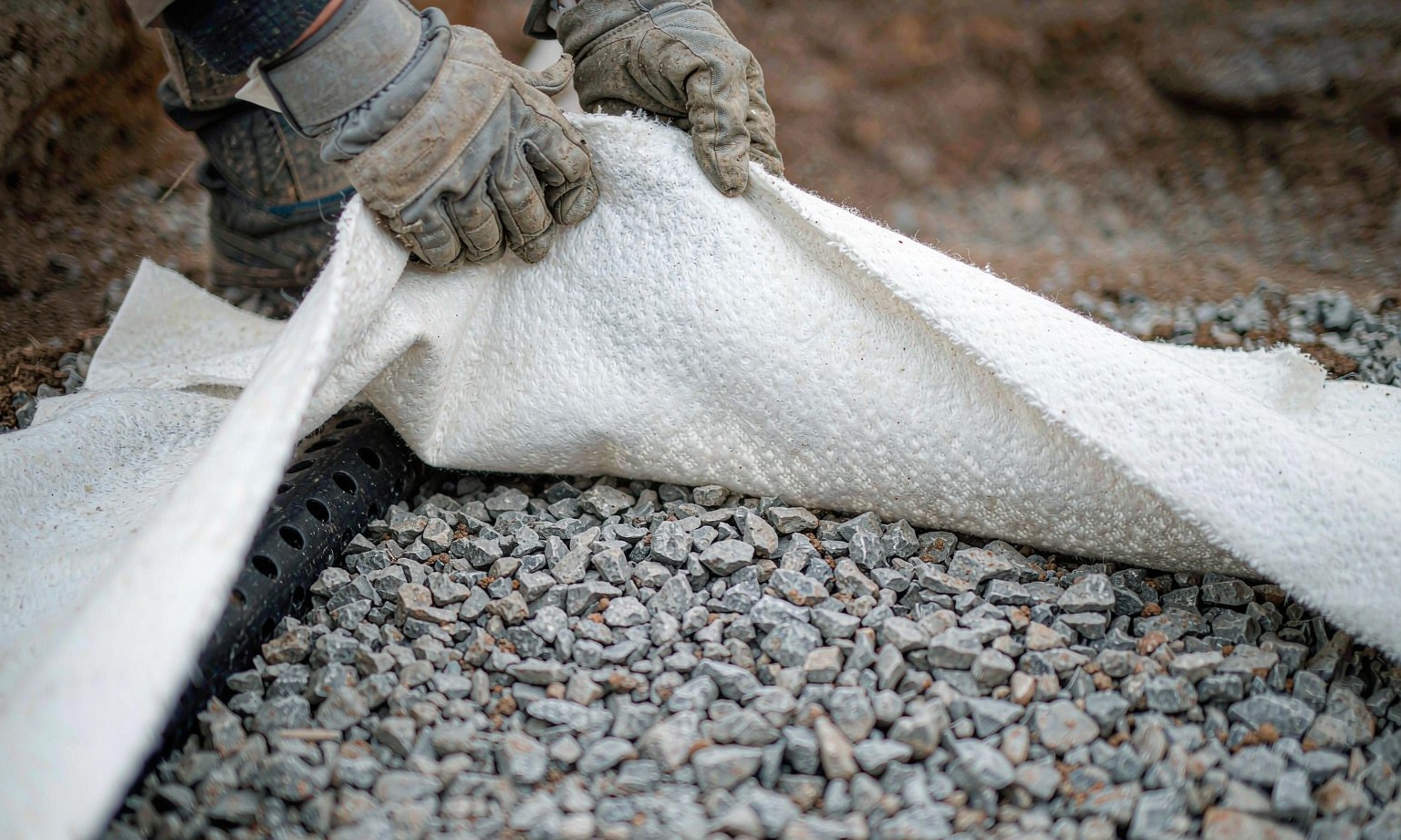
Wrap geometry is where quotations quietly grow. Consider a typical roadside trench: 0.6 m wide, 1.2 m deep, 400 m long, wrapped before the stone goes in.
| Method | Fabric path per metre of trench | Total area for 400 m | 2.0 × 100 m rolls | Notes |
|---|---|---|---|---|
| Full wrap, 0.3 m top laps each side | 0.6 + 2 × 1.2 + 2 × 0.3 = 3.6 m | 1,600 m² | 8 rolls (+10% offcuts → 9) | Two 2.0 m lanes laid with 0.4 m centre overlap |
| Fillet only (bottom + 0.3 m up each wall) | 0.6 + 2 × 0.3 = 1.2 m | 480 m² | 3 rolls | Gravel above the fillet touches raw trench wall |
Six extra rolls separate the two methods. At 200 g/m² the full wrap is 320 kg of fabric — nine rolls of 40 kg each, palletised. Do not economise here: those six rolls cost less than re-excavating 400 m of blind trench two summers later, and a fillet detail leaves exactly the sand-size window above it where fines pump in.
Survivability: the CBR Number Most Drainage Specs Ignore
Installation, not service, destroys more drainage wraps than anything else. A 20–40 mm angular stone dropped from an excavator bucket concentrates its weight on one point of fabric stretched over soft ground. M288 handles this with static CBR puncture (ASTM D6241): 2,750 N Class 1, 2,200 N Class 2, 1,650 N Class 3 in the low-elongation column, and 1,925 / 1,375 / 990 N for needle-punched nonwovens in the ≥ 50% elongation column. A trench in firm ground with rounded gravel can justify Class 2; wet clay backfilled with crushed stone is Class 1 territory.
Grab tensile (D4632) follows the same logic — 900 / 700 / 500 N for the nonwoven column — and 500 hours of UV exposure (ASTM D4355) must leave 50% strength, which is why rolls should stay wrapped until the trench is open. If a supplier quotes "typical" values instead of MARV, nothing above has been demonstrated.
Reading a Failed Trench: Diagnose Before You Reorder
| What you see in the trench | Failure mode | The number that was wrong |
|---|---|---|
| Fabric face coated in fine silt, trench stays dry | Blinding / clogging | AOS tighter than the soil needed — re-check fines % against the M288 table |
| Sediment inside the pipe at cleanouts | Retention lost | AOS too coarse (0.43 mm fabric against silty soil) |
| Fabric torn at stone contact points after backfill | Puncture during placement | CBR below Class 1 2,750 N, or no sand cushion under angular stone |
| Laps gapped or folded into the trench | Survivability / workmanship | Grab tensile below 900 N, laps under 300 mm |
| Fabric brittle after a summer on site | UV degradation | Unwrapped rolls; verify 50% retention at 500 h (D4355) |
Notice what is not on the list: permittivity. Across a decade of such calls, the wrap has almost never failed hydraulically on day one — it failed because a number was matched to a datasheet instead of to the soil.
What Goes in the PO When You Order From a Source Factory
One page is enough if it carries the right lines: soil fines passing 0.075 mm and D85; required AOS and permittivity from the table above; M288 class with CBR and grab values; mass per unit area; roll width and length; packing. As a factory-direct geotextile supplier we cut rolls to the trench geometry you actually dig — a 3.6 m wrap path needs two 2.0 m lanes, and cutting at 2.0 m instead of 2.1 m is the difference between 8 rolls and 9 over 400 m. Quotations from our mill carry batch test certificates for AOS, permittivity and CBR, and mixed loads with geogrid or geomembrane are normal business, not a favour.
Where to Go Next
- Product range and data sheets — see the full nonwoven geotextile range, plus woven, PET and PP families with their published material lines.
- Talk to an engineer — message us on WhatsApp for a same-day technical answer, or email cn8978688@gmail.com.
- Related reading — Geotextile filter fabric: matching AOS and permeability covers filter criteria, AASHTO M288 geotextile classes explained walks the full class tables, and geocomposite drainage nets show when a prefabricated drain beats a wrapped trench.
GeoTexGrid manufactures needle-punched nonwoven and woven geotextiles at our own mill and ships them worldwide with batch certificates. Send your soil gradation and trench cross-section — you will get a confirmed specification and quotation, usually within one working day.
相关文章
Fiberglass Geogrid China Supplier: Mesh and Coat
How to vet a fiberglass geogrid China supplier: mesh size, bitumen vs polymer coating, and the rib-count arithmetic that proves a 30-100 kN/m datasheet.
Woven Geotextile China Manufacturer: Slit Film
A woven geotextile China manufacturer explains slit film tapes, the grab-versus-wide-width trap, and how roll width changes the area you pay for.
Geocell China Manufacturer: Perforation Surface
Perforated or textured walls decide how a geocell drains and grips. A geocell China manufacturer explains wall options, weld QC and checks before order.