
Geomembrane for Mining: Heap Leach Pad Liner Design
作者 GeoTexGrid Engineering Team
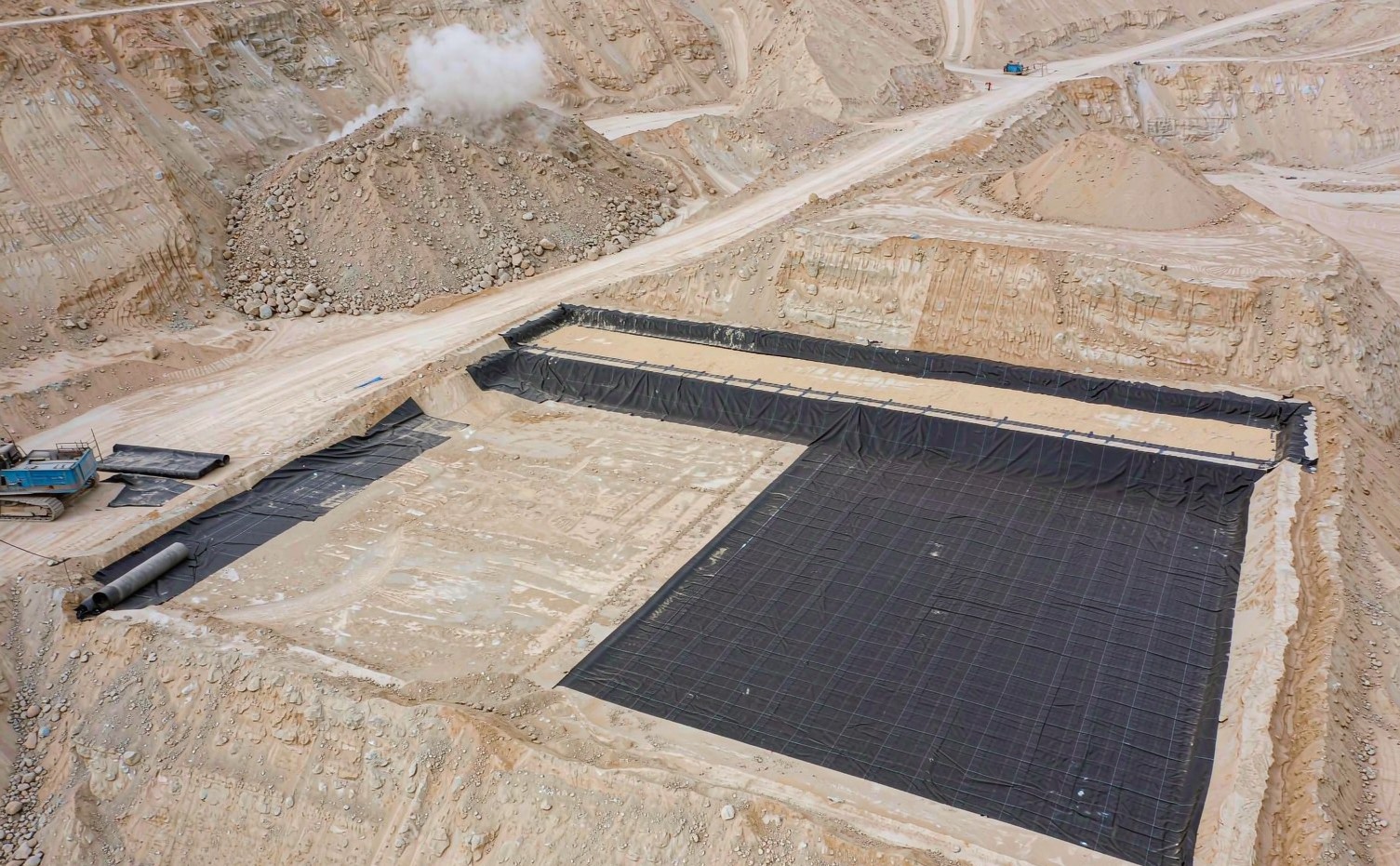
Gold and copper operations do not specify a geomembrane for mining the way a water utility specifies a pond liner. The liquid on top of it can be cyanide leach solution or acid rock drainage, the service life is measured in decades, and a failure is a reportable environmental event, not a maintenance ticket. This guide walks through how heap leach pad and tailings engineers choose a geomembrane for mining containment, which liner configurations are actually built, and two design checks you can reproduce with your own project numbers.
Why Geomembrane Selection Is Harder in Mining
Three factors separate mining containment from ordinary water containment:
- Chemistry. Heap leach solution is a strong alkaline cyanide circuit or dilute sulfuric acid, depending on the process. Acid rock drainage in tailings can sit at pH 2–4 with dissolved metals. The polymer system has to survive that chemistry for the full operating life, which is why High-density polyethylene (HDPE) dominates this market: it is essentially inert to cyanide solutions and highly resistant to acids and salts.
- Mechanical load. An 8 m ore lift applies roughly 128 kPa of vertical stress to the liner (16 kN/m³ × 8 m), and run-of-mine ore is angular and sharp. The liner is a barrier, but the puncture protection is designed into the system around it.
- Consequence. Most jurisdictions treat process solution ponds and tailings facilities as high-consequence containment. That usually means a composite or double liner with leak detection, not a bare single sheet.
Heap Leach Pad Liner Systems: Three Configurations
Single liner with protection geotextile. The base configuration for pad areas where subgrade is competent and solution collection is efficient: geomembrane over a cushion layer, with a perforated collection pipe network above. Simple, fast to build, lowest cost per square metre.
Composite liner (geomembrane + GCL). The regulatory baseline for process ponds and pad bases in many jurisdictions. A geosynthetic clay liner — Sodium bentonite between woven and nonwoven geotextile — is placed under the geomembrane. If the sheet leaks, the hydrated bentonite seals against the subgrade and the composite leak rate drops by orders of magnitude compared with either component alone.
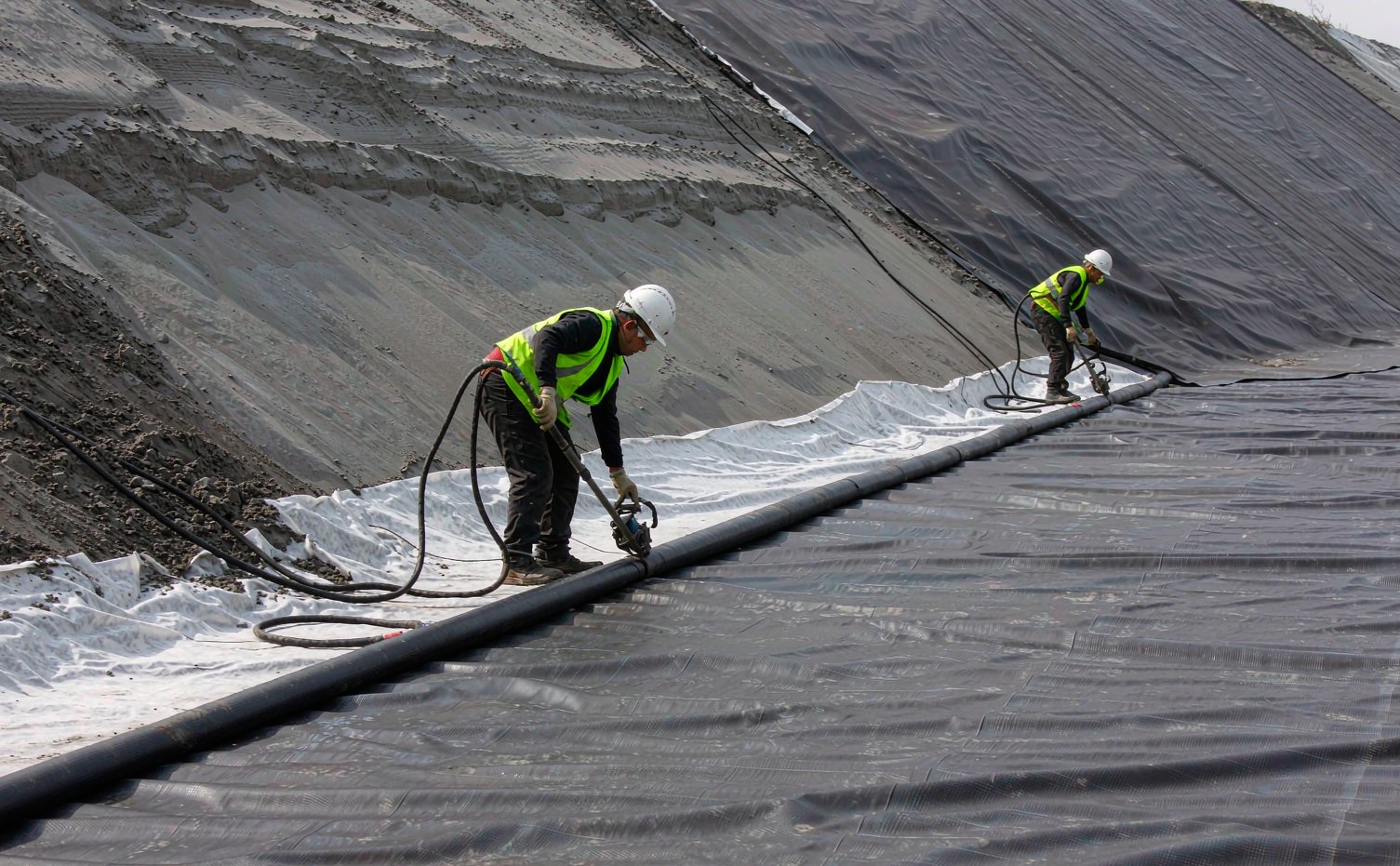
Double liner with leak detection. Used for solution ponds and event ponds: primary geomembrane, then a drainage layer — typically a Tri-planar / bi-planar geonet, optional geotextile lamination — acting as the leak detection and collection layer, then the secondary geomembrane. Any flow collected between the two liners is measured, which turns leakage from an assumption into a number.
Comparing Geomembrane Options for Mining Containment
The table below lines up the liner types a mining project actually chooses between, using our production structures as supplied:
| Liner type | Structure as supplied | Typical role in mining containment | Watch-out |
|---|---|---|---|
| HDPE geomembrane | High-density polyethylene (HDPE), smooth / textured available | Pad base liner, solution and event ponds | Low elongation; needs cushion layer over sharp ore |
| LLDPE geomembrane | Linear low-density polyethylene (LLDPE) | Tailings dams and areas with differential settlement | Lower stiffness means lower chemical margin than HDPE |
| Textured geomembrane | HDPE, textured surface, single-side / double-side | Steep tailings dam faces and pad side slopes | Texturing reduces measured sheet thickness |
| Composite geomembrane | Membrane + nonwoven geotextile (1-side / 2-side) | Puncture-prone pad areas; factory-bonded cushion | Field handling must avoid delamination at roll ends |
| Geosynthetic clay liner (GCL) | Sodium bentonite between woven and nonwoven geotextile | Mineral layer under HDPE in composite systems | Desiccation and cation exchange if left uncovered |
Two practical notes on that table. First, thickness is a specification decision, not a catalogue decision: GRI-GM13 covers smooth and textured HDPE from 0.75 mm to 3.0 mm, and typical heap leach pad specifications land on 1.5 mm (60 mil) for pad bases with 1.5–2.0 mm textured sheet on dam slopes. Second, HDPE and LLDPE are not interchangeable: HDPE gives the chemical margin, LLDPE gives elongation that follows settlement. Choose by which risk the location carries.
Geomembrane Design Checks: Slope Stability and Puncture
Check 1 — veneer stability on a 1V:3H dam slope. The geomembrane slides on the layer beneath it, so interface friction governs. For a 1V:3H slope, β = 18.4° and tan β = 0.333. With a smooth HDPE sheet on a nonwoven geotextile, a typical interface friction angle δ ≈ 22° gives FS = tan 22° / tan 18.4° = 0.404 / 0.333 ≈ 1.21 — below the FS ≥ 1.5 usually required for veneer stability. The same slope with a textured sheet, δ ≈ 32°, gives FS = 0.625 / 0.333 ≈ 1.88, which passes. This is exactly why textured geomembrane exists, and the numbers must be confirmed for your own materials with interface shear testing per ASTM D5321.
Check 2 — base stress and puncture protection. Under that 8 m ore lift the liner sees about 128 kPa. The sheet itself is not the defence; the system is: a smooth, well-graded, proof-rolled subgrade, a cushion geotextile — typically Needle-punched nonwoven (PET / PP) — and then the geomembrane. Verify the cushion with static CBR puncture testing per ASTM D6241 and the sheet with index puncture per ASTM D4833. If the subgrade cannot be cleaned of protrusions, upgrade the cushion rather than the polymer.
Mining Containment Failure Modes and the Tests That Catch Them
| Symptom in service | Root cause | The check that catches it before operation |
|---|---|---|
| Seam peels along weld line | Welding over thermal wrinkles | Trial weld each start-up plus destructive seam testing per ASTM D4437 |
| Stress cracking at anchor trench | Out-of-plane strain at the trench edge | Notched constant-load testing and correct trench geometry |
| Puncture under ore load | Sharp particles, undersized cushion | ASTM D4833 index puncture and ASTM D6241 CBR puncture on the cushion |
| Veneer slides on dam slope | Smooth sheet interface friction too low | ASTM D5321 interface shear with project materials |
| GCL loses seal performance | Desiccation or cation exchange before cover | Flux and permeability index per ASTM D5887; cover promptly |
| Leak at pipe penetrations | Boot detail welded cold or dirty | Vacuum box testing on every extrusion weld |
The pattern in that table: almost no mining liner failure is a polymer failure. It is a seam, a subgrade or an interface problem — all of which are caught by a CQA programme that costs a fraction of a single remediation.
Seam Quality and CQA: How to Verify Before Ore Goes On
- Resin and sheet. Specify to GRI-GM13: thickness per ASTM D5199, tensile properties per ASTM D6693, and oxidative induction time per ASTM D5885 to confirm the antioxidant package survives decades of service.
- Trial welds. Every crew, every start-up, and after any weather change: a trial seam is destructively tested before production welding begins.
- Production seams. Double wedge welds are air-pressure tested along their full length; extrusion welds get vacuum box testing. Destructive peel and shear samples are cut at a set frequency per ASTM D6392, with the seam map kept as the handover record.
- Electrical leak location. After deployment and before ore placement, a leak location survey over the finished pad is now standard practice on major projects — it finds construction damage that visual inspection cannot.
Choosing a Geomembrane for Your Mining Project
- Product range and data sheets — see the full geomembrane product range for HDPE geomembrane, textured geomembrane, composite geomembrane and geosynthetic clay liner options, plus the nonwoven cushion geotextile that completes the system.
- Talk to an engineer — message us on WhatsApp for a same-day technical answer, or email cn8978688@gmail.com with your pad layout, solution chemistry and dam slope.
- Related reading — HDPE Geomembrane for Fish Pond: Thickness and Cost explains how thickness selection works in a lower-consequence setting, and Nonwoven Geotextile as Landfill Liner Protection covers the cushion layer in detail.
GeoTexGrid manufactures smooth and textured HDPE, LLDPE and composite geomembranes with roll widths and lengths cut to pad geometry, supplied with GRI-GM13 conformant property documentation. Send your liner layout and design loads to cn8978688@gmail.com — you will get a confirmed specification and quotation, usually within one working day.
相关文章
Fiberglass Geogrid China Supplier: Mesh and Coat
How to vet a fiberglass geogrid China supplier: mesh size, bitumen vs polymer coating, and the rib-count arithmetic that proves a 30-100 kN/m datasheet.
Woven Geotextile China Manufacturer: Slit Film
A woven geotextile China manufacturer explains slit film tapes, the grab-versus-wide-width trap, and how roll width changes the area you pay for.
Geocell China Manufacturer: Perforation Surface
Perforated or textured walls decide how a geocell drains and grips. A geocell China manufacturer explains wall options, weld QC and checks before order.