
GCL China: Bentonite Clay Liner Specs and QC Tests
作者 GeoTexGrid Engineering Team
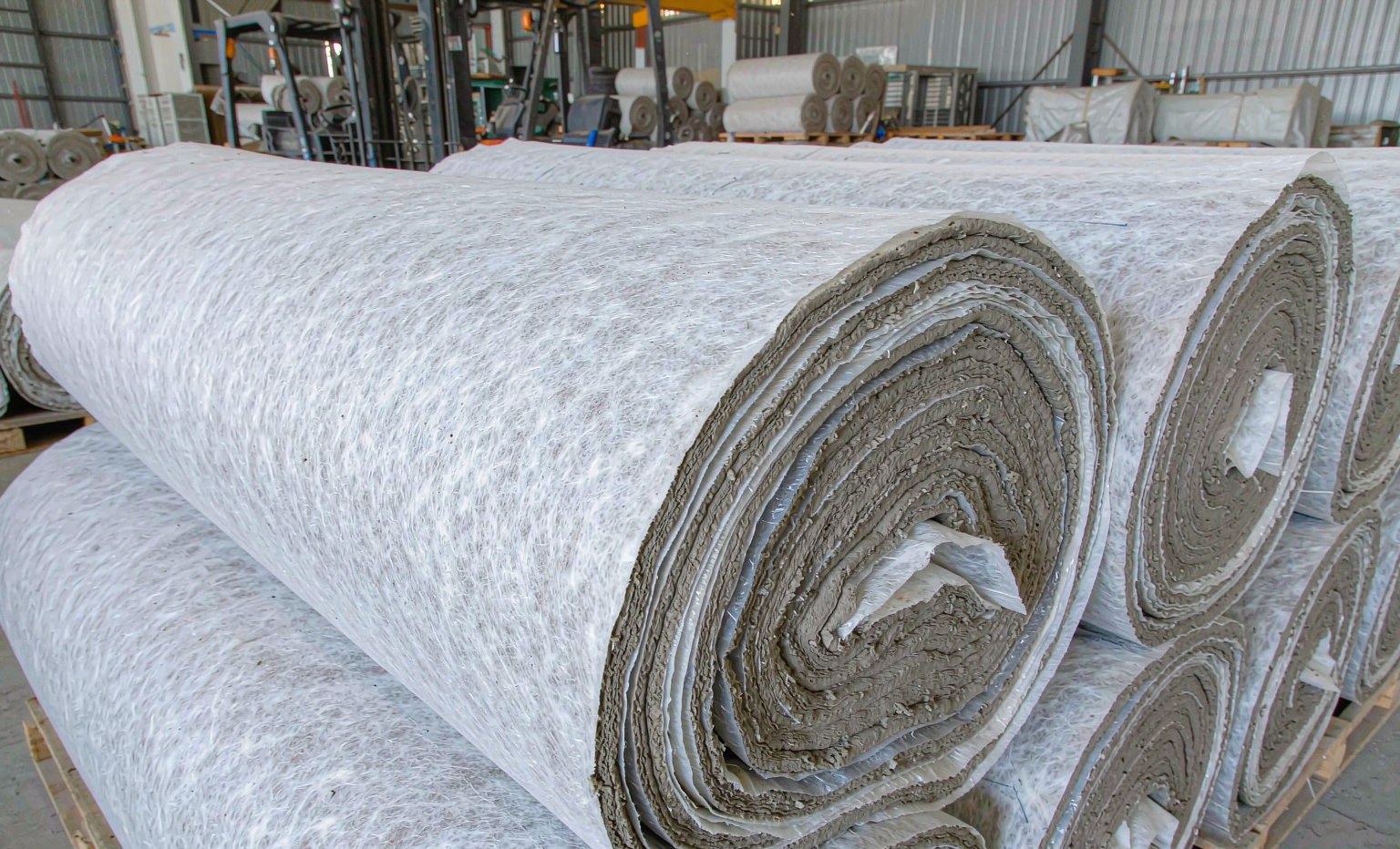
Two suppliers quoted the same canal buyer two very different prices for what both called a bentonite clay liner, and neither offer said how much clay was in the roll. The panel is thin, the clay is invisible, and the gap between a liner that holds twenty years and one that fails in its first wet season hides in a few index tests.
What Is Actually Inside a Bentonite Clay Liner
A geosynthetic clay liner has three parts: Sodium bentonite between woven and nonwoven geotextile. The carrier side, Needle-punched nonwoven (PET / PP), traps clay in its fibre structure so it cannot migrate. The cap side, Woven PP slit film / PET yarn, carries tensile load so the panel does not stretch when a crew drags it. Ours carries Natural sodium bentonite, not activated calcium clay.
That is the difference worth arguing about. Sodium bentonite takes water between its layers and, under confinement, the swollen clay packs into a low-permeability barrier. Calcium bentonite swells weakly and disperses. Both are invoiced as "bentonite" and neither shows in a photograph, so test for it: swell index per ASTM D5890, 24 mL/2 g minimum, and fluid loss per ASTM D5891, 18 mL maximum.
Needle-punching earns its place for the same reason: needles push fibres through the clay core, so the panel has real peel strength (360 N/m minimum average, ASTM D6496) and takes shear on a slope instead of delaminating. And the roll is still not the barrier — the barrier is the gel that forms after the clay hydrates under load.
Which Liner Belongs on Which Job
Most bad GCL specifications I read are geomembrane specs with the product name swapped:
| Liner we supply | Composition | Choose it when |
|---|---|---|
| GCL (bentonite clay liner) | Sodium bentonite between woven and nonwoven geotextile | Clean water containment, canals and ponds, secondary barrier under a membrane, sites where 600 mm of compacted clay will not fit |
| HDPE geomembrane | High-density polyethylene (HDPE), smooth / textured available | Primary barrier for leachate, exposed slopes, welded seams, gas containment |
| LLDPE geomembrane | Linear low-density polyethylene (LLDPE) | Ground that settles and needs elongation rather than stiffness |
| Composite geomembrane | Membrane + nonwoven geotextile (1-side / 2-side) | One pass over the subgrade to get barrier and protection layer together |
A GCL self-seals and gives up chemical resistance: aggressive leachate swaps calcium for the sodium in the clay, the gel collapses, and permeability climbs by orders of magnitude. On hazardous waste, the answer is a composite.
The Batch Tests Behind a GCL China Quotation
A datasheet describes a product family; a batch report describes the material on your pallet. Buying a bentonite clay liner China factory-direct should get you the second one, tied to the lot number in the container:
| Test | What it proves | Value we work to |
|---|---|---|
| ASTM D5890 | Swell index of the clay | 24 mL/2 g minimum |
| ASTM D5891 | Fluid loss of the clay | 18 mL maximum |
| ASTM D5993 | Bentonite mass per unit area | 3.7 kg/m² clay inside a 4.0 kg/m² panel, dry |
| ASTM D5887 | Index flux of the hydrated liner | 1 × 10⁻⁸ m³/m²/s maximum |
| ASTM D6496 | Peel strength, needle-punched products | 360 N/m minimum average |
| ASTM D6768 | Tensile strength, machine direction | 4.0 kN/m minimum |
| ASTM D6243 | Hydrated internal and interface shear | Reported; sets your max slope |
Mass per unit area is what gets quietly reduced. This market quotes GCL by total mass — 4,000, 4,800 and 6,000 g/m² are the usual grades — so ask for the bentonite mass, not the panel mass. A "4,000 g/m²" panel carrying 3.0 kg of clay passes a glance and fails the clay. We test to GB/T 17643 on our own line and to the ASTM methods above on request, and both reports travel with the shipment.
Laps, Roll Weight and Container Maths
GCL is cheap per square metre and expensive per kilogram of freight, so the take-off decides whether a quote works. Take a 20,000 m² cell, 200 m × 100 m, in 5.0 m panels:
| Item | Arithmetic | Result |
|---|---|---|
| Longitudinal laps at 300 mm | 39 laps × 0.30 m × 200 m | 2,340 m² extra, about 11.7% of the order |
| Same cell, laps cut to 150 mm | 39 laps × 0.15 m × 200 m | 1,170 m² extra, about 5.9% |
| Panel mass | 5.0 m × 40 m = 200 m² at 4.0 kg/m² | 800 kg per roll |
| One 40 ft high-cube, 26 t payload | 26,000 kg ÷ 800 kg | 32 rolls, roughly 6,400 m² |
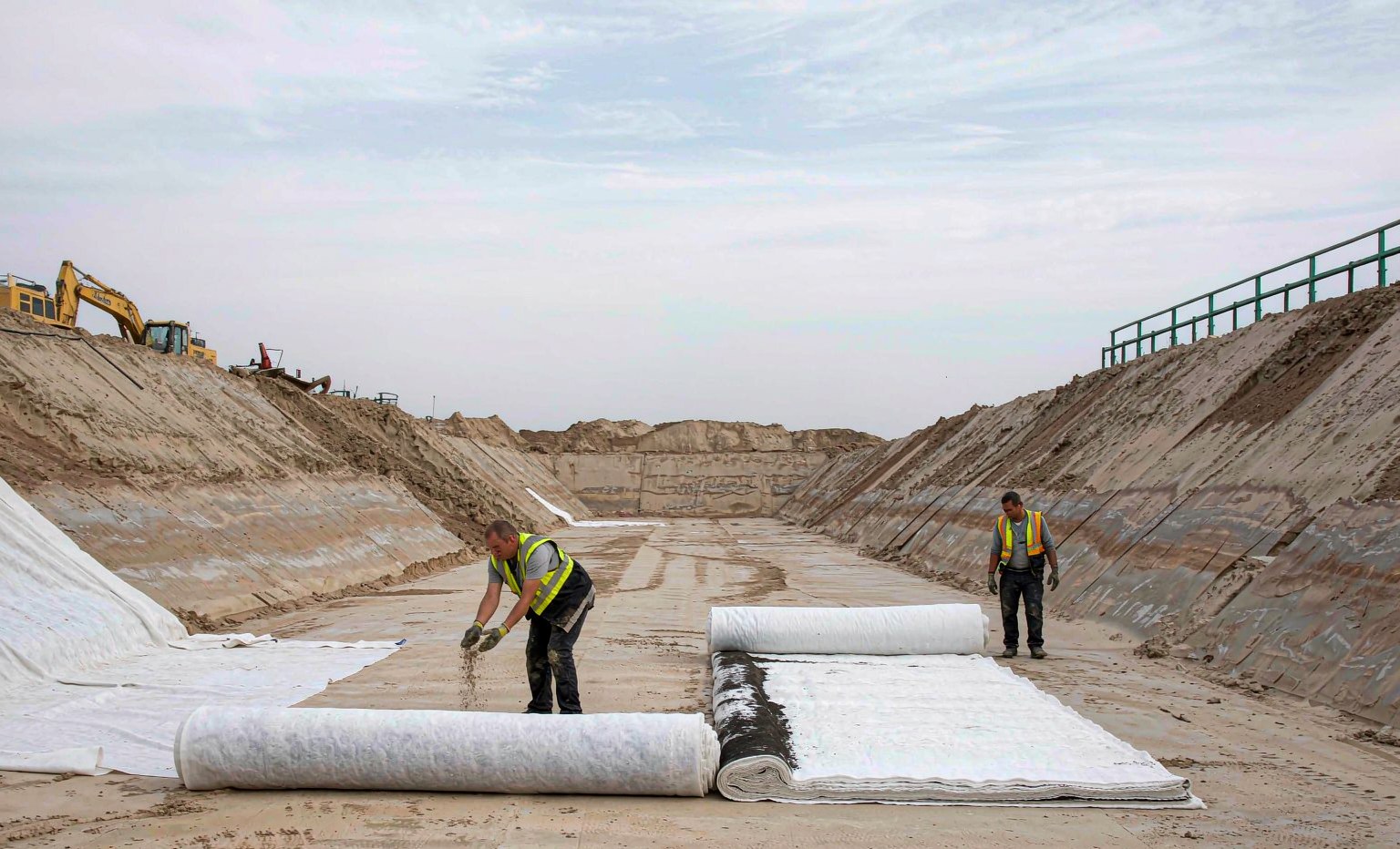
Halving the lap saves 1,170 m² on paper, and buyers try it. On a slope, or under more than about 300 mm of head, keep the 300 mm lap and work 300–500 g of granular bentonite per metre of lap into the seam. Seam leakage, not panel permeability, fills most failure reports.
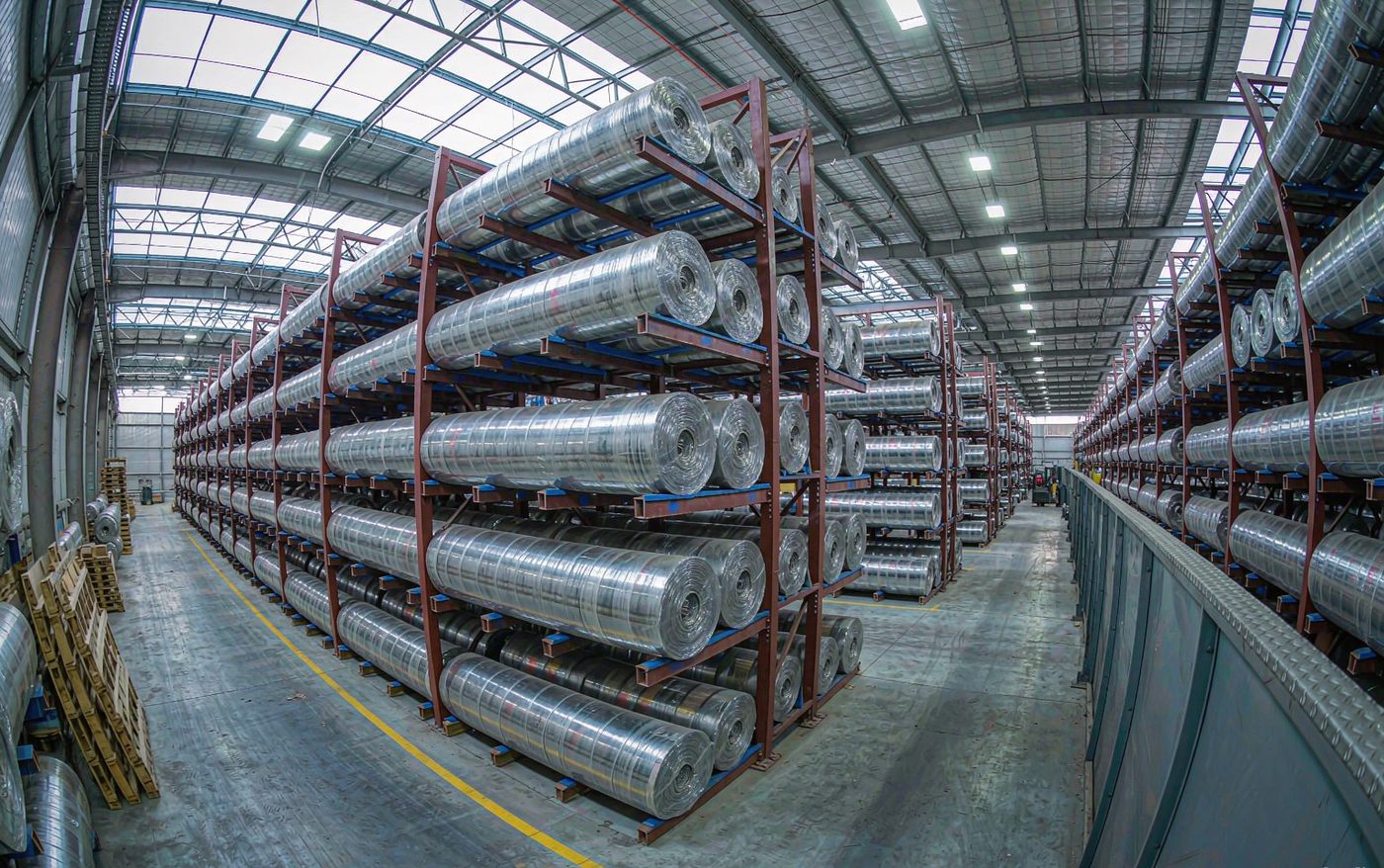
That container figure is the commercial story: a 40 ft high-cube carries about 6,400 m², which sets the minimum order quantity and why a 2,000 m² job pays painful freight per square metre. Most buyers consolidate GCL, geotextile and geogrid on one pallet schedule out of one source factory instead — one container, not three.
For scale, a 600 mm compacted clay liner at 1.8 t/m³ puts 1,080 kg of borrow clay on every square metre; a 4.0 kg/m² GCL puts four kilograms there, so the same cell drops from roughly 830 truckloads of hauled clay to three loads of rolls. You are trading a soil layer for a ten-millimetre product that works only while the clay stays hydrated and confined.
Be straight about flux too: that 1 × 10⁻⁸ m³/m²/s ceiling is a per-lot production check at low confining stress, not a design permeability.
How a Bentonite Clay Liner Fails
Almost every GCL problem I get photos of is one of six things:
| What you see | What actually failed | Fix on the next job |
|---|---|---|
| Seepage along a straight line, panels intact | Lap opened, or no granular bentonite in the seam | 300 mm laps with granular bentonite; stagger roll ends |
| Bentonite washed out along a panel edge | Panel left open and rained on before it hydrated | Cover the same shift |
| Laboratory flux comes back high | Calcium bentonite blended in, or low clay mass | Require per-lot swell index and clay mass |
| Performance drifts down over a season | Cation exchange from high-calcium water or leachate | Run ASTM D6766 compatibility; membrane above the GCL |
| Punctures that never self-seal | Dry core, or angular rock under the panel | Screed the subgrade, cap protrusions at 12 mm |
| Panel tears at the toe of a slope | Shear at low normal stress, steeper than D6243 allows | Get the shear report before going steeper than 4H:1V |
Four of those six are installation discipline, not material.
Buying a GCL China Source Factory Direct
Three questions separate a real source factory from a trading desk, and none is about price. Can they state the bentonite mass per square metre with the D5993 result for that lot? Are swell index and fluid loss routine batch values rather than paid extras? Can they wind a custom width and length — Roll Width and Roll Length are set per order — so the site gets the lap count it designed?
Buying a bentonite clay liner China direct answers all three in one conversation, because the clay is weighed, needled and wound on the same floor that issues the report. Our geosynthetic clay liner China pricing is ex-works per square metre by mass grade, clay named as the cost driver. If the project also needs a landfill liner China grade, a protection geotextile or a geogrid above the clay, one container absorbs it: one load, one set of reports.
Where to Go Next
- Specification data — the GCL bentonite clay liner page lists clay type, roll options and the test method behind each value
- Talk to an engineer — send area, water chemistry and cover thickness on WhatsApp for a same-day answer, or email cn8978688@gmail.com for batch test values and a lap plan.
- Related reading — Nonwoven Geotextile as a Landfill Liner Protection Layer covers the cushion above the clay.
We manufacture GCL, geomembrane and geotextile on our own lines in China and quote factory direct, so clay grade, roll size, MOQ and container loading are settled in one reply. Send your drawing and the water chemistry to cn8978688@gmail.com or on WhatsApp.
相关文章
Fiberglass Geogrid China Supplier: Mesh and Coat
How to vet a fiberglass geogrid China supplier: mesh size, bitumen vs polymer coating, and the rib-count arithmetic that proves a 30-100 kN/m datasheet.
Woven Geotextile China Manufacturer: Slit Film
A woven geotextile China manufacturer explains slit film tapes, the grab-versus-wide-width trap, and how roll width changes the area you pay for.
Geocell China Manufacturer: Perforation Surface
Perforated or textured walls decide how a geocell drains and grips. A geocell China manufacturer explains wall options, weld QC and checks before order.