
Geomalla para vías de acarreo en minería: guía de especificación
Por GeoTexGrid Engineering Team
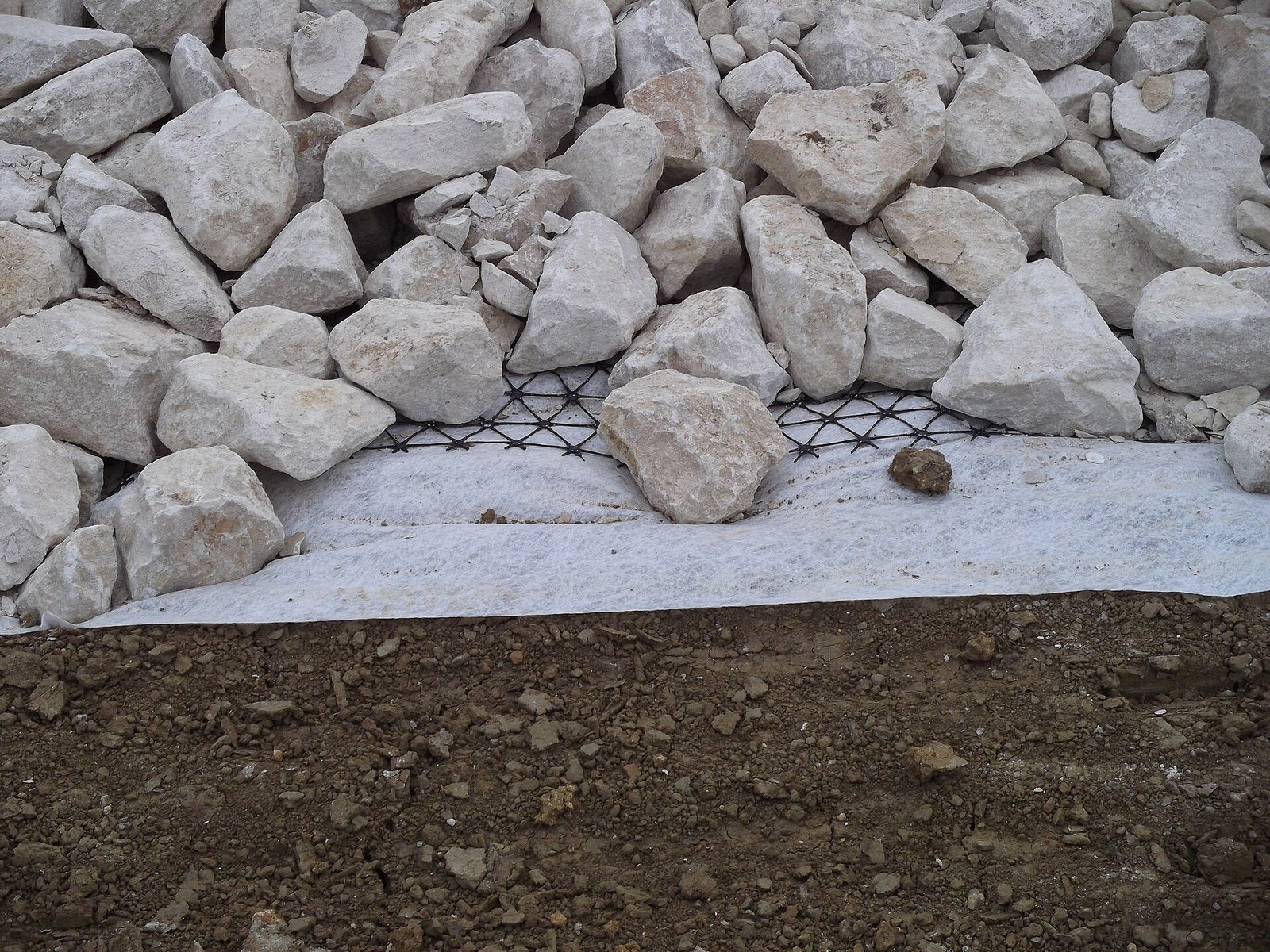
Mining haul roads are the harshest pavements anyone builds: loaded trucks in the 200–400 t payload class, tyre contact pressures several times a highway wheel load, subgrades that are often just placed waste or weathered rock, and a service life measured in decades of continuous production. A geogrid for mining haul roads has to survive installation, interlock with the base aggregate and hold the section together over ground a highway crew would never accept. This guide works through the specification with real numbers: tensile grade, aperture versus aggregate, and a base thickness check on a soft CBR 3 alignment.
Photo: Wikimedia Commons contributor, Wikimedia Commons, CC BY 3.0
What a Geogrid Has to Do on a Haul Road
Three mechanisms do the work, and each one is specified with a different number:
- Lateral restraint through interlock. Confined base aggregate wants to shear sideways under every loaded pass. A geogrid with the right aperture locks the stones in place, so the base behaves as one constrained layer. The controlling properties are aperture against your aggregate gradation and rib tensile strength, tested per ASTM D6637 (multi-rib, reported at 2% and 5% strain).
- Tensioned membrane over soft ground. On a CBR 2–3 subgrade the surface deflects between wheel paths; a stiff geogrid in tension carries part of that load and cuts the stress reaching the subgrade.
- Separation at the subgrade interface. Stopping fines migrating up into the base is the job of a geotextile — on most haul roads a nonwoven fabric meeting the separation requirements of AASHTO M288 geotextile classes.
Geogrid for Mining Haul Roads: Selection Table
The three products below come from the GeoTexGrid range; all values are taken directly from our data sheets:
| Product | Tensile strength | Aperture / mesh | Elongation | Roll width | Coating |
|---|---|---|---|---|---|
| Steel-Plastic Biaxial Geogrid | 30–150 kN/m | 12.7mm / 25.4mm / 38.1mm | — | 1.0 – 3.0 m (custom) | HDPE / LDPE |
| Steel-Plastic Uniaxial Geogrid | 50–300 kN/m | Custom (≥ 100mm) | — | 1.0 – 2.0 m | HDPE |
| Fiberglass Geogrid | 30–100 kN/m | 12.7mm / 25.4mm | ≤ 4% | 1.0 – 2.0 m | Bitumen / Polymer |
How to read it for a haul road:
- Steel-plastic biaxial is the default for the running surface base. Its strength works in both directions, the 25.4mm and 38.1mm meshes suit crushed base aggregate, and the polymer coating isolates the steel core from moisture. Roll widths up to 3.0 m mean fewer transverse laps on a wide dual-carriageway haul section.
- Steel-plastic uniaxial (50–300 kN/m, see the product page) belongs where load is concentrated in one direction: dump-wall ramps, embankment fills over soft ground and pit-edge high fills.
- Fiberglass geogrid is an asphalt-bound-layer product. Its ≤ 4% elongation suits a bound surfacing, but an unbound base strains far more than 4% on soft ground, so fiberglass belongs on permanent sealed ramps and paved intersections, not on the unbound running surface.
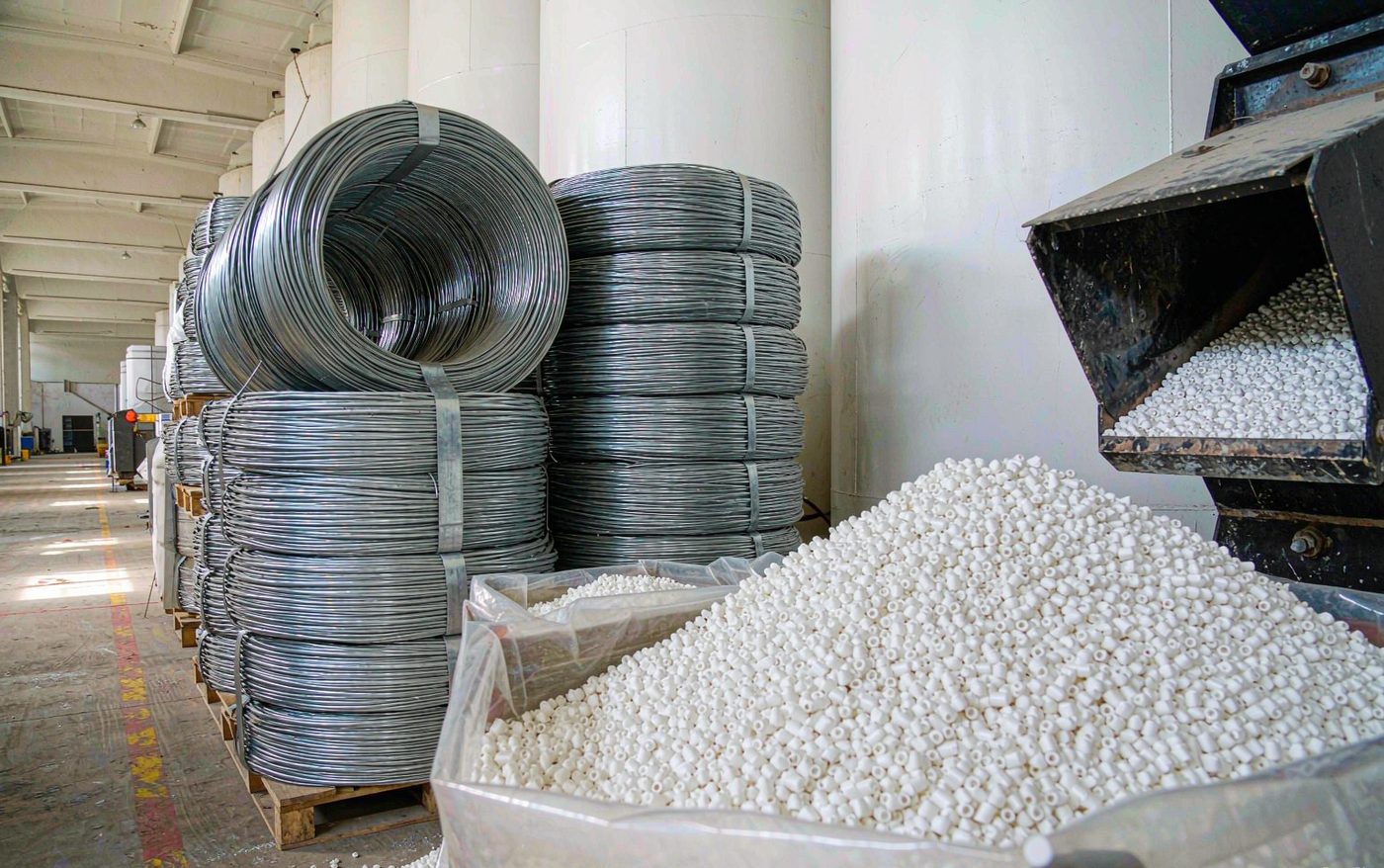
The steel core and polymer coating are what make the steel-plastic system work in wet pit conditions — this is the raw material that goes into it:
Aperture, Aggregate and the Interlock Check
Interlock is a geometry match, and it is checkable before any order is placed:
- Take the D50 of your base aggregate (the sieve size half the material passes).
- A practical starting rule used in haul road detailing is an aperture in the range of roughly 1–3 × D50 — small enough that particles cannot punch through and pump, large enough that the stone seats into the openings instead of riding on top.
- Worked example: crushed base course with D50 = 12 mm calls for an aperture of roughly 15–35 mm → the 25.4mm mesh is the fit; a coarser pit-run base with D50 = 20 mm pushes the range to 20–60 mm → the 38.1mm mesh is the safer choice.
Two boundary failures: an aperture far larger than the rule lets fines pump up under traffic until the base loses density; an aperture far smaller means the stone rides on top of the grid and the restraint you paid for never engages.
From Tensile Strength to Long-Term Design Strength
Do not order against the front-page number. A data-sheet tensile strength is a short-term ultimate value; the design uses a reduced allowable:
T(design) = T(ultimate) / (RF creep × RF installation damage × RF junction × RF durability)
Worked example on the top grade of our steel-plastic biaxial range, with factors assumed for a permanent haul road (your project factors may differ):
- T(ultimate) = 150 kN/m (wide-width, per ASTM D6637; European projects request the equivalent ISO 10319 wide-width method)
- RF creep = 2.0, RF installation damage = 1.3, RF junction = 1.1, RF durability = 1.1
- T(design) = 150 / (2.0 × 1.3 × 1.1 × 1.1) ≈ 47.6 kN/m
The acceptance check is then concrete: the grid you order must show a published ultimate tensile strength of at least the design demand times the same factors, with long-term design strength following a documented procedure such as GRI-GG4. If a supplier cannot produce the D6637 multi-rib report at 2% and 5% strain, the front-page number is a claim, not a specification. Send your design demand to cn8978688@gmail.com and we will match it to a grade with the test data to back it.
Base Thickness Check on a CBR 3 Subgrade
This is the calculation that pays for the geogrid. Take a typical project condition: subgrade CBR = 3, a dual-lane section with an 8 m running width, and a first-pass unreinforced granular requirement of 600 mm (from your pavement model — the value below is only an illustration).
- Reinforced section: with a steel-plastic biaxial geogrid at the subgrade/base interface and a separator geotextile beneath it, typical practice for unpaved heavy-access roads is to hold 20–40% of the unreinforced thickness. Assume 33% here → 400 mm of base instead of 600 mm.
- Aggregate saving: 200 mm × 8 m × 1,000 m = 1,600 m³ of material per kilometre that is never quarried, hauled or compacted.
- The saving compounds: fewer truck cycles on the very road you are building, and less subgrade churn during construction.
Two details decide whether this works in the field: the separator must survive stone placement (check ASTM D6241 static CBR puncture against your aggregate sharpness), and the laps must be detailed — on firm ground a 300–450 mm untied lap is common practice, but on CBR < 3 ground tie the laps or widen the rolls so laps fall outside the wheel paths.
Haul Road Failure Modes: A Diagnostic Table
Every symptom below traces back to one specification decision:
| Symptom on the road | Mechanism | What to verify |
|---|---|---|
| Deep longitudinal ruts along the wheel paths | Base aggregate shears laterally and punches into the subgrade | Aperture vs D50 interlock; rib tensile per ASTM D6637 |
| Grid sheets separate at the laps | Lap too short, or laps landed in the wheel paths | Roll width (1.0 – 3.0 m (custom)) and lap detailing |
| Junctions shear or ribs rupture in year one | Design strength overdrawn — reduction factors never applied | Long-term design strength per GRI-GG4 |
| Coating cut through, steel core exposed | Sharp angular rock plus tracked plant on bare grid | Coating (HDPE / LDPE) integrity and placement method |
| Fiberglass grid delaminates in the unbound base | Bound-layer product used where strains exceed its range | Elongation ≤ 4% suits bound layers only |
The last row is the most common cross-ordering mistake in quotations — the grid was not wrong, just specified for the wrong layer.
Where to Go Next: Specifying Your Haul Road Geogrid
- Product range and data sheets — start with the steel-plastic biaxial geogrid for unbound base sections and the steel-plastic uniaxial geogrid for ramps and embankments, or browse the full geosynthetics product range for the separator geotextiles that pair with them.
- Talk to an engineer — message us on WhatsApp for a same-day technical answer, or email cn8978688@gmail.com. Send the subgrade CBR, aggregate gradation and design wheel load — you will get a confirmed specification and quotation, usually within one working day.
- Related reading — Biaxial Geogrid for Road Base Reinforcement covers the paved-road version of this design, and How Geogrid Reduces Aggregate Thickness quantifies the cost side of the same mechanism.
GeoTexGrid manufactures steel-plastic biaxial and uniaxial geogrids from 30 kN/m to 300 kN/m with ASTM D6637 test reports available for project submittals. Send your section drawing and design loads — we will return a confirmed specification with roll sizes matched to your layout.
Artículos relacionados
Fiberglass Geogrid China Supplier: Mesh and Coat
How to vet a fiberglass geogrid China supplier: mesh size, bitumen vs polymer coating, and the rib-count arithmetic that proves a 30-100 kN/m datasheet.
Woven Geotextile China Manufacturer: Slit Film
A woven geotextile China manufacturer explains slit film tapes, the grab-versus-wide-width trap, and how roll width changes the area you pay for.
Geocell China Manufacturer: Perforation Surface
Perforated or textured walls decide how a geocell drains and grips. A geocell China manufacturer explains wall options, weld QC and checks before order.