
Geotextile vs Geomembrane: Which One Fits Your Design?
بقلم GeoTexGrid Engineering Team
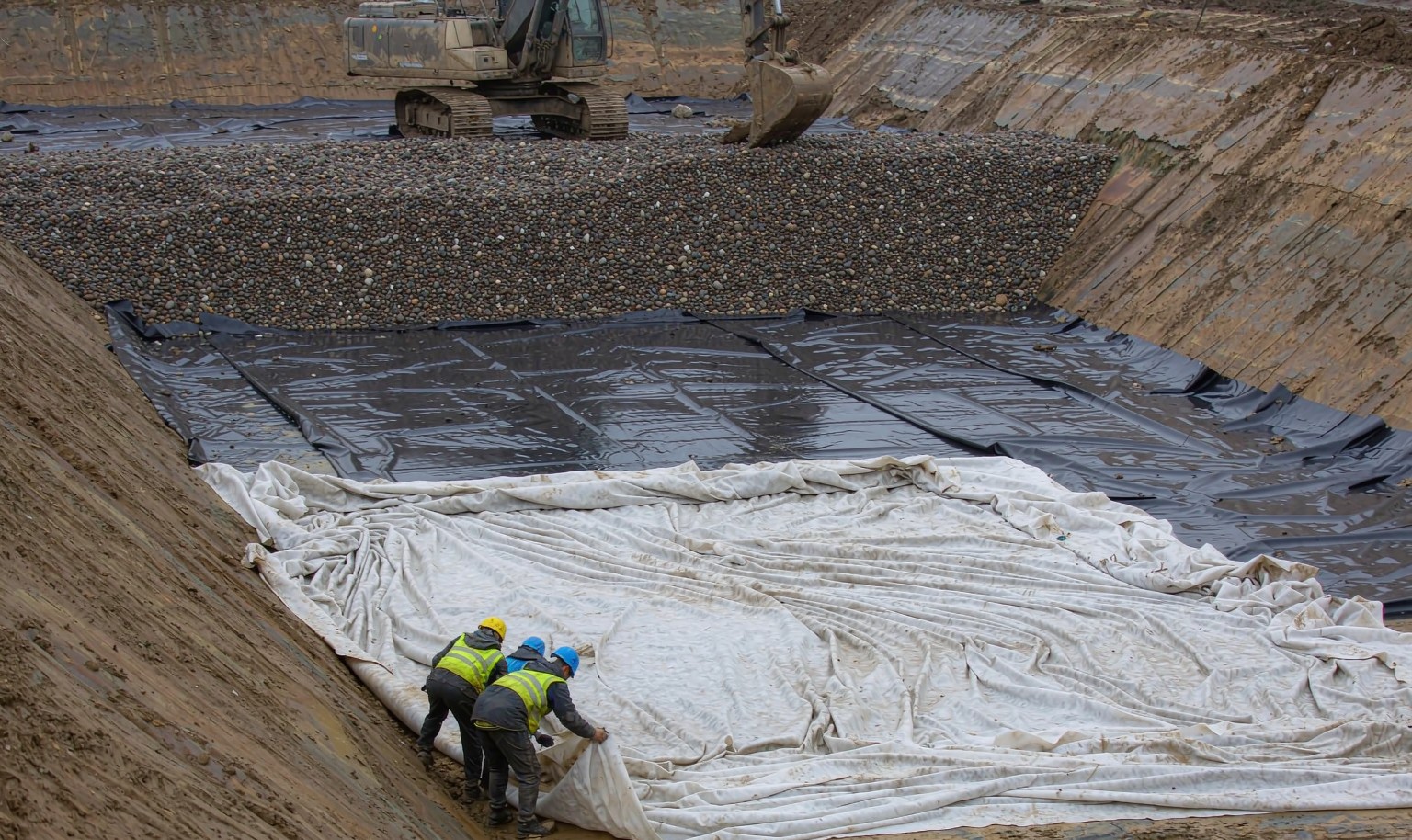
Choosing between a geotextile and a geomembrane is a statement about water: one material lets water move through it while holding soil back, the other stops water entirely. Get the geotextile vs geomembrane decision wrong at the specification stage and no amount of good installation work will recover it — a filter that seals becomes a drainage failure, and a barrier that weeps becomes an environmental liability.
What Separates a Geotextile From a Geomembrane
The difference is hydraulic, and it spans about ten orders of magnitude:
- Geotextiles are permeable. Needle-punched or woven fabrics pass water at roughly 10⁻⁴ to 10⁻³ m/s, measured as permittivity (typically 0.1–1.5 s⁻¹) under ASTM D4491. Their jobs are filtration, separation, drainage and puncture protection.
- Geomembranes are barriers. HDPE sheet passes on the order of 10⁻¹³ m/s — effectively nothing. Their job is containment: water, leachate, slurry or gas stays on one side.
- Both are usually present in the same structure. The mistake is not using them together; it is writing one where the other belongs, or assuming a fabric can hold liquid because it "looks solid."
A quick sanity check on your own drawing: follow the water. If it has to enter the material and leave again clean, you need a geotextile. If it must never cross the line, you need a geomembrane.
Geotextile vs Geomembrane: Product Lines Compared
Here are the two families side by side, using the specifications we actually supply. The materials and build descriptions below are the ones that appear on our data sheets — they are the numbers to design against, not generic textbook ranges.
| Family | Product | Supplied structure | Primary function | Design tests |
|---|---|---|---|---|
| Geotextile | Nonwoven geotextile | Needle-punched nonwoven (PET / PP) | Filtration, separation, drainage, liner cushion | ASTM D4751 (AOS), ASTM D4491 (permittivity) |
| Geotextile | Woven geotextile | Woven PP slit film / PET yarn | Separation with high wide-width strength | ASTM D4595, ASTM D4632 |
| Geotextile | PET filament geotextile | Polyester (PET) continuous filament | Long-life filtration in permanent works | ASTM D4595, ISO 10319 |
| Geomembrane | HDPE geomembrane | High-density polyethylene (HDPE) — Smooth / textured available | Watertight containment of liquid or leachate | ASTM D5199 (thickness), GRI-GM13 |
| Geomembrane | LLDPE geomembrane | Linear low-density polyethylene (LLDPE) | Containment over irregular or settling ground | ASTM D5199, ASTM D6392 (seams) |
| Geomembrane | Composite geomembrane | Membrane + nonwoven geotextile (1-side / 2-side) | Containment with built-in cushion and drainage | ASTM D4833, ASTM D4437 |
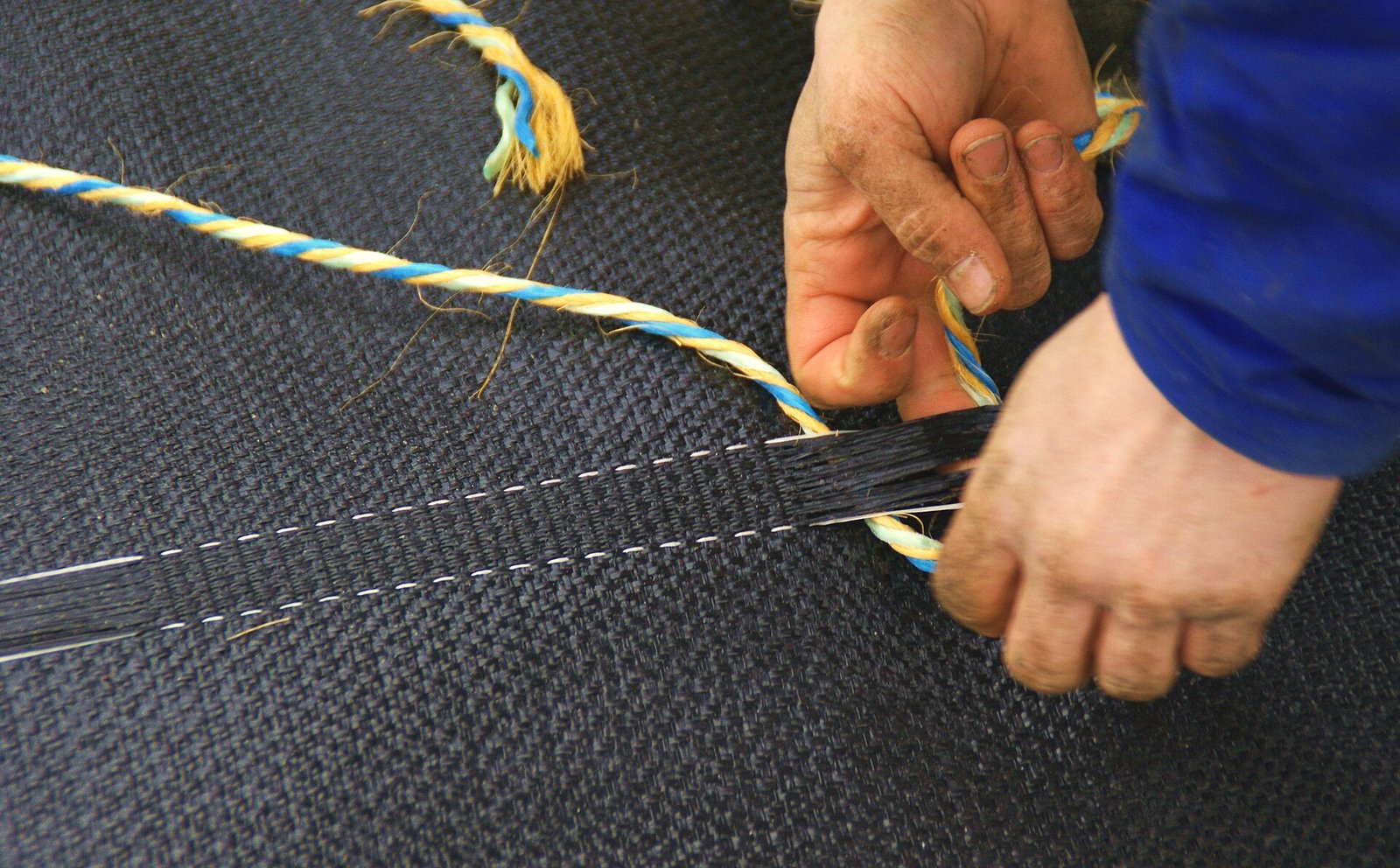
Photo: Wikimedia Commons contributor via Wikimedia Commons, CC BY-SA 4.0
One line deserves attention: Polypropylene (PP) nonwovens and Polyester (PET) continuous filament fabrics sit in the same family but behave differently over decades. PP suits short-life separation and drainage; PET holds its strength where design life is measured in decades.
Does the Water Have to Pass? The First Design Question
Everything downstream of this question is a detail. Ask it in this order:
- Must liquid be contained? Then the primary material is a geomembrane, and any geotextile is the cushion or drainage layer around it. Thickness, puncture resistance and seam integrity govern.
- Must liquid pass while soil is held? Then the primary material is a geotextile, and the governing properties are opening size and permittivity, not tensile strength.
- Is it both a filter and a container? Then the two are stacked, and the sequence matters: fabric outside the barrier for cushioning and drainage, barrier in the middle for containment.
When Both Materials Go Into One Build
Layered systems are the norm in lined containment — a liner with a needle-punched cushion above and below, plus a drainage net to collect what percolates. Those rules differ from a single-material spec and we cover them separately: see how a nonwoven geotextile protects a geomembrane liner against gravel and compaction traffic, and how a composite geomembrane with one-side versus two-side lamination folds barrier and cushion into a single roll.
Sizing a Geotextile Filter: Retention Governs, Not Permeability
New specifiers expect permeability to be the tight criterion in a filter. The arithmetic shows it rarely is.
Step 1 — retention (this is the binding check). The usual criterion is O95 ≤ 2 × D85 of the soil being retained, verified as AOS under ASTM D4751. For a silty sand with D85 = 0.20 mm, the requirement is AOS ≤ 0.40 mm. Cross-check against AASHTO M288, which permits up to 0.43 mm AOS for high-fines soils while requiring higher permittivity (up to 0.5 s⁻¹): 0.40 < 0.43, so a medium-weight nonwoven passes both.
Step 2 — permeability (almost always satisfied). Take a needle-punched nonwoven (PET / PP) with permittivity ψ = 0.5 s⁻¹ and a design head of Δh = 0.3 m. The flow it will pass is ψ × Δh = 0.15 m/s across each square metre of fabric — roughly 150 L/s per m². A drain design collecting 1 × 10⁻⁴ m³/s is three orders of magnitude below that capacity.
Step 3 — the contrast with the membrane. The same fabric has a coefficient of permeability near 1 × 10⁻³ m/s (k = ψ × t), against 10⁻¹³ m/s for HDPE sheet — ten orders of magnitude, and the reason these two materials are never interchangeable, however similar they look on a pallet.
Specifying a Geomembrane: Where the Numbers Change
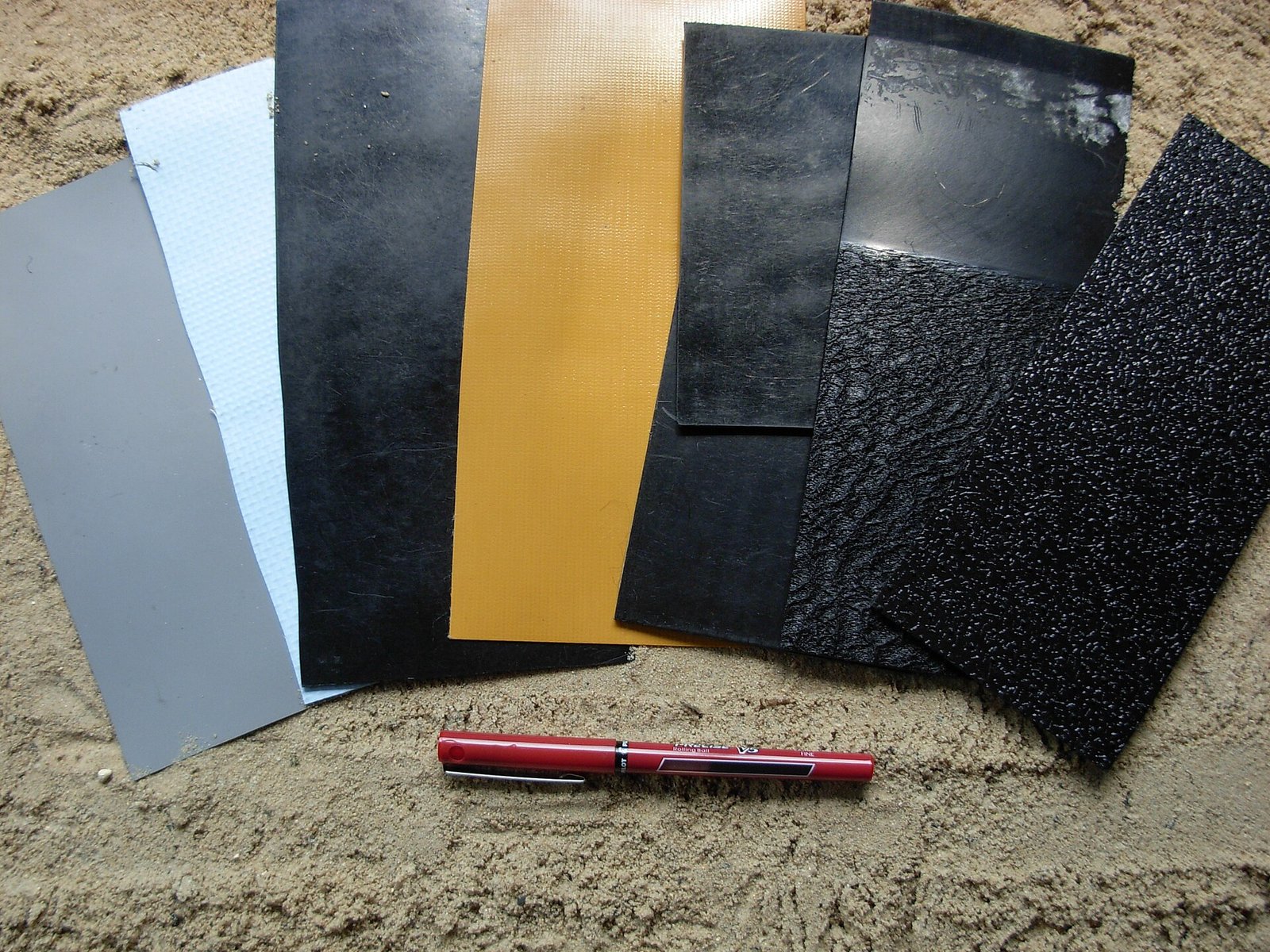
On the barrier side, the governing properties have nothing to do with flow:
- Thickness and mass per area. Sheet is specified by thickness under ASTM D5199 — 1.0 mm, for example, which in HDPE at a density of about 0.94 g/cm³ works out to 0.94 kg/m². Mass per area drives both cost and puncture resistance.
- Surface. Smooth sheet is standard on flat bases; where the liner sits on a face, HDPE, textured surface grades with Single-side / double-side texturing raise the interface friction so the sheet does not creep downhill.
- Seams. A membrane is a set of welded panels, so seam strength is part of the specification, not a contractor detail. Specify trial seams and field testing under ASTM D4437 for non-destructive continuity and ASTM D6392 for seam strength, and follow GRI-GM13 where the project requires it.
- Defects. Where the material is a barrier, one pinhole is a leak. Vacuum-box or spark testing of every seam is normal practice — something a filter fabric never needs.
Failure Modes and Which Property to Check
When a structure misbehaves, the symptom usually points back to the property that was never specified:
| Symptom on site | Underlying cause | Property to check | Reference test |
|---|---|---|---|
| Water ponds on the upstream side of the fabric | Permittivity too low for the soil's fines content | Permittivity (0.1–0.5 s⁻¹ range by fines content) | ASTM D4491 / AASHTO M288 |
| Fines migrate through and blind the drain | Opening size too coarse for the soil | AOS (O95) against D85 of the soil | ASTM D4751 |
| Barrier punctured under cover gravel | Cushion missing, or sheet too thin for the load | CBR puncture resistance; sheet thickness | ASTM D6241 / ASTM D5199 |
| Leak traced to a panel joint | Weld defect or contaminated seam | Seam shear and peel strength | ASTM D4437 / ASTM D6392 |
| Liner creeps down a slope face | Smooth sheet on the critical interface | Interface friction (δ) on the real soil–liner contact | ASTM D5321 |
| Fabric torn during placement | Grab strength below installation loads | Grab tensile | ASTM D4632 |
Read the first two rows together and the pattern shows: geotextile failures are retention or permeability errors, catchable with a soil gradation curve and two test certificates, while geomembrane failures are construction-quality issues rather than material-grade issues.
Where to Go Next
- Product range and data sheets — compare the nonwoven geotextile and HDPE geomembrane lines, or look at a composite geomembrane if your build needs containment and cushion in one roll. The full geosynthetics product range lists roll widths and grades.
- Talk to an engineer — send your cross-section and either a soil gradation curve (for a filter) or your containment volume and slope (for a liner) on WhatsApp, or email cn8978688@gmail.com for a same-day technical answer.
- Related reading — AASHTO M288 Geotextile Classes Explained breaks down the class table behind the permittivity check above, and Nonwoven vs Woven Geotextile settles the choice once you know a geotextile is the right family.
GeoTexGrid manufactures both families — needle-punched and woven geotextiles, HDPE and LLDPE geomembranes, and laminated composites — so the recommendation follows your design conditions rather than what happens to be in stock. Send your drawings and design loads for a confirmed specification and quotation, usually within one working day.
مقالات ذات صلة
Fiberglass Geogrid China Supplier: Mesh and Coat
How to vet a fiberglass geogrid China supplier: mesh size, bitumen vs polymer coating, and the rib-count arithmetic that proves a 30-100 kN/m datasheet.
Woven Geotextile China Manufacturer: Slit Film
A woven geotextile China manufacturer explains slit film tapes, the grab-versus-wide-width trap, and how roll width changes the area you pay for.
Geocell China Manufacturer: Perforation Surface
Perforated or textured walls decide how a geocell drains and grips. A geocell China manufacturer explains wall options, weld QC and checks before order.