
Geogrid for Container Yards: Base and Load Guide
作者 GeoTexGrid Engineering Team

A container yard is not a road with heavier trucks. It is a warehouse without a roof, and the loads arrive from two directions that behave nothing alike.
Geogrid enquiries for port pavements usually reach us as a drawing, an area and a price per roll. The two numbers that decide the specification — stack height and RTG corner load — are usually missing. Get them wrong and you either pay for strength the pavement never uses, or under-build the layer that keeps the base aggregate from walking away under a 30-tonne wheel.
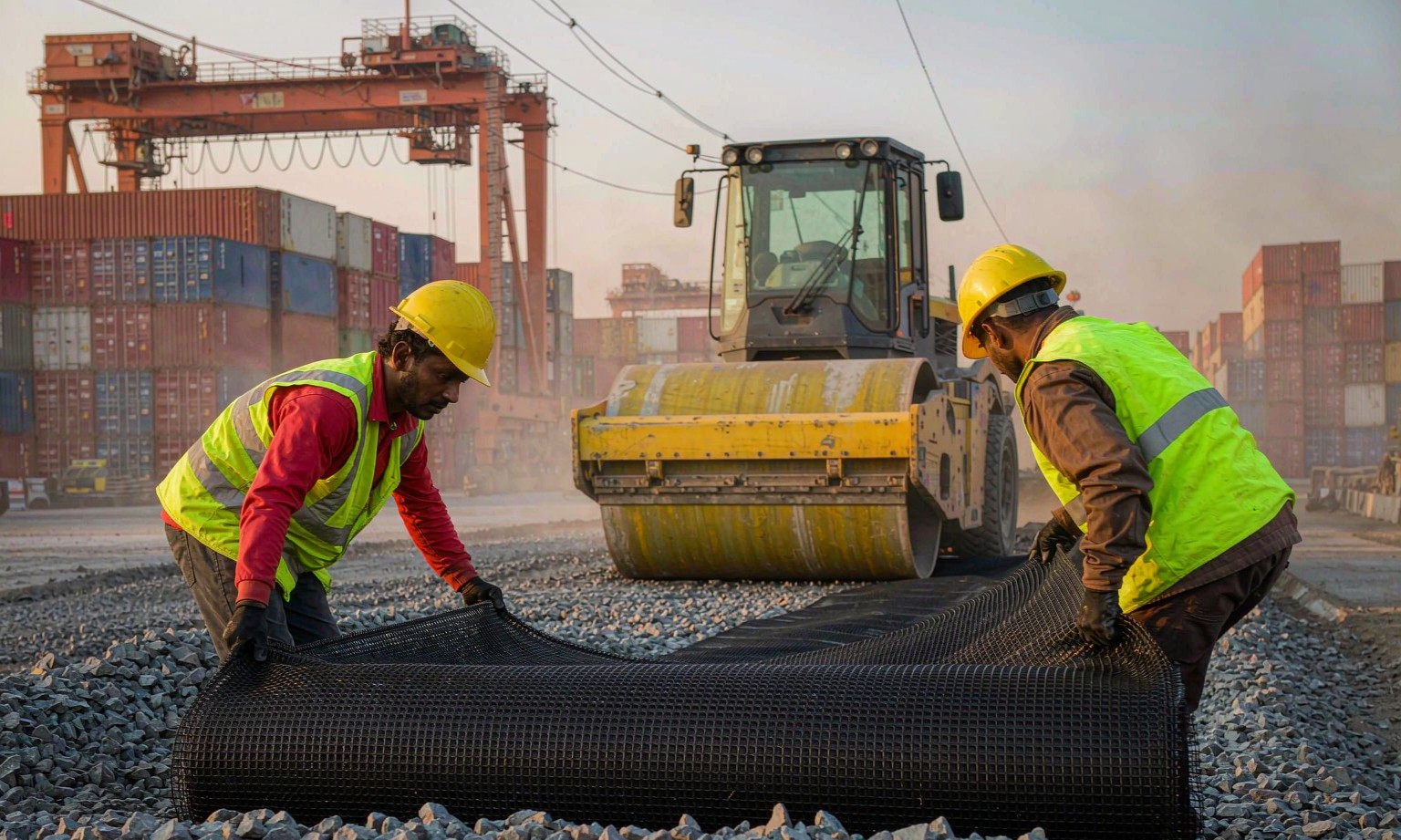
Two Load Cases Decide a Container Yard Pavement
The first is the area load. An ISO 668 forty-foot container at maximum gross mass weighs 30,480 kg on a footprint of 12.192 m × 2.438 m — 29.72 m². One tier presses 10.1 kPa into the surface; six tiers, a normal empty stack, is 60.4 kPa held there all year. A twenty-foot box at the same gross mass sits on half the footprint, so three tiers of 20 ft nearly match six of 40 ft.
The second is the wheel. A rubber-tyred gantry crane typically carries 25 to 35 tonnes on a corner — confirm the figure with your crane supplier. Take 30 t. At a tyre contact pressure around 1.0 MPa the patch is roughly 0.29 m², about 0.54 m square. That is 1,000 kPa at the surface, sixteen times the stack pressure.
Two loads, two failure pictures: the stack squeezes the subgrade slowly and shows up as settlement at the corner castings; the wheel shears the base sideways in half a second and shows up as a rut down the RTG lane.
| Load case | Surface pressure | After 0.6 m of base (2:1 spread) | What it does to the yard |
|---|---|---|---|
| 40 ft stack, 6 high, ISO 668 max gross | 60.4 kPa | 46 kPa | slow settlement at corner castings |
| 20 ft stack, 3 high, same gross mass | 60.7 kPa | 44 kPa | same pressure at half the height |
| RTG corner load, 30 t | 1.0 MPa tyre contact | 226 kPa | rutting and shear in the base |
What the Numbers Say After 0.6 m of Base
Run both through a simple 2:1 spread — not a design method, but honest enough for sizing — and the difference gets brutal.
The six-high stack spreads from 29.7 m² to 38.9 m² through 0.6 m of base: 1,794 kN over 38.9 m² leaves 46 kPa at subgrade level. The wheel spreads from 0.54 m square to about 1.30 m²: 294 kN over 1.30 m² leaves 226 kPa. The area load barely notices the base; the wheel sheds 78 percent of its pressure and still lands like a small excavator.
Now the subgrade. A common rule of thumb puts allowable bearing pressure near 30 × CBR in kPa — your geotechnical report always overrides this. On a CBR 4 silty subgrade that is 120 kPa. The stack clears it. The wheel does not: to spread 294 kN down to 120 kPa you would need about a metre of crushed stone under every RTG lane. That is not a design, it is a budget hole — which is why heavy lanes end up as concrete or block paving on a stabilised base, and the geogrid goes where it actually helps.
Where does it help? Confining the base so the aggregate cannot shear sideways. A screening check: lateral thrust in a 0.6 m granular layer, friction angle 38°, is roughly Ka·q·h plus the self-weight term — 0.238 × 226 kPa × 0.6 m ≈ 31 kN/m, self-weight under 1 kN/m. Call it 33 kN/m.
Read that against the product data. The entry grade of a steel-plastic biaxial geogrid starts at 30 kN/m, tested per ASTM D6637 — right at the edge. This is why we quote 50 kN/m for RTG lanes and keep 30 kN/m for empty-stack areas and access roads. It is also why the "geogrid replaces half your base" story from farm roads does not survive a 30-tonne corner load. Screening only — the final design belongs to your pavement engineer.
Which Geogrid Goes Where in the Yard
A yard is not one product; it is four jobs on one site.
Under stacks and RTG lanes, the workhorse is a biaxial grid at the base/subgrade interface, with a second layer about 300 mm up in soft ground. At the perimeter — MSE walls, slopes where the yard meets the quay wall — the load turns one-directional and a uniaxial takes over. Where access roads get asphalt overlays over cracked concrete, fiberglass earns its place: elongation at break of 4% or less locks up before the overlay can reflect a crack. Underneath, where the subgrade is silty and wet, a needle-punched nonwoven geotextile keeps the aggregate from silting itself dead.
Aperture follows the aggregate: 25.4 mm apertures interlock with 0–40 mm crushed stone; step up to 38.1 mm for a 0–63 mm base. Skip the match and stones ride on top of the grid instead of punching through and locking.
| Product | Tensile strength | Aperture / mesh | Roll width | Roll length | Best fit in a yard |
|---|---|---|---|---|---|
| Steel-plastic biaxial geogrid (HDPE / LDPE coating) | 30–150 kN/m | 12.7mm / 25.4mm / 38.1mm | 1.0 – 3.0 m (custom) | 30 – 50 m | base reinforcement under stacks and RTG lanes |
| Steel-plastic uniaxial geogrid | 50–300 kN/m | Custom (≥ 100mm) | 1.0 – 2.0 m | 30 – 100 m | perimeter walls and slopes at the yard edge |
| Fiberglass geogrid | 30–100 kN/m | 12.7mm / 25.4mm | 1.0 – 2.0 m | — | asphalt overlays on terminal access roads, elongation ≤ 4% |
| Nonwoven geotextile | — | Needle-punched nonwoven (PET / PP) | Customizable | Customizable | separation and filtration under the base |
Ordering Geogrid China Direct for a Yard Programme
On a 42,000 m² empty-yard programme, the roll arithmetic is where buying geogrid China direct from a source factory pays for itself.
Rolls come 1.0–3.0 m wide, cut to order, in 30–50 m lengths. Unroll a 3.0 m roll with 0.3 m overlaps and each pass covers 2.7 m: the whole yard needs about 15,600 linear metres, call it 312 rolls with 11 percent lost to laps and trims. Order the same job in 2.0 m rolls and the laps multiply — 495 rolls, 18 percent waste, twice the handling, sixty extra pallet positions at the quay. Same polymer, same grade, very different landed cost.
That is what factory direct buys you here: width cut to your paving plan instead of a stock catalogue, one production batch so every roll carries the same test certificate, and a mixed-width container instead of two half-empty ones. Ask any supplier — us included — for the mill test report per batch and the test method behind the quoted kN/m before you compare prices. Sourcing biaxial geogrid China wide for a terminal programme? Send the paving plan on WhatsApp and we will price the width mix, not just the square metres.
Failure Modes We Get Called About in Port Yards
Five failures account for most calls. Each maps to a check that was skipped, not bad luck.
| What shows up | What actually failed | The check that was skipped |
|---|---|---|
| Corner castings settle into the block paving | subgrade creeping under sustained 60 kPa, fines migrating | subgrade CBR profile; geotextile AOS per ASTM D4751 matched to soil D85 |
| A rut down every RTG travel lane | base aggregate shearing sideways, no confinement | lateral thrust vs grid tensile strength (screened above) |
| Longitudinal crack along the stack row edge | base thins and walks at the perimeter, no edge restraint | confining edge beam or geogrid wrap at the boundary |
| Fines pumping at paving joints after rain | water trapped under the pavement, no filter | nonwoven separator with matched AOS and permeability |
| Grid torn or chewed after placement | installation damage: sharp aggregate dropped onto the grid | a 150 mm fine lift first; grid survival per ISO 10722 |
None of these are exotic. All five are visible at handover inspection — exactly when the contractor still owns them.
Where to Go Next
- Product range and data sheets — see the steel-plastic biaxial geogrid and uniaxial geogrid data sheets, plus the nonwoven geotextile separation layer.
- Talk to an engineer — message us on WhatsApp for a same-day technical answer, or email cn8978688@gmail.com.
- Related reading — Geogrid for mining haul roads covers the other heavy-wheel end of the scale; how geogrid reduces aggregate thickness explains where the thinner-base claim holds.
GeoTexGrid manufactures steel-plastic biaxial and uniaxial geogrid, fiberglass geogrid and geotextiles in our own plant. Send the stack height, RTG corner load and subgrade CBR profile — you get a confirmed grade, a roll-width plan and a quotation, usually within one working day.
相关文章
Fiberglass Geogrid China Supplier: Mesh and Coat
How to vet a fiberglass geogrid China supplier: mesh size, bitumen vs polymer coating, and the rib-count arithmetic that proves a 30-100 kN/m datasheet.
Woven Geotextile China Manufacturer: Slit Film
A woven geotextile China manufacturer explains slit film tapes, the grab-versus-wide-width trap, and how roll width changes the area you pay for.
Geocell China Manufacturer: Perforation Surface
Perforated or textured walls decide how a geocell drains and grips. A geocell China manufacturer explains wall options, weld QC and checks before order.