
HDPE Geomembrane Welding China: Seam QC Checklist
Автор GeoTexGrid Engineering Team
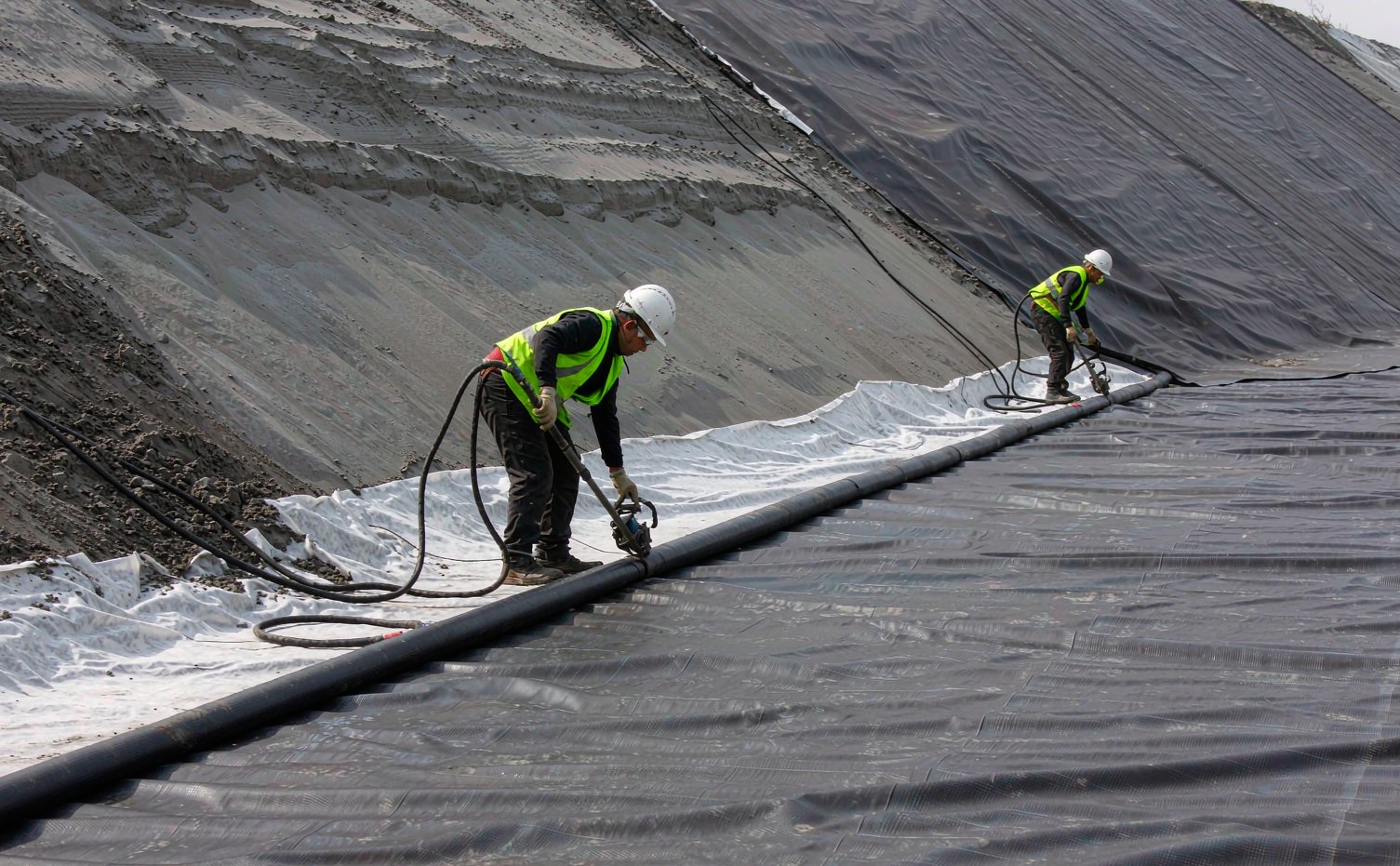
A 9,600 m² landfill cell works out to about 1,400 m of seam. That is the number I care about when a project asks for HDPE geomembrane welding quality control, because the sheet almost never leaks. The seam does.
I have watched crews weld a perfect run at 09:00 and a bad one at 15:00, same machine, same operator. The difference was a cloud passing over the cell and the welder not touching the speed dial. Nobody caught it until the air channel test failed on 60 m of seam.
GRI-GM13 tells you what the liner has to be: resin density, carbon black, tensile yield, stress-crack resistance, thickness tolerances you can argue about in a warehouse. Read it end to end and you will not find one sentence about how fast a wedge should travel across 1.5 mm sheet on a cold morning.
A 2 mm sheet that passes every factory test still leaks at a seam welded wet, welded cold, or welded with grit trapped in the lap. The QC plan is the only thing standing between a good roll of liner and a bad cell.
Dual-track wedge welding, and where extrusion takes over
Nearly all long straight seams on an HDPE liner are wedge welded: both edges heated against a hot wedge, then pulled through rollers under pressure. Dual-track machines leave an unwelded channel between two parallel weld tracks. That channel is a built-in test port: a 300 m seam can be checked in three minutes instead of an hour.
Extrusion welding is the other half of the trade. A hand-held extruder feeds molten polyethylene rod into a prepared groove. It is slower, uglier and indispensable at pipe boots, sumps, anchor trenches, patch repairs and anywhere the geometry will not let a wedge machine run.
Use one where the other belongs and it shows. A dual-track seam run around a 90° corner produces a wrinkle at the outside of the bend that no amount of pressure will close. Extrusion weld that corner, then run the wedge from the tangent point.
Seam length is decided before anyone welds
The cheapest way to improve seam quality is to have fewer seams. On a 120 m × 80 m cell — 9,600 m² — the arithmetic is straightforward.
| Liner roll width | Strips across 80 m | Longitudinal seams | End laps at 60 m panels | Total seam | Seam per m² |
|---|---|---|---|---|---|
| 5.8 m | 14 | 13 × 120 m = 1,560 m | 14 × 5.8 m = 81 m | 1,641 m | 0.171 m/m² |
| 7.0 m | 12 | 11 × 120 m = 1,320 m | 12 × 7.0 m = 84 m | 1,404 m | 0.146 m/m² |
| 7.0 m, factory-fabricated 120 m panels | 12 | 11 × 120 m = 1,320 m | 0 | 1,320 m | 0.138 m/m² |
Moving from 5.8 m to 7.0 m rolls takes 237 m of seam out of the cell — 14% of the work, 14% of the testing, 14% of the leak risk. Factory panel fabrication removes another 84 m by eliminating every end lap.
Overlap costs material too: a 100 mm lap on 11 seams of 120 m buries 132 m² — 1.4% of the cell area — and narrow rolls push that to 1.7%.
Four liners, four different welding behaviours
Geomembrane is not one material, and the weld window moves with the product. These are our own line specifications:
| Product | Material | Structure / surface | Texturing | Roll width |
|---|---|---|---|---|
| HDPE geomembrane | High-density polyethylene (HDPE) | Smooth / textured available | — | Customizable |
| LLDPE geomembrane | Linear low-density polyethylene (LLDPE) | — | — | Customizable |
| Composite geomembrane | Membrane + nonwoven geotextile (1-side / 2-side) | 1-side or 2-side geotextile | — | Customizable |
| Textured geomembrane | HDPE, textured surface | Textured sheet | Single-side / double-side | Customizable |
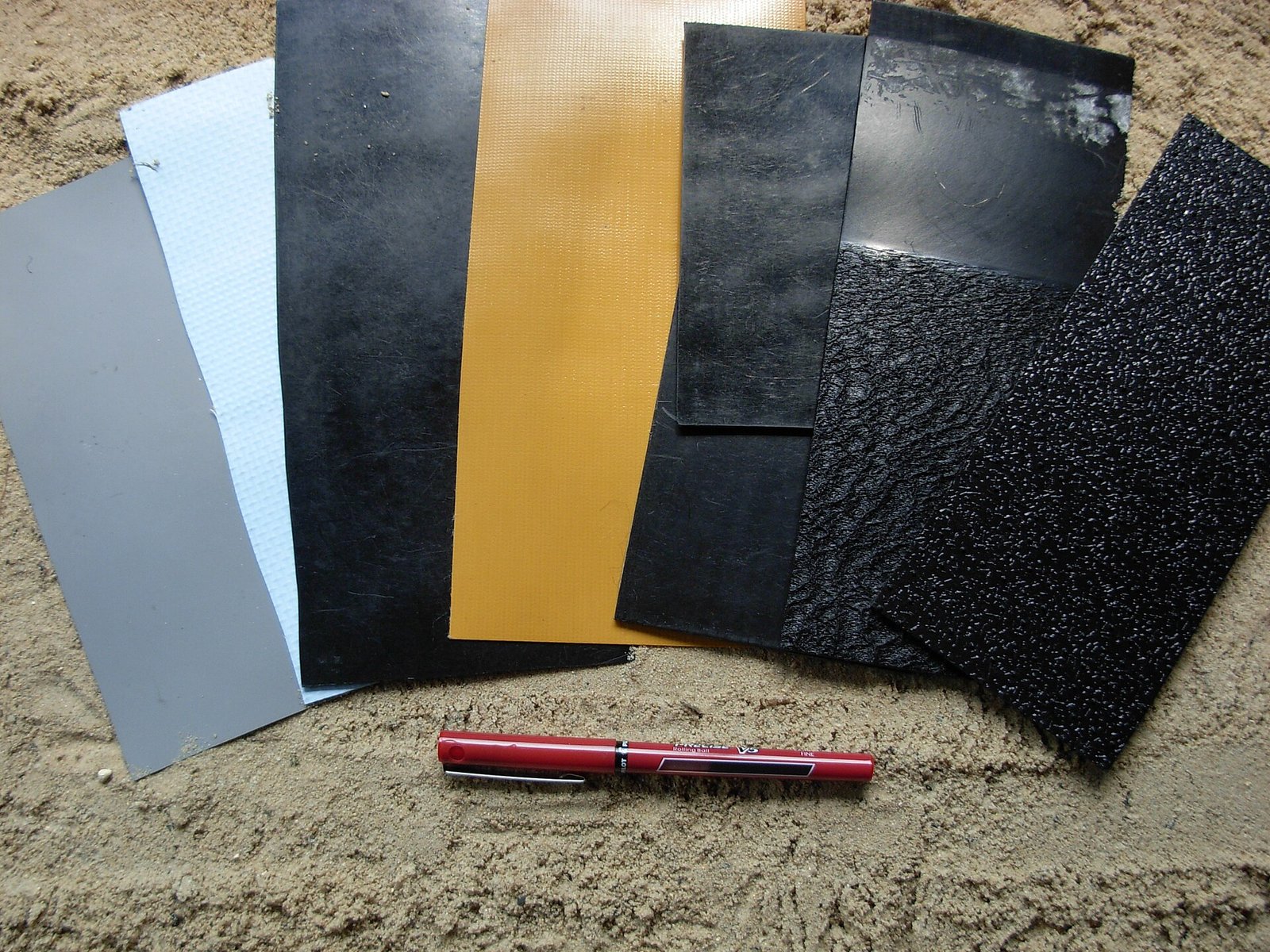
The practical consequences:
- HDPE is stiff and strong with a narrow weld window. Too cold and the interface never melts; too hot and the sheet turns waxy and peels clean.
- LLDPE is softer, conforms to a rough subgrade and tolerates a wider temperature band. It also wrinkles more easily, and a wrinkle running into a seam is a leak waiting for settlement.
- Composite must be welded membrane-to-membrane. Weld through the white nonwoven face and you are joining fabric, not liner — strip the geotextile back 100 mm at every seam first.
- Textured sheet needs more heat and slower travel, because the asperities sit between the wedge and the core. Double-side textured is the worst case: both faces fight the heating element.
What ten samples actually prove
Standard CQA practice is one destructive sample per 150 m of seam, per thickness, per shift. On the 1,404 m cell that is 1,404 ÷ 150 = 9.4, so ten samples.
Each sample is tested in both peel and shear. Peel tells you whether the two sheets fused into one material. Shear tells you whether the joint carries load. A seam can pass shear and fail peel — that is a cold weld, and it opens under settlement rather than under load.
Ten cut-outs also mean ten lengths of seam to re-weld and ten patches to re-test. Budget for it — the alternative is finding the same defect during the flood test with 9,600 m² already under gravel.
Non-destructive testing runs alongside:
- Air channel test on every dual-track seam. Pressurise the channel; pressure that holds means both tracks are continuous. A drop means at least one track is interrupted, and you re-test in sections to locate it.
- Vacuum box test on every extrusion weld and patch. Soap solution, clear box, vacuum — bubbles show the leak.
- Visual walk of every seam, both sides, before backfill. Most defects are visible: a lifted edge, a fishmouth, a discoloured track.
Defects that turn into leaks
| What you find | What actually happened | What to do |
|---|---|---|
| Water weeping at a seam in the flood test | Cold weld — travel speed too fast for the sheet thickness | Cut out the run, re-weld slower, re-test the channel |
| Seam peels open with a glossy film on the surface | Moisture or dust trapped in the lap, or oxidised sheet not scraped | Scrape and clean, re-weld, reject the shift's output |
| Fishmouth wrinkle at a panel end | Panel cut short, so the seam carries the slack | Re-cut with slack allowance, re-weld |
| Channel will not hold pressure | Interrupted track — grit in the channel or a bowed wedge | Re-run the failed track or cap with extrusion weld |
| Leak at a pipe boot | Extrusion weld laid on unground HDPE; nothing to bond to | Grind the surface, re-extrude, vacuum box test |
| Puncture under gravel | No protection layer, or sharp stone against the sheet | Add nonwoven geotextile, re-test |
Each traces back to the same thing: temperature and speed unchecked against the sheet in front of the operator.
Factory direct: fewer seams before the liner leaves China
Price per m² is not the main reason to buy HDPE geomembrane China direct from a source factory. The factory can cut the roll to your cell width instead of shipping a standard 5.8 m roll and letting your crew build laps on site.
We fabricate panels to the drawing — up to full cell length — and factory-weld the longitudinal joints under a fixed setting, indoors, with no wind and no dust. Those seams leave the plant already tested. What arrives on site is a panel, not a roll, and the field seam count drops accordingly.
Most of what we ship goes to waste cells, so a request that starts as "HDPE geomembrane for landfill China" usually ends as a weld map and a panel schedule. We also run biaxial geogrid in the same plant — 1.0 – 3.0 m (custom) roll widths, 30 – 50 m roll lengths, 30–150 kN/m — so one container can carry both the liner and the haul road grid. One LCL shipment, one set of documents, one supplier to chase when a seam fails.
Send the cell drawing; you get a panel layout with the seam count — more useful than a price per m².
Where to Go Next
- Product range and data sheets — see the full HDPE geomembrane range for smooth and textured sheet, and composite geomembrane where a bonded nonwoven layer replaces a separate protection geotextile.
- Protection layer — the geotextile above a liner is selected on CBR puncture (ASTM D6241) and AOS (ASTM D4751), not weight alone; see nonwoven geotextile as liner protection.
- Talk to an engineer — message us on WhatsApp for a same-day answer on welding parameters, or email cn8978688@gmail.com.
GeoTexGrid Materials Co., Ltd. manufactures HDPE, LLDPE, composite and textured geomembrane in China and ships factory direct, with panels fabricated against your drawings. Send your cell dimensions and liner thickness — you will get a panel layout, a seam count and a confirmed quotation, usually within one working day.
Похожие статьи
Fiberglass Geogrid China Supplier: Mesh and Coat
How to vet a fiberglass geogrid China supplier: mesh size, bitumen vs polymer coating, and the rib-count arithmetic that proves a 30-100 kN/m datasheet.
Woven Geotextile China Manufacturer: Slit Film
A woven geotextile China manufacturer explains slit film tapes, the grab-versus-wide-width trap, and how roll width changes the area you pay for.
Geocell China Manufacturer: Perforation Surface
Perforated or textured walls decide how a geocell drains and grips. A geocell China manufacturer explains wall options, weld QC and checks before order.