
Geogrid for Railway Subgrade: Ballast Layer Specs
Автор GeoTexGrid Engineering Team
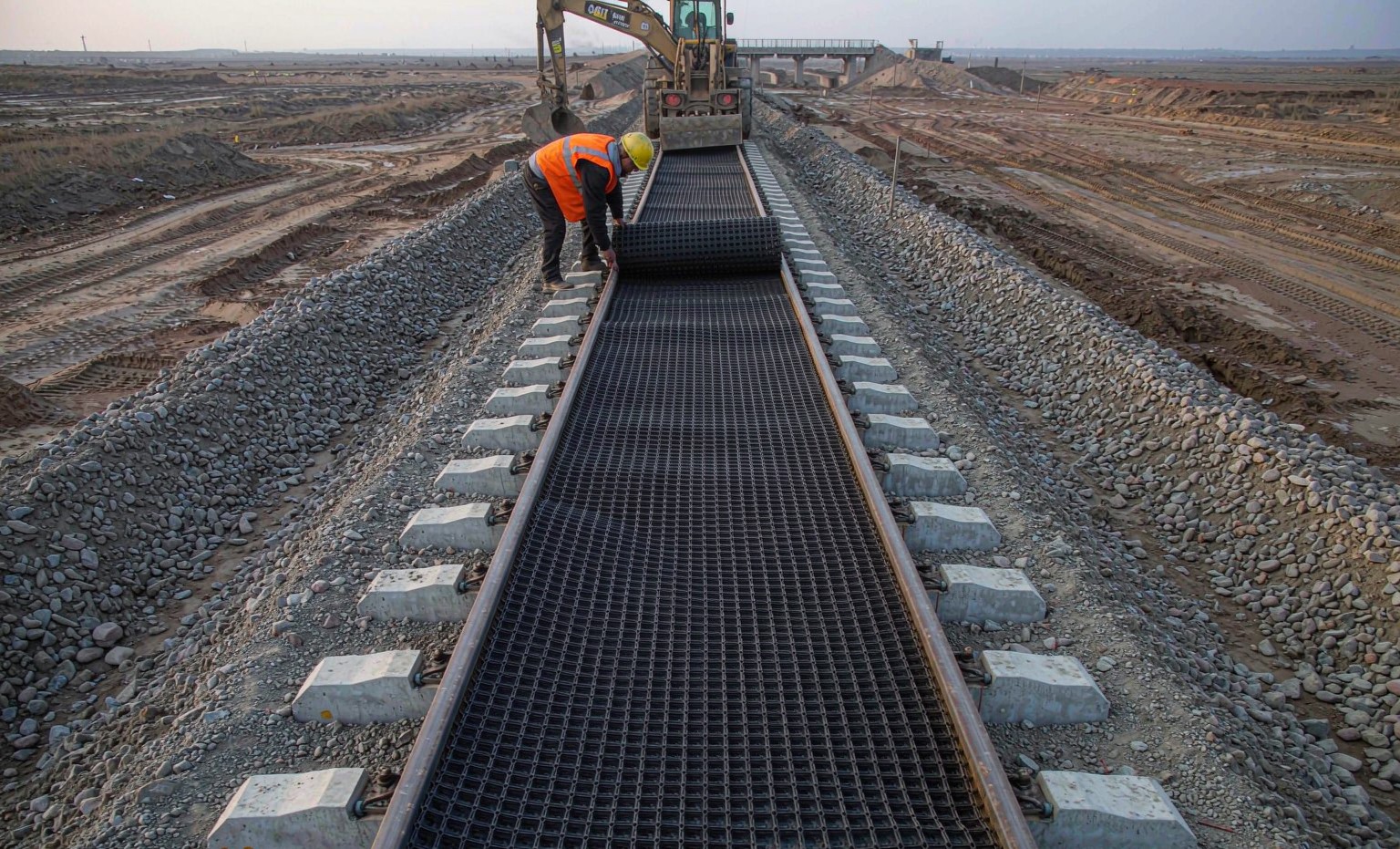
A track that will not hold its line is rarely a rail problem. Two winters ago I stood on a 25 t axle coal line where the tamping gang had been back on the same 180 m three times in one season. The ballast looked clean from the cess. Under the sleepers the formation had gone to slurry, and every tamp was driving stone deeper into mud.
Geogrid for railway subgrade work fixes that class of failure at the source. Not because a grid makes soil stronger, but because it decides where the ballast stops and the fines stop. Get that interface wrong and you pay for tamping crews until the next relaying cycle.
Why a Railway Subgrade Fails Under Cyclic Load
Railway loading is not road loading with bigger numbers. A 25 t axle at 80 km/h puts roughly 125 kN on each wheel, and with sleepers at 0.6 m the same square metre takes that several times a second, tens of thousands of times a year. Static bearing capacity tells you almost nothing about year three.
What fails is the interface. Fines migrate upward, ballast punches downward, and the layer that was meant to drain becomes a pump. This is the table I use on site before quoting anything.
| What you see | What actually failed | Indicator to check |
|---|---|---|
| Mud pumping at sleeper ends after rain | Separation lost, subgrade fines rising into ballast | Subgrade D85 against geotextile AOS (ASTM D4751) |
| Hanging sleepers, void under the tie | Ballast punched into a soft formation | Formation CBR or Ev2, ballast depth, proof rolling |
| Shoulder spreading, ballast slope flattening | Lateral restraint gone at the shoulder | Aperture against ballast D50, shoulder width |
| Differential settlement at a bridge approach | Stiffness change, not total settlement | Settlement rate over time, not the absolute value |
| Tamping holds six weeks, then fails again | Ballast already fouled, no separation layer | Fouling index, percent passing 22.4 mm |
Fix the middle column. Adding ballast to a pumping formation buys one more season.
Where the Geogrid Sits in a Trackbed
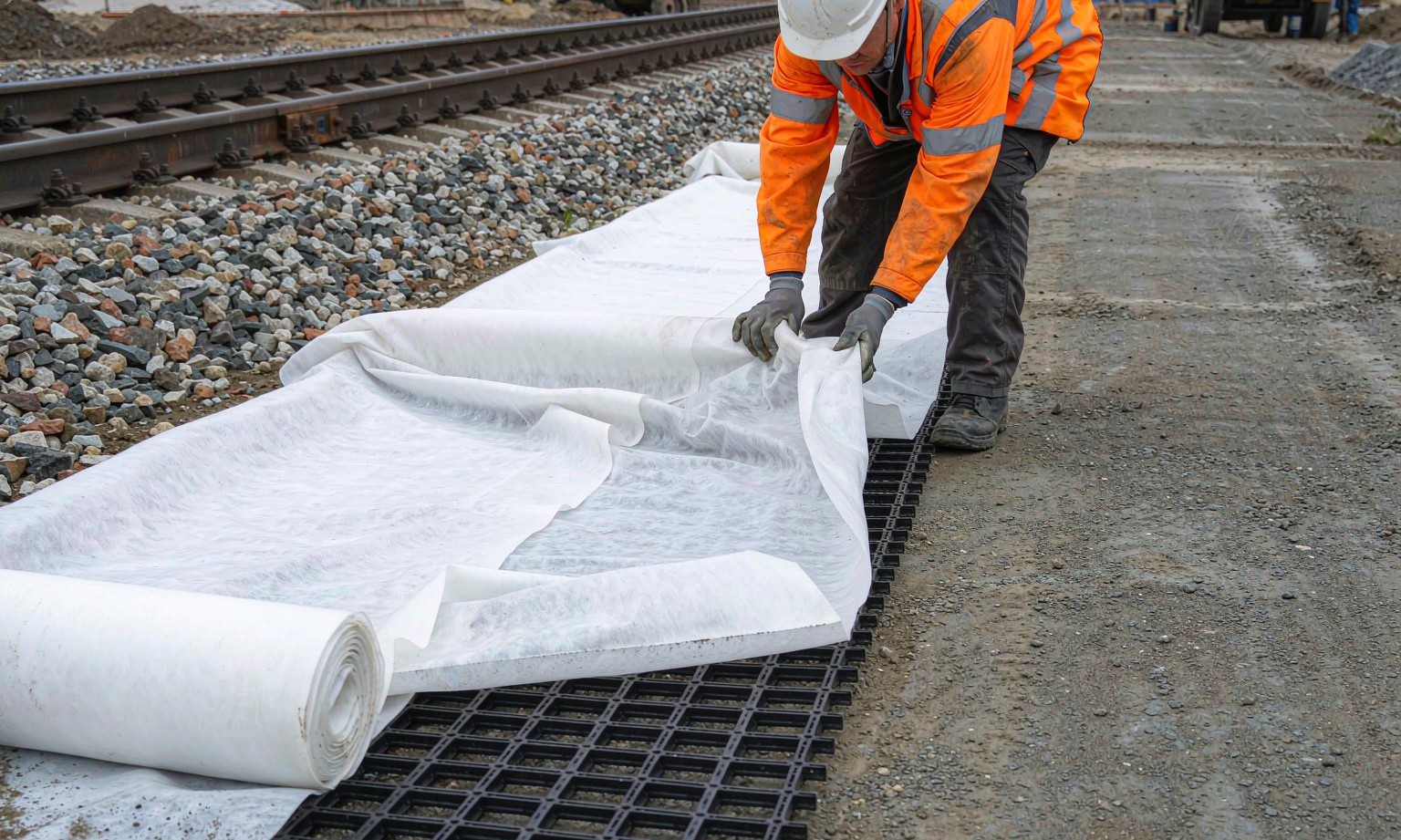
Two positions matter. The first is the top of the formation under the sub-ballast, where the grid reinforces and the geotextile beside it separates. The second is inside the shoulder, where a uniaxial grid restrains lateral spread of the ballast prism.
Nearly every trackbed problem I see is the first position, and nearly every wrong quote specifies strength alone, aperture left to the supplier. Aperture is what creates interlock.
Mainline ballast to 31.5/63 mm has a D50 around 45 mm. I work to an aperture between 0.5 and 1.0 times the ballast D50 — small enough that stone cannot pass, large enough that stone strikes through and locks.
| Aperture | Ratio to 45 mm D50 | What happens in service |
|---|---|---|
| 12.7mm | 0.28 | Stone cannot enter. The grid behaves as a blinding layer, nodes take the load and rib ends snap |
| 25.4mm | 0.56 | Stone penetrates about half way, good mechanical interlock. My default for 31.5/63 ballast |
| 38.1mm | 0.85 | Workable on open-graded ballast, less confinement per rib |
| Custom (≥ 100mm) | 2.2 | For rockfill and cobble, not for ballast. Stone falls straight through |
Matching Geogrid Grade to the Line You Are Building
Strength range is the other half of the decision, and it has to be read as a range. A supplier quoting "30–150 kN/m" has told you nothing until you name the point in that range you are buying.
| Product | Tensile strength | Grid / mesh | Roll width | Roll length | Where it belongs |
|---|---|---|---|---|---|
| Steel-Plastic Biaxial Geogrid | 30–150 kN/m | 12.7mm / 25.4mm / 38.1mm | 1.0 – 3.0 m (custom) | 30 – 50 m | Formation top under sub-ballast, mainline and yard |
| Steel-Plastic Uniaxial Geogrid | 50–300 kN/m | Custom (≥ 100mm) | 1.0 – 2.0 m | 30 – 100 m | Shoulder restraint, wing walls, approach embankments |
| Fiberglass Geogrid | 30–100 kN/m | 12.7mm / 25.4mm | 1.0 – 2.0 m | 30 – 50 m | Asphalt overlay only, never trackbed |
| Self-Adhesive Fiberglass Geogrid | 30–80 kN/m | 12.7mm / 25.4mm | 1.0 – 2.0 m | 30 – 50 m | Bridge deck and pavement joints |
| Nonwoven Geotextile | Needle-punched nonwoven (PET / PP) | — | Customizable | Customizable | Separation layer under ballast, over formation |
On a 25 t axle mainline I would not go below 80 kN/m ultimate in the formation, and most designs land between 100 and 150 kN/m. Yard and siding work is a different job: 30–50 kN/m is often enough over a competent formation.
Fiberglass stays out of the trackbed. Its elongation is ≤ 4% — right under an asphalt overlay, wrong over a formation that settles differentially. It takes load, then it snaps. Steel-plastic with HDPE or LDPE coating stretches and keeps working, which is why coating grade matters as much as strength.
Four Reduction Factors, One Usable Number
The figure on the data sheet is ultimate wide-width strength to ASTM D6637 or ISO 10319. It is not a design value. Strip it down first:
T_design = T_ult ÷ (RF_id × RF_creep × RF_install × RF_durability)
Values I would put in a tender calculation: RF_id 1.3 for installation damage, RF_creep 2.2, RF_install 1.2, RF_durability 1.2 for design life. Product: 4.12.
- 150 kN/m ÷ 4.12 = 36.4 kN/m
- 100 kN/m ÷ 4.12 = 24.3 kN/m
- 30 kN/m ÷ 4.12 = 7.3 kN/m
If lateral demand at the shoulder is 25 kN/m, the 100 kN/m product fails on paper before a roll is loaded. The 150 kN/m product passes with margin. Same supplier, same catalogue page, different structure.
Also ask for 2% and 5% strain values and for junction efficiency — a weak junction pulls apart at the first overlap.
Ballast Volume and Truck Loads
Take 1 km of single track, 4.5 m formation width, 300 mm ballast depth:
4.5 × 1,000 × 0.30 = 1,350 m³ of ballast. At a loose density near 1.6 t/m³ that is 2,160 t, or 72 truck loads at 30 t each, for one kilometre.
If the designer accepts a 50 mm reduction once the grid and the improved formation are in — a design decision, not a promise from the supplier — you remove 225 m³, about 360 t, twelve truck loads per kilometre. Over a 40 km section that is roughly 480 fewer loads. Grid for that kilometre is 4,500 m², about 33 rolls of 3.0 m × 50 m.
What to Write Into the Specification
- Grid tensile: ASTM D6637 for US tenders, ISO 10319 where CE marking is required, GB/T 19274 for plastic geogrid sourced in China, EN 13250 on EU railway work.
- Separation geotextile: AASHTO M288 class, AOS to ASTM D4751 at or below twice the subgrade D85, permittivity to ASTM D4491, CBR puncture to ASTM D6241.
- Ballast: Los Angeles abrasion and fouling. A good grid over poor ballast is money in the wrong layer.
Buying Geogrid China Direct for a Railway Job
Railway work is quantity work. A 30 km section is not a pallet order, and buying pattern decides the price more than the unit rate.
Ordering geogrid China direct from the producing factory — rather than through a trading company buying from the same three lines — changes three things. The roll width can be made to your formation width instead of you designing around a stock width. The batch certificate comes from the line that ran your order. And the container can be planned: geogrid rolls load together with the nonwoven geotextile for the separation layer, so one 40HQ covers both layers of the same kilometre.
The schedule breaks on the second shipment: a full container of geogrid plus part-loads of geotextile from another supplier is how a formation sits open through a wet month.
For a source factory, the questions that separate a real line from a reseller are boring: minimum order per strength grade, one resin batch across a 40HQ, and will you test the rolls actually shipped. A factory direct quotation should answer all three without a follow-up email. That is the standard I would hold any geosynthetics China supplier to, including us.
Where to Go Next
- Product data and roll options — the steel-plastic biaxial geogrid range covers 30 to 150 kN/m, and the nonwoven geotextile is the separation layer beneath it.
- Talk to an engineer — send axle load, formation CBR and ballast grading on WhatsApp for a same-day answer, or email cn8978688@gmail.com.
- Related reading — geogrid for soft soil stabilization covers the embankment case, and how geogrid reduces aggregate thickness runs the same layer arithmetic for roads.
GeoTexGrid Materials Co., Ltd. produces geogrid, geotextile and geomembrane in China and ships direct. Send the drawing and axle load — you will get a confirmed specification and quotation, usually within one working day.
Похожие статьи
Fiberglass Geogrid China Supplier: Mesh and Coat
How to vet a fiberglass geogrid China supplier: mesh size, bitumen vs polymer coating, and the rib-count arithmetic that proves a 30-100 kN/m datasheet.
Woven Geotextile China Manufacturer: Slit Film
A woven geotextile China manufacturer explains slit film tapes, the grab-versus-wide-width trap, and how roll width changes the area you pay for.
Geocell China Manufacturer: Perforation Surface
Perforated or textured walls decide how a geocell drains and grips. A geocell China manufacturer explains wall options, weld QC and checks before order.