
Geocell China: How to Specify HDPE Cells for Load Support
Автор GeoTexGrid Engineering Team
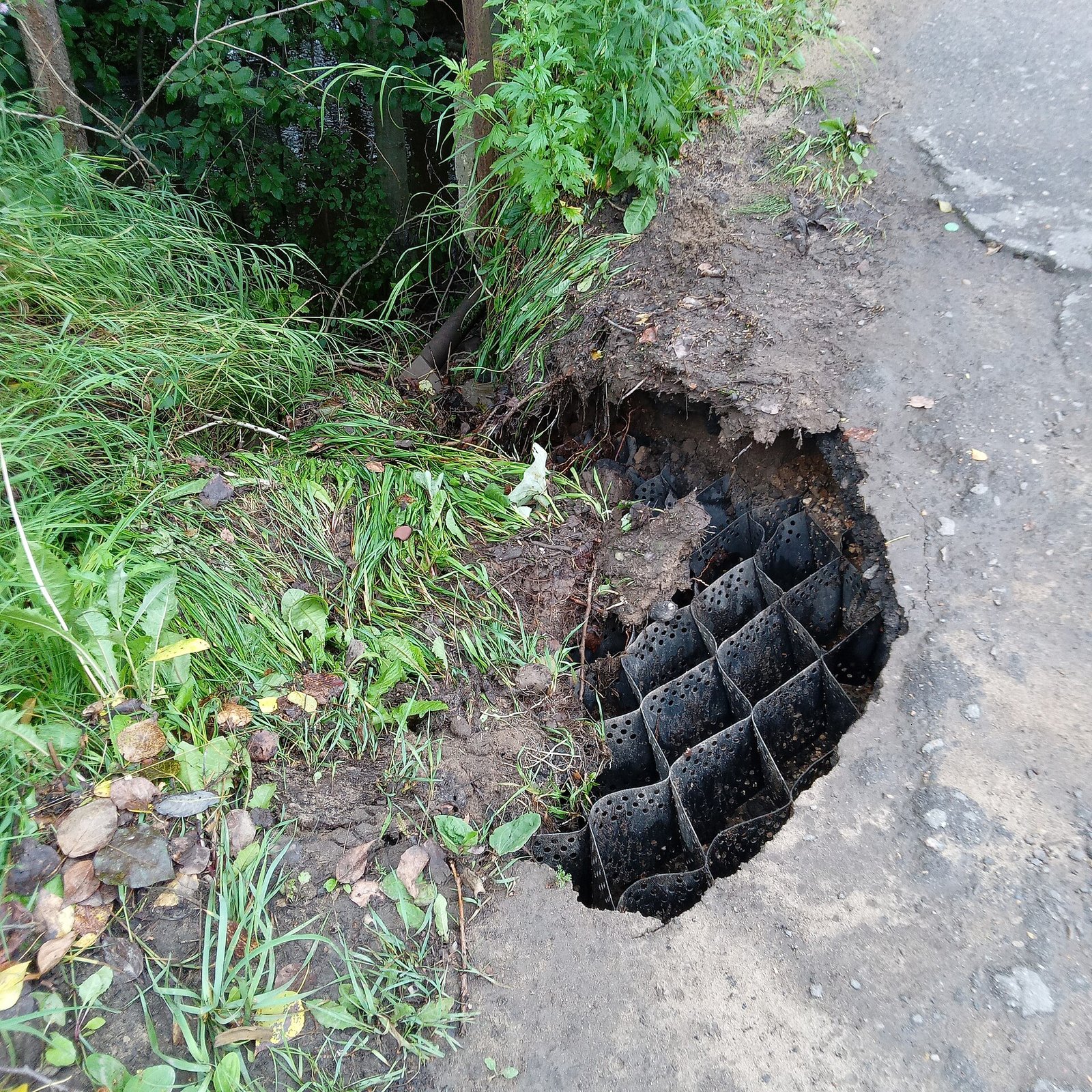
The first time I quoted a geocell job, the buyer sent me a geogrid spec sheet and asked which strength class matched. It took a phone call to untangle: geocell is not a tensile grid. It is a three-dimensional HDPE honeycomb that confines fill, and almost nothing on a geogrid datasheet predicts how it will behave. If you are sourcing geocell China for a haul road, a yard or a slope face, the parameters that matter are depth, cell size, perforation and the infill you can actually get to site. This post walks through how we size them, the same way our engineers do it on a factory-direct quote.
What a Geocell Actually Does
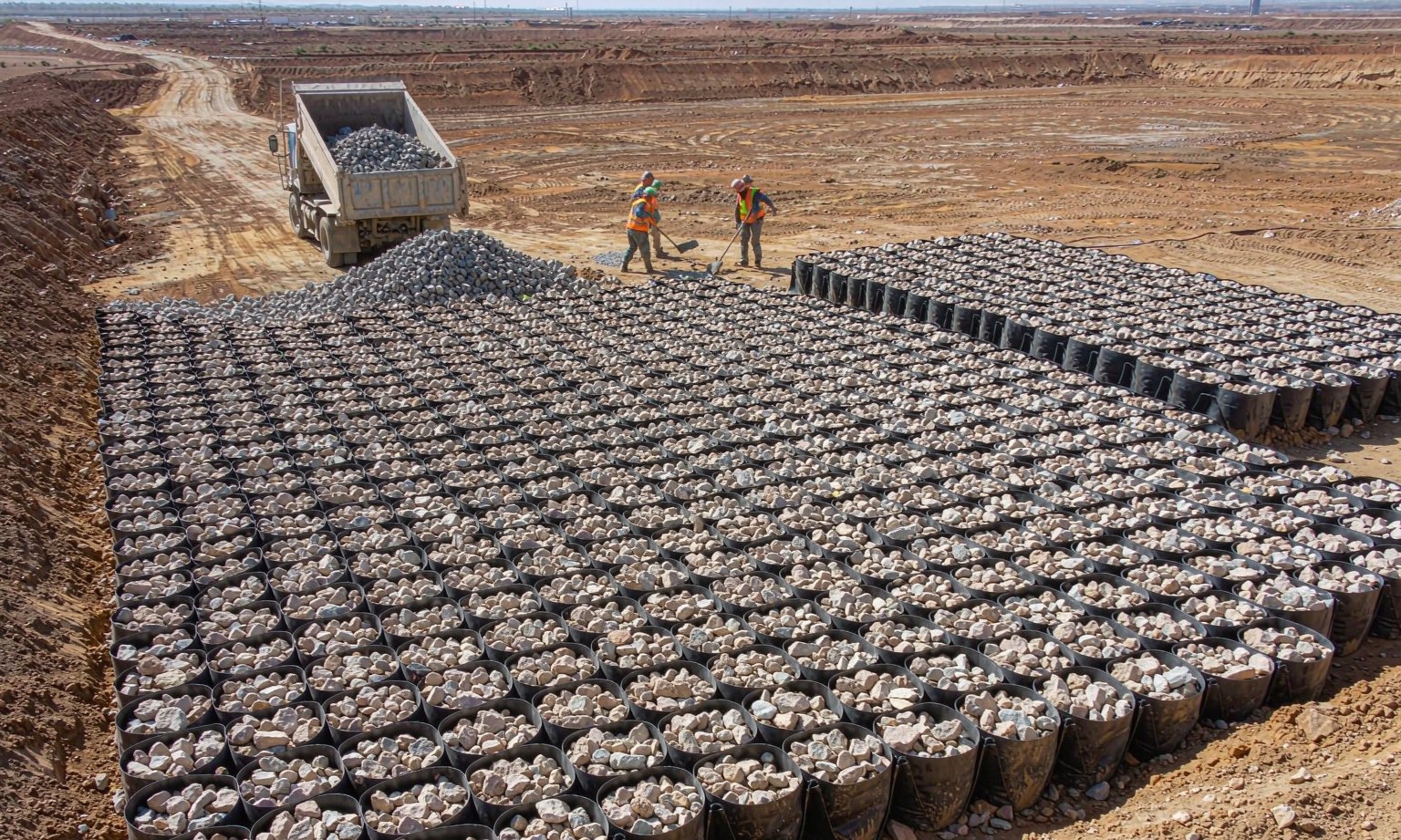
A geogrid works through interlock: ribs pass through aggregate, and the stone strikes through the apertures. A geocell works through confinement. The strips are welded into a honeycomb, expanded on site, filled with granular material, and the cell walls stop that fill from spreading sideways. Under a wheel load, the confined layer starts acting like a stiff slab instead of loose stone, so the load spreads before it reaches the subgrade.
The material is simple and that is the point. Ours is HDPE (High-Density Polyethylene), sheet density around 0.94 g/cm³ by ASTM D1505, UV-stabilised so it survives a summer of open storage. No coating, no composite layers — which is exactly why the specification lives in four or five decisions rather than twenty.
Geocell China: What a Source Factory Can Actually Customize
Because we extrude and weld the strips on our own floor, every one of these is made to order rather than picked off a shelf:
| Parameter | Our standard offering | What it changes on site |
|---|---|---|
| Material | HDPE (High-Density Polyethylene) | Base polymer — stiffness, UV life |
| Cell Depth | Customizable | Layer thickness and confinement |
| Cell Size | Customizable | How coarse the infill can be |
| Surface | Perforated / Non-perforated, Textured / Smooth | Drainage through the wall; friction on slopes |
| Panel Size (Expanded) | Customizable | How fast the crew covers ground |
Cell depth is the big one. Cell size runs second: a coarse, open cell wants big angular stone; a tight cell can hold sandy gravel. Perforation matters more than most buyers expect — on wet subgrade, a non-perforated wall turns the cell into a bathtub, while a perforated, textured wall lets water escape and grips the slope.
This is where buying from a geocell factory in China pays for itself. Order factory direct and depth, size, perforation and panel dimensions are one conversation with the extrusion line, not a negotiation with a trading company waiting on a third plant. Price transparency works the same way: sheet weight is arithmetic once the depth and density are fixed, so our quotes for geocell China list what each parameter actually costs. And because geocell ships collapsed and flat, it mixes into a shared container with geogrid and geotextile without wasting cube — a real advantage when you are consolidating a mixed geosynthetics China order into one shipment.
Sizing the Cell: The 2:1 Spread Check
You do not need software to get a defensible first number. The classic 2:1 stress distribution — textbook soil mechanics, no empirical factors — says a load at depth H spreads over a plan area that grows by H on each side. Take a 40 kN wheel on a 0.30 m × 0.30 m patch:
| Total cover thickness H | Spread area (0.30+H)² | Stress reaching the subgrade |
|---|---|---|
| 0.125 m (75 mm cell + 50 mm cover) | 0.18 m² | ≈ 221 kPa |
| 0.20 m (150 mm cell + 50 mm cover) | 0.25 m² | ≈ 160 kPa |
| 0.25 m (200 mm cell + 50 mm cover) | 0.30 m² | ≈ 132 kPa |
Compare the right-hand column with the allowable bearing pressure in your geotechnical report, and the cell depth picks itself: if your report caps the subgrade at 150 kPa, a 75 mm cell under this wheel is already 50% over, while 200 mm clears it with margin. Two honest caveats. First, 2:1 is the unreinforced baseline — confinement bends the spread wider than this, which is precisely what you are buying, so the method errs on the safe side. Second, it assumes the infill is compacted in lifts; an uncompacted cell is just a plastic basket full of loose stone.
Geocell or Geogrid? Side by Side
Clients ask this constantly, and the honest answer is that they solve different problems:
| Product | Material (our data sheet) | Key specification | Where it wins |
|---|---|---|---|
| HDPE geocell | HDPE (High-Density Polyethylene) | Perforated / Non-perforated, Textured / Smooth | Confinement over very soft ground; slope faces; channels |
| Steel-plastic biaxial geogrid | Steel / HDPE composite | 30–150 kN/m, apertures 12.7mm / 25.4mm / 38.1mm | Base reinforcement where aggregate interlock matters |
| Steel-plastic uniaxial geogrid | Steel / HDPE composite | 50–300 kN/m, aperture Custom (≥ 100mm) | Walls and steep slopes, one-direction load |
| Woven geotextile | Woven PP slit film / PET yarn | Separation and filtration | Layer under the cells, keeps fines out of the infill |
Roughly: if the stone can be kept where you put it, a geogrid does it cheaper. If the stone would wander — mud, channel flow, a steep face — that is geocell territory. We go deeper into the geogrid side in Geogrid for Mining Haul Roads, and the two products often end up on the same project, one above the other.
Don't Skip the Separation Layer Under the Cells
A perforated cell or a coarse infill over soft clay will pump fines upward until the layer loses its structure. Every load-support job we quote includes a separation geotextile — Needle-punched nonwoven (PET / PP) — directly on the subgrade. Specify it with the same three numbers you would use anywhere else: wide-width tensile per ISO 10319, apparent opening size per ASTM D4751, and CBR puncture resistance per ASTM D6241, which is the value that matters most under construction traffic. AASHTO M288 separation class is a sensible default where the project references US practice. Our nonwoven geotextile page lists the grades we keep on the same production floor as the geocell line.
Infill Volume: What to Budget
Cell depth drives your haul cost more than the polymer does. A typical project condition: 4,000 m² of yard at 150 mm depth needs 4,000 × 0.15 = 600 m³ of infill. At a compacted 1.8 t/m³ for crushed stone, that is about 1,080 t — roughly 43 truckloads at 25 t each. If imported aggregate runs your project, halving cell depth halves that bill, which is why we always ask about local fill before fixing a depth. The geocell itself, collapsed flat, adds only a few pallet positions to a mixed container.
Reading a Failed Cell Layer
Most geocell failures we are sent photos of trace back to one of five things:
| Symptom | What it usually means |
|---|---|
| Deep rutting along wheel paths | Cell depth too shallow for the subgrade stress — rerun the 2:1 check |
| Seams splitting at the welds | Poor weld quality; ask for weld peel tests before infill, not after |
| Infill pumping, fines migrating up | Missing or wrong geotextile — check AOS against the subgrade soil |
| Edge of the layer breaking out | Anchor trench too shallow for the expanded panel |
| Slope face sloughing down | Smooth, non-perforated wall on a slope — switch to textured, perforated |
| Water sitting in the cells | No perforation and no drainage gradient out of the layer |
Where to Go Next
- Product data — the HDPE geocell page covers depth, size, perforation and panel options, and the full product range lists what else rides in the same container.
- Talk to an engineer — message us on WhatsApp for a same-day answer, or email cn8978688@gmail.com with the area, the subgrade description and your infill source.
- Related reading — Geotextile China: How to Spec Nonwoven and Woven Fabric covers the separation layer in depth, and Custom Size Geosynthetics explains how roll widths and panel sizes are actually made.
GeoTexGrid runs its own geocell line in China, extrusion to welding on one floor next to our geogrid and geotextile production, so cell depth, perforation and panel size come back priced factory direct with MOQ and container loading spelled out. Send the area and subgrade details to cn8978688@gmail.com or on WhatsApp, and compare our geocell China quotation against any other supplier on your list.
Похожие статьи
Fiberglass Geogrid China Supplier: Mesh and Coat
How to vet a fiberglass geogrid China supplier: mesh size, bitumen vs polymer coating, and the rib-count arithmetic that proves a 30-100 kN/m datasheet.
Woven Geotextile China Manufacturer: Slit Film
A woven geotextile China manufacturer explains slit film tapes, the grab-versus-wide-width trap, and how roll width changes the area you pay for.
Geocell China Manufacturer: Perforation Surface
Perforated or textured walls decide how a geocell drains and grips. A geocell China manufacturer explains wall options, weld QC and checks before order.