
Textured Geomembrane for Steep Slope Lining: Spec Guide
Por GeoTexGrid Engineering Team
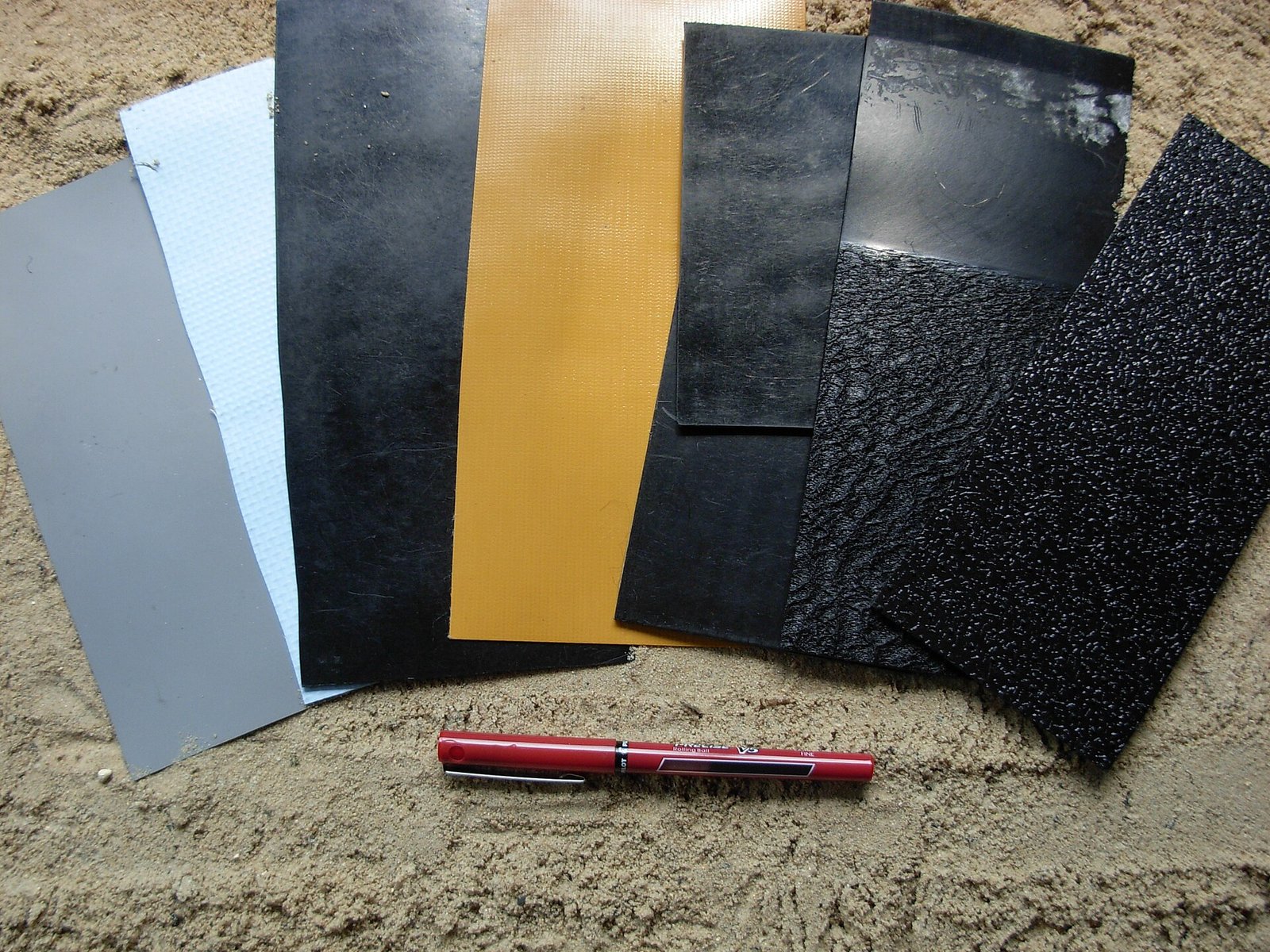
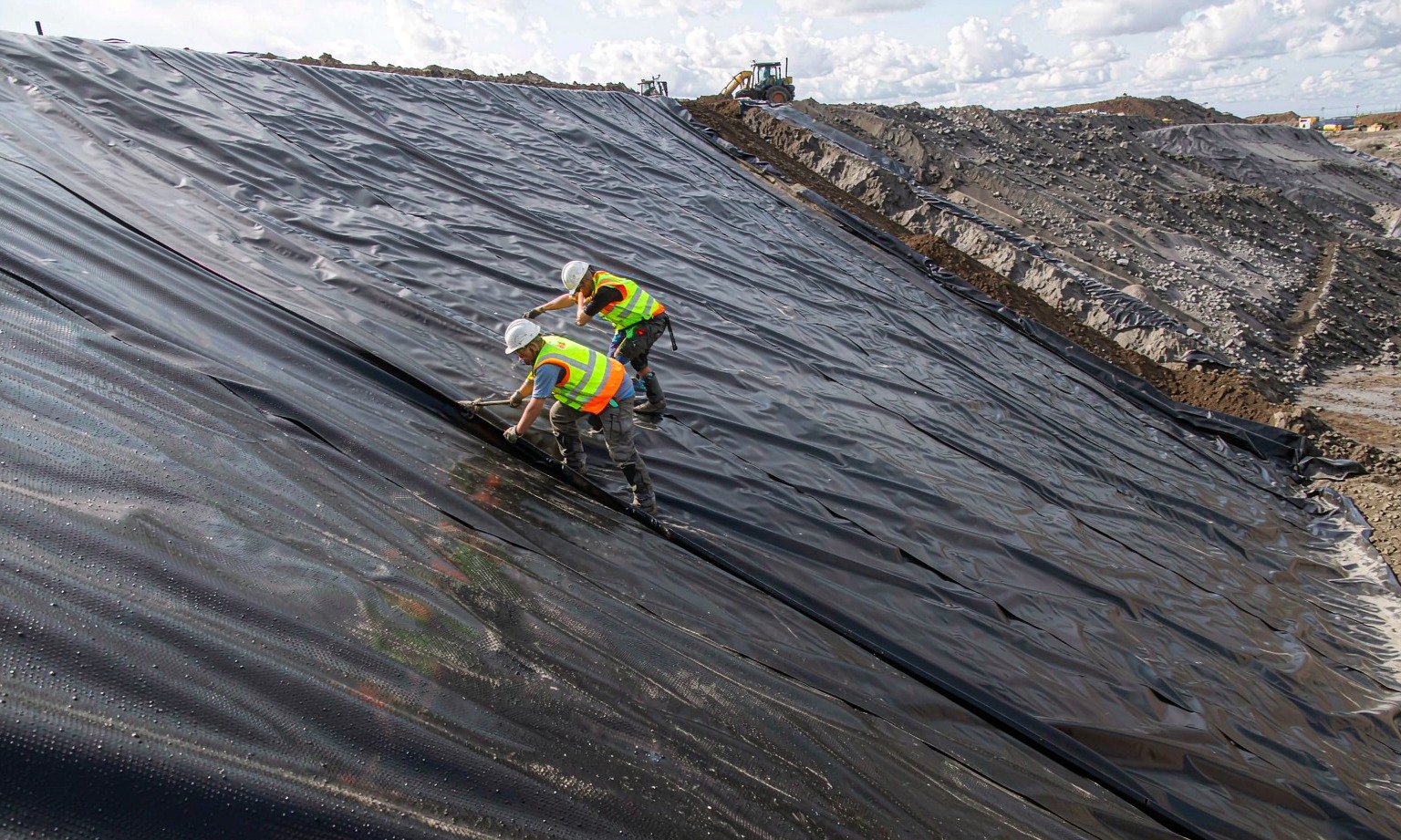
A steep liner face turns one property into the deciding one: friction. On a flat base, any HDPE geomembrane simply sits where it is unrolled; on a face steeper than about 1V:3H, the smooth sheet and the soil beneath it become the weakest plane in the entire lining system. A textured geomembrane answers that by trading a little surface flatness for a deliberately rough profile — and deciding how much roughness, on which face, is a specification call you should make before the slope is cut, not after the liner starts creeping.
Where a Textured Geomembrane Earns Its Place
The product line splits cleanly by geometry, and the rough surface is only worth specifying where gravity actually competes with friction:
- Flat bases and gentle slopes (1V:4H to 1V:3H). A smooth geomembrane in High-density polyethylene (HDPE) — Smooth / textured available on the same data sheet — is usually sufficient, cheaper per square meter, and faster to weld because the whole surface is uniform.
- Steep slope faces (steeper than 1V:3H). This is the textured geomembrane's home ground: HDPE, textured surface, supplied with Single-side / double-side texturing so the friction lands exactly on the weak interface.
- Settlement-prone bases. Linear low-density polyethylene (LLDPE) stretches more before it yields; it is the barrier choice where the subgrade is expected to move, though on a steep face it still needs texturing to hold position.
- Puncture-dominant sections. A composite geomembrane — Membrane + nonwoven geotextile (1-side / 2-side) — solves puncture and friction together, but if slope friction is the only driver, a textured sheet is the leaner specification.
Textured Geomembrane Selection: The Line Compared
| Product | Material / surface | Texturing or build | Role on a slope liner |
|---|---|---|---|
| Textured geomembrane | HDPE, textured surface | Single-side / double-side | Barrier plus interface friction on the slope face |
| HDPE geomembrane | High-density polyethylene (HDPE) | Smooth / textured available | Barrier on flat bases and gentle slopes |
| LLDPE geomembrane | Linear low-density polyethylene (LLDPE) | — | Higher elongation where settlement is expected |
| Composite geomembrane | Membrane + nonwoven geotextile (1-side / 2-side) | — | Barrier and puncture cushion delivered in one roll |
| Nonwoven geotextile | Needle-punched nonwoven (PET / PP) | — | Cushion or drainage layer; carries no barrier function |
Two selection rules fall out of that table. First, texture is a friction device, not a protection device — it adds almost nothing against sharp stones, so a cushion layer or a composite build still carries that job. Second, the same roughness that holds the liner in place slightly complicates seaming, which is why textured rolls keep a smooth selvage strip along each panel edge for welding.
How Steep Can the Face Be? Working the Friction Math Backwards
Most slope liner failures are veneer stability problems: the membrane, its cover and the interface beneath slide as a thin wedge. In the simplified infinite-slope balance, with no water pressure in the interface, the factor of safety reduces to FS = tan δ / tan β, where δ is the interface friction angle and β the slope angle. Inverting that gives the steepest face each interface can hold at a minimum FS of 1.5:
| Interface (typical design values, ASTM D5321 large-scale direct shear) | δ | tan β max = tan δ / 1.5 | Steepest face at FS 1.5 |
|---|---|---|---|
| Smooth HDPE against compacted sandy soil | 22° | 0.404 / 1.5 = 0.269 | ≈ 15° (≈ 1V:3.7H) |
| Single-side textured against compacted sandy soil | 30° | 0.577 / 1.5 = 0.385 | ≈ 21° (≈ 1V:2.6H) |
| Double-side textured against compacted sandy soil | 34° | 0.675 / 1.5 = 0.450 | ≈ 24° (≈ 1V:2.2H) |
Read it against common geometries: a 1V:3H face (18.4°) sits above the smooth-sheet limit and below the single-side textured limit — which is exactly why smooth liners slide on faces that look gentle. A 1V:2.5H face (21.8°) needs at least single-side texturing; 1V:2H (26.6°) demands double-side texturing plus a verified anchor at the crest, or a rethink of the cross-section.
Two cautions keep this math honest. The friction angles above are representative values reported for HDPE interfaces in published large-scale direct shear testing — the design numbers for your project must come from an ASTM D5321 test on the actual soil and the actual sheet, not from a table. And the simple balance only holds without interface water: seepage or gas pressure along the weak plane adds a driving force that no amount of texturing cancels, which is why drainage below the liner stays mandatory even on textured systems.
One-Side or Double-Side: Which Face Does What
Single-side texturing is the default for slope liners where the weak plane is at the bottom. The rough face goes down against the subgrade; the smooth face stays up, which keeps wedge and extrusion welding straightforward and leaves a clean surface for inspection and for any bonded or loose protection layer above.
Double-side texturing earns its cost when both interfaces can fail: steep covers placed directly over the membrane, interim liners that receive fill, or a design where the slope continues above the liner as a soil face. It costs more per square meter, deploys a little slower, and both faces must then be checked — the subgrade interface and the cover interface — because neither can be assumed benign.
One deployment detail matters more than it looks: on a long panel, the textured face must stay oriented the same way from crest to toe. A panel flipped mid-run quietly converts a double-side sheet into a single-side one at the worst possible elevation, and nothing about the rolled goods will reveal it later.
Deployment and Anchoring on the Face
- Anchor the crest, not just the toe. Typical anchor trenches run 300–500 mm deep, sized so the pullout capacity of the buried run exceeds the downslope driving forces with margin; the trench is backfilled and compacted before cover placement.
- Run panels crest-to-toe in one piece. Horizontal seams mid-slope are avoided by design; where a seam cannot be avoided, move it to a bench and test it per ASTM D4437.
- Deploy in the cool hours and re-tension. HDPE grows and shrinks with temperature; panels deployed slack at midday can ripple or concentrate folds when they cool, so texturing or not, the sheet is tensioned and tucked before final welding.
- Protect while covering. Any cover soil or gravel over the liner brings back the puncture question — a needle-punched nonwoven (PET / PP) cushion or a composite build per AASHTO M288 Class 1 expectations keeps the barrier whole under compaction traffic.
Slope Liner Failure Modes and What They Point To
| Symptom on the slope | Failure mode | Specification line to check |
|---|---|---|
| Liner slides at mid-slope after rain | Interface friction below what the design assumed | δ per ASTM D5321 on the real interface; texturing side orientation |
| Folds and ripples migrate downhill | Panels deployed slack, thermal contraction | Deployment and tensioning procedure |
| Pullout at the crest trench | Anchor capacity below driving force | Trench depth and embedded run length |
| Punctures after cover placement | Cushion layer missing or too light | CBR puncture per ASTM D6241 against the AASHTO M288 class |
| Seam peel on the slope face | Contaminated or overheated seam | Trial seams per ASTM D4437; sheet thickness per ASTM D5199 |
| Stress whitening at the toe | Sheet stretched beyond yield during tensioning | GRI-GM13 tensile at yield and break |
Nearly every slope liner failure traces back to one of two assumptions that were never tested: that the interface friction was "obviously" enough, or that the anchor would hold "because it always has." Both assumptions cost nothing to replace with a number — one ASTM D5321 report and one trench calculation — and either one can spare a month of remediation.
Where to Go Next
- Product range and data sheets — see the textured geomembrane specification (single-side and double-side texturing), or compare it with the HDPE geomembrane and nonwoven geotextile lines for a layered build-up.
- Talk to an engineer — message us on WhatsApp with your slope angle and cross-section, or email cn8978688@gmail.com for a same-day technical answer.
- Related reading — Geomembrane for Mining: Heap Leach Pad Liner Design works through liner selection under aggressive containment, and Composite Geomembrane: One-Side vs Two-Side Liner Design covers the puncture-plus-friction alternative in one roll.
GeoTexGrid manufactures textured geomembrane in single-side and double-side builds, with sheet thickness and texturing matched to your slope geometry and cover design. Send your cross-section, slope angle and cover loads — you will get a confirmed specification and quotation, usually within one working day.
Artículos relacionados
Fiberglass Geogrid China Supplier: Mesh and Coat
How to vet a fiberglass geogrid China supplier: mesh size, bitumen vs polymer coating, and the rib-count arithmetic that proves a 30-100 kN/m datasheet.
Woven Geotextile China Manufacturer: Slit Film
A woven geotextile China manufacturer explains slit film tapes, the grab-versus-wide-width trap, and how roll width changes the area you pay for.
Geocell China Manufacturer: Perforation Surface
Perforated or textured walls decide how a geocell drains and grips. A geocell China manufacturer explains wall options, weld QC and checks before order.