
HDPE Geomembrane China Landfill Leak Test
بقلم GeoTexGrid Engineering Team
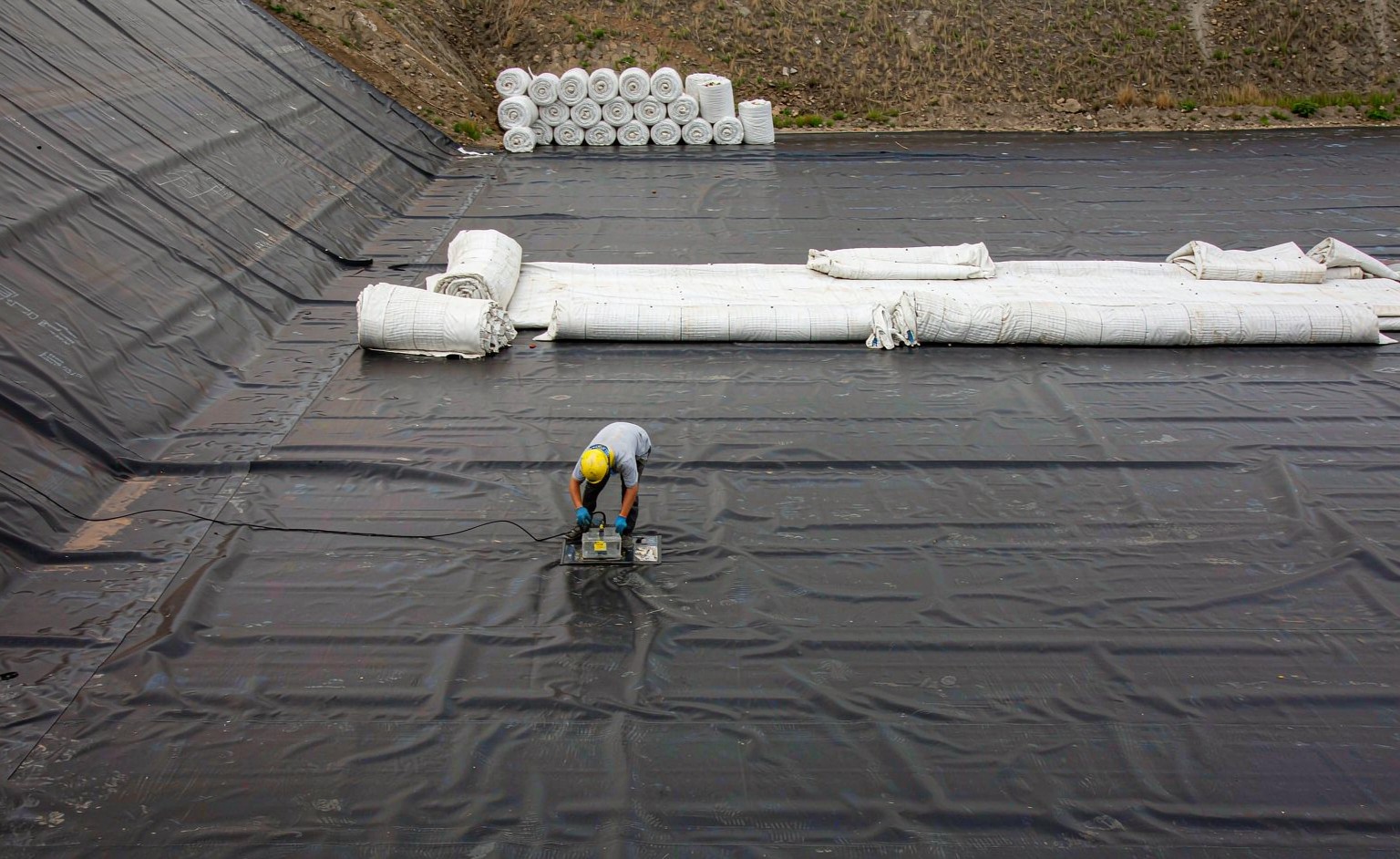
A geomembrane liner almost never leaks because the sheet itself was bad. It leaks because somebody covered it the same afternoon it was deployed, and a pinhole under a gravel drainage layer is invisible until leachate shows up where it shouldn't. That is why the leak test — not the resin certificate — is the last real chance to catch a defect on an HDPE geomembrane landfill liner before it gets buried under 300 mm of protection geotextile and drainage stone.
I have watched crews roll out 40,000 m² in a week and then lose two days to leaks a vacuum box found in the first hour of testing. The survey is cheap. The rework after cover soil goes in is not.
Where Landfill Liner Leaks Actually Come From
Field leak-location crews flag the same handful of defects year after year, and almost none of them are sheet failures:
- Seams. The majority of found leaks sit on or beside a weld — a cold wedge pass, grit under the lap, a burn spot at a tack weld.
- Penetrations. Pipe boots, sump corners, anchor trench turns. Every place the sheet has to change geometry is a place a welder works slowly or doesn't.
- Punctures. A stone left on the subgrade, a boot heel, a dropped hand tool. Small, hard to see on black HDPE, easy to find with a proper survey.
Material quality still matters — GRI-GM13 exists so the resin, thickness and oxidative induction time are locked before the roll leaves the plant — but once the sheet is on the ground, leak risk is a workmanship problem, and the only defense is testing while everything is still exposed.
Which Geomembrane Goes Where in a Landfill Cell
Before the test plan makes sense, the liner layout has to. Most cells mix products, and each one gets tested differently. Here is how our range maps onto a typical base liner plus side slopes, using the structure wording straight from our data sheets:
| Liner type | Data sheet structure | Typical position in the cell | Leak-test focus |
|---|---|---|---|
| Smooth HDPE geomembrane | High-density polyethylene (HDPE) | Base floor, leachate collection zones | Air channel on every double weld, vacuum box on details |
| Textured HDPE geomembrane | Smooth / textured available; texturing Single-side / double-side | Side slopes where interface friction governs | Same as smooth, plus visual check that texturing did not trap grit under laps |
| LLDPE geomembrane | Linear low-density polyethylene (LLDPE) | Settlement-prone pockets that need elongation capacity | Air channel plus closer seam peel checks |
| Composite geomembrane | Membrane + nonwoven geotextile (1-side / 2-side) | Cushion layer over rough subgrade or above a GCL | Spark or vacuum testing on factory-bonded seams, careful lap prep |
The texture choice changes the surface, not the test logic. If you want the friction numbers side by side, the textured geomembrane spec guide covers slope use in detail.
Four Field Leak Tests Every Geomembrane Seam Must Pass
1. Air channel pressure test. Double hot-wedge welds leave a sealed channel between the tracks. We cap one end, pump the other up to the pressure the QA plan calls for, close the valve and watch the gauge for the full hold time. A channel that bleeds down means the weld has a path — the crew walks the seam with soapy solution until the bubble tells them where.
2. Vacuum box. Extrusion welds, patches, corners and pipe boots have no channel to pressurize. The tester puts a soapy film on the seam, presses the box over it, pulls a vacuum and watches for foam. Slow work, roughly a meter at a time, but it is the only direct test on those details.
3. Spark test. Where rolls carry a conductive layer under the lap, a high-voltage probe walks the seam and arcs through any gap. Fast, and it finds pinholes a visual check will never catch.
4. Electrical leak location survey. The whole exposed liner, not just seams — the crew drags a charged probe over the sheet and every hole lets current through, so the instrument beeps. On big cells this is the test that finds the stray boot-heel punctures in the middle of a panel.
The Survey Math, So You Can Check the Quote
Leak-location quotes are priced by area and access, and the arithmetic is simple enough to verify on paper. Take a base liner cell of 60 m × 45 m — 2,700 m²:
- Lanes walked across the 45 m width at 1.5 m spacing: 45 ÷ 1.5 = 30 lanes
- Each lane runs the full 60 m length: 30 × 60 = 1,800 m of walking
- At a steady survey pace of about 40 m/min: 1,800 ÷ 40 ≈ 45 minutes of pure traverse
That is the instrument time. Add marking, re-walking flagged spots, and the vacuum box retest of each flag, and one crew comfortably finishes this cell in half a day. If a quote for the same cell says three days, somebody is padding it; if it says one hour, somebody is not walking the lanes.
Every flagged point gets a circular patch cut at least a hand-width beyond the damage on all sides, extrusion welded, vacuum box tested, and the zone re-surveyed. No exceptions — a patched spot that was never retested is just a leak with extra steps.
What Survey Findings Trace Back To
This is the diagnostic table we hand to site QA teams. It shortens the argument about whose defect it is:
| Survey finding | Usual root cause | On-site fix | What to check with the supplier |
|---|---|---|---|
| Air channel will not hold pressure | Wedge temperature drift, or grit in the lap | Re-weld the section after cleaning | Wedge welder calibration records per shift |
| Bubble cluster under vacuum box | Extrusion weld porosity, damp surface during welding | Grind and re-weld dry | Welder certification, surface prep procedure |
| ELL beep mid-panel, no visible damage | Puncture under the sheet from subgrade stone | Patch, then fix the subgrade ahead of the crew | Roll delivery handling notes |
| Leaks grouped at one roll edge | Off-spec lap width from a mis-aligned panel | Re-lap and re-weld | Factory roll edge cut tolerance |
| Leak at a pipe boot | Site-made boot, stress at the collar | Prefabricated boot, welded at low-stress hour | Prefab boots supplied with the rolls |
Most of that right-hand column is paperwork you should be able to ask for without a fight. When you source HDPE geomembrane for a landfill project from a China source factory, as we do, the batch test reports, resin certificates and welder calibration sheets go out with the rolls — asking for them afterwards is too late, because a trader will not have them at all.
Buying Geomembrane for Landfill Projects Factory Direct
There is a practical reason landfill contractors keep moving to factory-direct supply for geomembrane for landfill China projects, and it is not just unit price. A source factory controls the variables that decide how the leak test goes: resin batch consistency, sheet thickness tolerance, roll length so the crew can plan laps, and prefab details like boots that remove half the difficult site welds. Buying through two or three middlemen, every one of those controls loosens.
We ship HDPE geomembrane rolls with the QC file included, quote by the exact roll dimensions the cell needs to cut seam length down, and mix products — membrane, protection geotextile, GCL — into one container for a single delivery to site. For a 2-hectare cell that container math alone is worth a conversation.
Leak-Test the Liner Before You Cover It
- Data sheets and the full range — start from the HDPE geomembrane product page for smooth and textured grades, or the composite geomembrane page for cushion-layer builds.
- Talk to an engineer before the pour — message us on WhatsApp for a same-day answer on test planning, or email cn8978688@gmail.com.
- Related reading — HDPE geomembrane welding and seam QC covers the weld-side checks that come before leak testing, and nonwoven geotextile as landfill liner protection covers the layer that goes on top.
Send us the cell drawings and the liner cross-section. You will get a roll plan, a seam-length estimate and a quotation — usually within one working day.
مقالات ذات صلة
Fiberglass Geogrid China Supplier: Mesh and Coat
How to vet a fiberglass geogrid China supplier: mesh size, bitumen vs polymer coating, and the rib-count arithmetic that proves a 30-100 kN/m datasheet.
Woven Geotextile China Manufacturer: Slit Film
A woven geotextile China manufacturer explains slit film tapes, the grab-versus-wide-width trap, and how roll width changes the area you pay for.
Geocell China Manufacturer: Perforation Surface
Perforated or textured walls decide how a geocell drains and grips. A geocell China manufacturer explains wall options, weld QC and checks before order.