
Geotextile China: How to Spec Nonwoven and Woven Fabric
بقلم GeoTexGrid Engineering Team
Last season an inquiry landed in three lines: geotextile, 200 g/m², 10,000 m², best price. We quoted it. So did four other mills, and the spread between the cheapest and dearest number was wider than the spread between two polymers. Nobody was cheating. A geotextile China roll at 200 g/m² can be a needle-punched PET fleece or a PP slit-film woven, and only one of them will filter that site's soil.
That is where most import problems begin. Grams per square metre tell you how much polymer is in the roll, and nothing about opening size, permittivity or puncture class. When the RFQ carries none of those, the mill quotes the cheapest roll that matches the weight — exactly what was asked for.
Why Weight Alone Is Not a Specification
Four properties decide whether a geotextile works, and each is tested separately:
- Retention — apparent opening size (AOS, or O95), ASTM D4751. Whether soil grains stay put or wash through.
- Permeability — permittivity, ASTM D4491. How fast water crosses the fabric.
- Strength — grab tensile (ASTM D4632) and CBR puncture (ASTM D6241). Whether it survives installation.
- Durability — polymer and UV stabilisation. Whether it is intact in year five.
A 200 g/m² nonwoven and a 200 g/m² woven can sit at opposite ends of all four. I have watched a slit-film woven get specified for filtration because "same as last time" was on the inquiry: it separated fine, then clogged in the first week of rain and the subgrade pumped for a month. The weight matched. Nothing else did.
The Two Families a Geotextile Factory China Ships Every Day
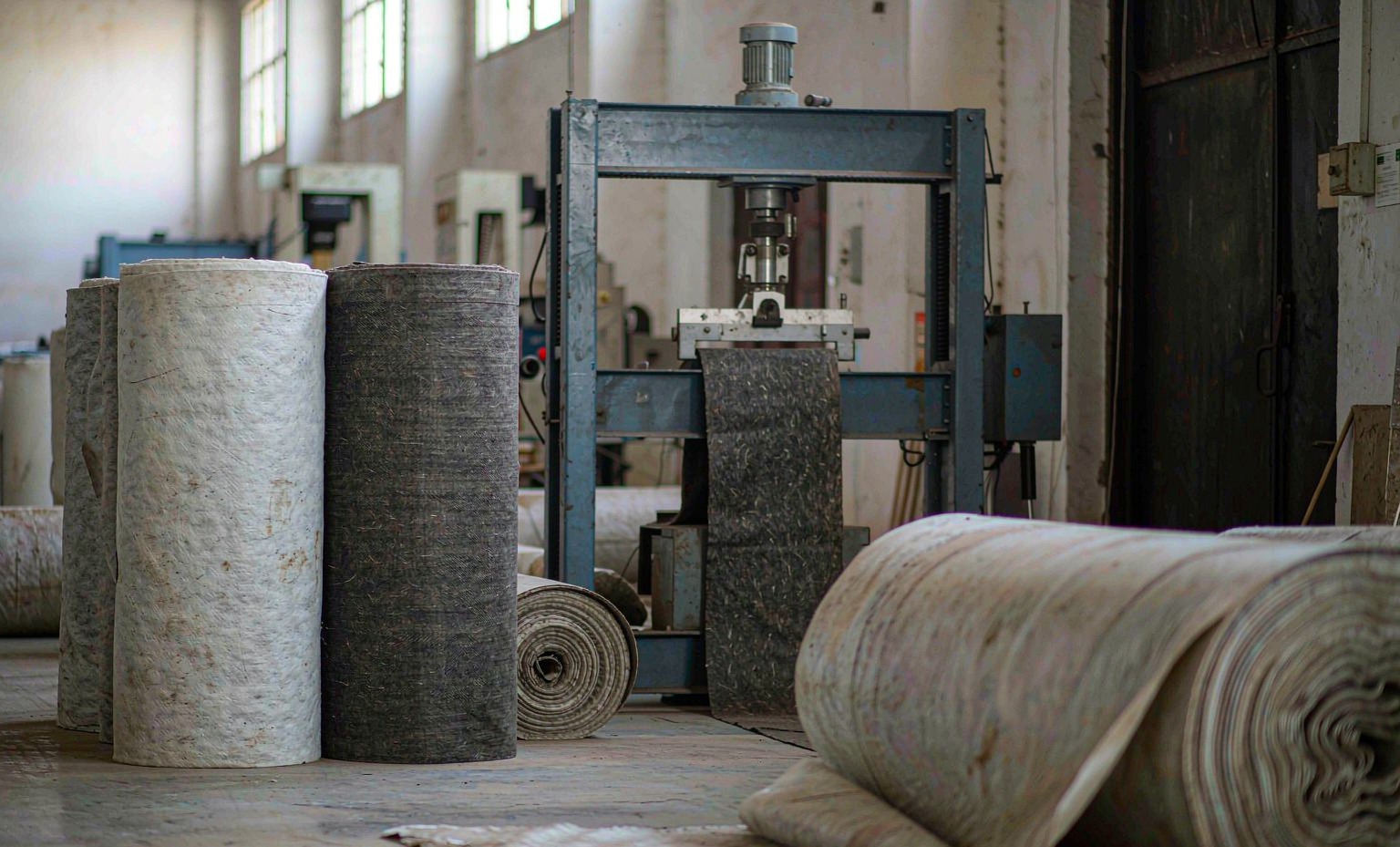
These are the four rolls we quote most often, with the material description taken off our own data sheets:
| Product | What the roll is | Where it wins | What to watch |
|---|---|---|---|
| Nonwoven geotextile | Needle-punched nonwoven (PET / PP) | Filtration, separation, cushion under a geomembrane | Strength tracks needle density — ask for grab and puncture values, not just weight |
| Woven geotextile | Woven PP slit film / PET yarn | High-strength separation, base stabilisation, silt fence | Geometric openings; lower permittivity than a nonwoven of equal weight |
| PET filament geotextile | Polyester (PET) continuous filament | Long-service filtration under sustained load, better creep behaviour | Hydrolysis risk in hot, strongly alkaline contact |
| PP geotextile | Polypropylene (PP) | Chemical resistance and cost per kN, general filtration | Lower modulus — not the first pick where creep governs |
Roll width and unit weight are built to order on all four — "Customizable" is the catalogue word, which means the mill runs whatever you write down. Write nothing and you get whatever the line was already running. The geobag range is the one exception we quote as Woven / nonwoven geotextile.
Grading and Filtration: Where AASHTO M288 Does the Work
One shortcut removes most of the guesswork: the AASHTO M288 survivability class. Name the class and the strength argument is over before it starts:
| Class | Grab tensile (ASTM D4632) — elongation < 50% / ≥ 50% | CBR puncture (ASTM D6241) — < 50% / ≥ 50% |
|---|---|---|
| Class 1 | 1400 N / 900 N | 2750 N / 1925 N |
| Class 2 | 1100 N / 700 N | 2200 N / 1375 N |
| Class 3 | 800 N / 500 N | 1650 N / 990 N |
Defaults for permanent works: subsurface drainage Class 2, separation Class 2, stabilisation Class 1, erosion control Class 1 — which is where most of our road and drainage orders land.
Retention and permeability come from the fines in the subgrade, not from the application. AASHTO M288 sets the hydraulic floor on the percentage passing the 0.075 mm sieve:
| Fines passing 0.075 mm | Minimum permittivity | Maximum AOS |
|---|---|---|
| < 15% | 0.10 s⁻¹ | 0.43 mm |
| 15–50% | 0.20 s⁻¹ | 0.25 mm |
| > 50% | 0.50 s⁻¹ | 0.22 mm |
Now the arithmetic behind those columns. Permittivity is permeability divided by thickness, psi = k / t. Take a 2.0 mm needle-punched nonwoven measuring 0.50 s⁻¹:
k = psi × t = 0.50 × 0.002 = 1 × 10⁻³ m/s
The usual rule is that the fabric must pass at least ten times the flow of the soil it protects, so k_geotextile ≥ 10 × k_soil. At 1 × 10⁻³ m/s that covers soils up to 1 × 10⁻⁴ m/s — fine silts and silty clays, exactly where pumping failures begin. Run the same check on a lower-permittivity woven and it can fall short on those soils even though the roll weighs more. Heavier is not safer, and the M288 numbers make that visible before anything ships.

The Failure Modes You Can Predict Before You Order
Almost every claim I have handled traces back to one missing line:
| Symptom on site | Line that was missing |
|---|---|
| Base course pumping, fines rising through the fabric | AOS / retention per ASTM D4751 |
| Water standing on the fabric after rain | Permittivity per ASTM D4491 |
| Fabric punctured while aggregate is placed | CBR puncture class per ASTM D6241 |
| Panels pulling apart along overlaps | Overlap width and seaming method |
| Fabric brittle along an exposed edge after one season | Polymer grade and UV stabilisation |
| Splices mid-lane, short rolls wasted at the end | Roll width and length plan |
What a Factory-Direct Geotextile China Quotation Should Print
When two suppliers sit 20% apart on square-metre price, the difference is nearly always hiding in this list:
- Unit weight in g/m² with the production tolerance, not a rounded nominal.
- Polymer — virgin or recycled, and which one. Recycled content shows up first as low grab strength, then as UV brittleness.
- Grade — the AASHTO M288 class, written out.
- AOS and permittivity with the test standard beside each value.
- Roll plan — width and length per roll, which sets your overlaps and splices.
- Certificates per lot — ASTM D4632, D4751, D4491 and D6241 run on the actual production lot, not a catalogue sheet.
- MOQ and validity — the minimum run, and how long the price holds.
If the family itself is still open, read the nonwoven and woven geotextile comparison first; the AASHTO M288 geotextile class breakdown carries the full grading tables.
On MOQ: a source factory can split one production run across two widths or weights without changing the polymer batch — same resin, same QC lot, one set of certificates. A trading office holding someone else's stock cannot re-cut a production plan. That is what factory direct buys, and it shows up as a smaller effective minimum rather than a lower headline price.
Quantity, Roll Size and Container Loading
Two pieces of arithmetic answer most quantity questions.
Overlaps first. A 300 m × 25 m layer is 7,500 m² net area. On a 5.8 m roll laid to a 300 mm overlap the effective width is 5.5 m, so the 25 m width takes five strips: 5 × 300 m = 1,500 linear metres, and 1,500 × 5.8 m = 8,700 m² of fabric, about 16% over net area. That 16% belongs in the order, not in a site argument later.
Then roll weight and container fill. A 5.8 m × 100 m roll carries 580 m², so at 150, 200, 300 and 400 g/m² it weighs about 87, 116, 174 and 232 kg. A 40HQ takes roughly 26 t of payload — at 200 g/m² that would be 130,000 m², far more than the container can physically hold. Roll goods pack at around 250–300 kg/m³, so a full 40HQ of light fabric weighs near 20–23 t and cubes out before it weighs out. Above roughly 400 g/m², payload binds instead.
That is the opposite of geomembrane, where weight governs from the first millimetre. Load both in one programme and the light geotextile runs out of volume first, so fix the roll width and cutting plan before committing to container counts.
Where to Go Next
- Product data — the nonwoven geotextile and woven geotextile pages list material options, and the full geosynthetics range covers the rest of the portfolio.
- Talk to an engineer — message us on WhatsApp for a same-day answer, or email cn8978688@gmail.com with the application, the subgrade description and the area.
- Related reading — Geogrid China: How to Vet a Source Factory Direct runs the same factory-vetting checklist, and Geomembrane China: Source Factory Price, MOQ & Lead Time covers the pricing side for liner work.
GeoTexGrid runs its own geotextile lines in China — needle-punched nonwoven and woven off the same floor as our geogrid and geomembrane production — so a subgrade description and a design area come back as a confirmed grade and price, quoted factory direct. Write to cn8978688@gmail.com or send the details on WhatsApp for numbers you can compare against any other geotextile China supplier.
مقالات ذات صلة
Fiberglass Geogrid China Supplier: Mesh and Coat
How to vet a fiberglass geogrid China supplier: mesh size, bitumen vs polymer coating, and the rib-count arithmetic that proves a 30-100 kN/m datasheet.
Woven Geotextile China Manufacturer: Slit Film
A woven geotextile China manufacturer explains slit film tapes, the grab-versus-wide-width trap, and how roll width changes the area you pay for.
Geocell China Manufacturer: Perforation Surface
Perforated or textured walls decide how a geocell drains and grips. A geocell China manufacturer explains wall options, weld QC and checks before order.