
Geomembrane China: Source Factory Price, MOQ & Lead Time
作者 GeoTexGrid Engineering Team
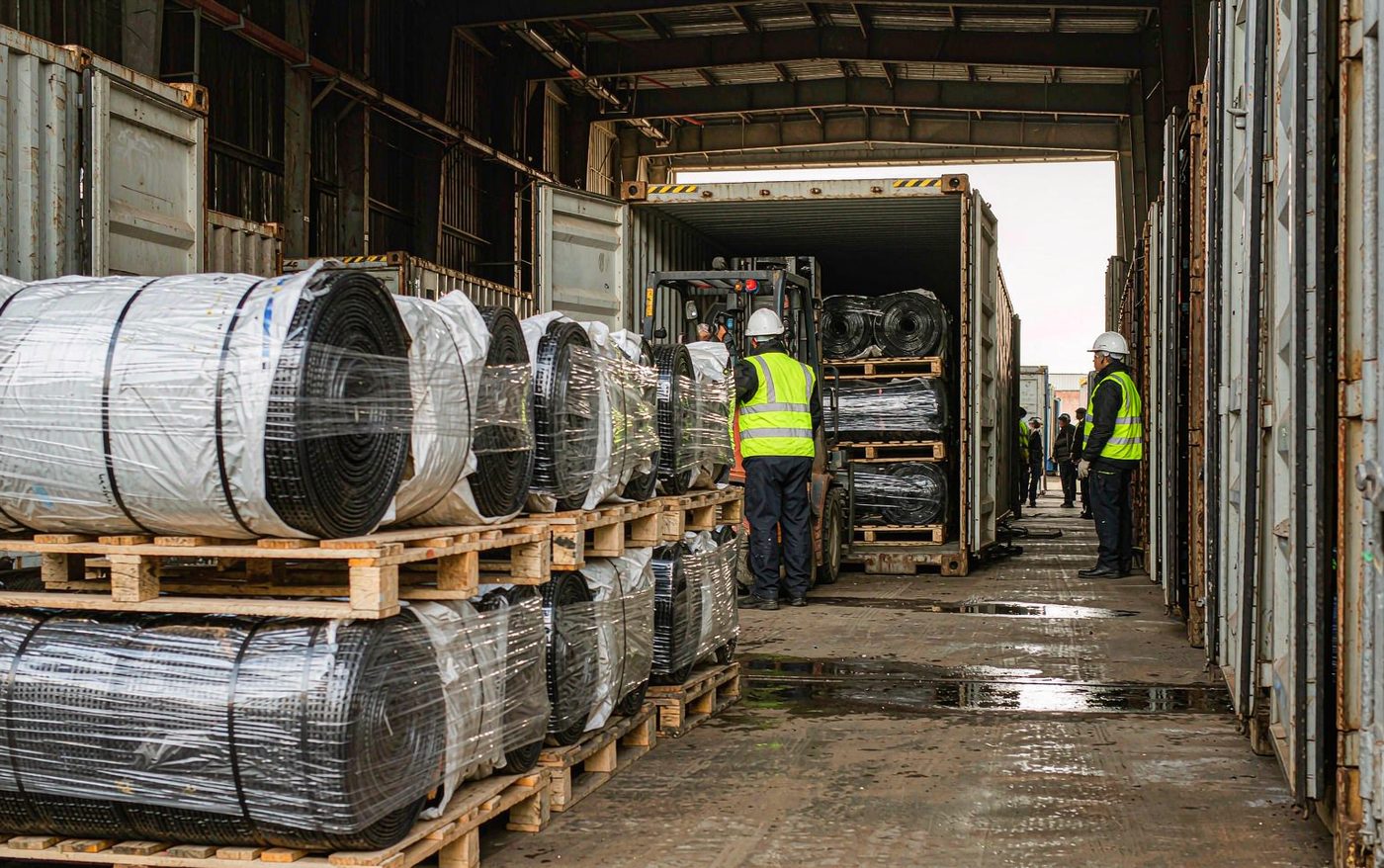
Three quotes for the same 60,000 m² landfill cell landed on my desk last month. All three were HDPE geomembrane China offers. Same 1.5 mm thickness on paper, same "GRI-GM13 compliant" line, and a forty percent spread between the highest and lowest number. Nobody was lying. The quotes were answering three different questions: resin index on different dates, different unit weights hiding behind the same thickness, and different assumptions about who pays for the container.
I sit on the mill side of these comparisons at a geomembrane China source factory, and this is the walkthrough I wish buyers asked for before sending an RFQ: how a price per square meter is built, what MOQ means inside an extrusion plant, and where lead time goes. None of it is secret; most of it just never makes a catalogue.
Why Geomembrane China Quotes Move So Much
A quote an HDPE geomembrane China mill issues is, underneath the letterhead, a resin position. We buy polyethylene by the tonne against an index that moves weekly. Between the day a quote is issued and the day you confirm, that index can move enough to swallow a salesperson's entire margin. So quotes carry validity dates, and the serious ones state the resin basis. If a quote has no validity date, that is the first thing to fix — not the price.
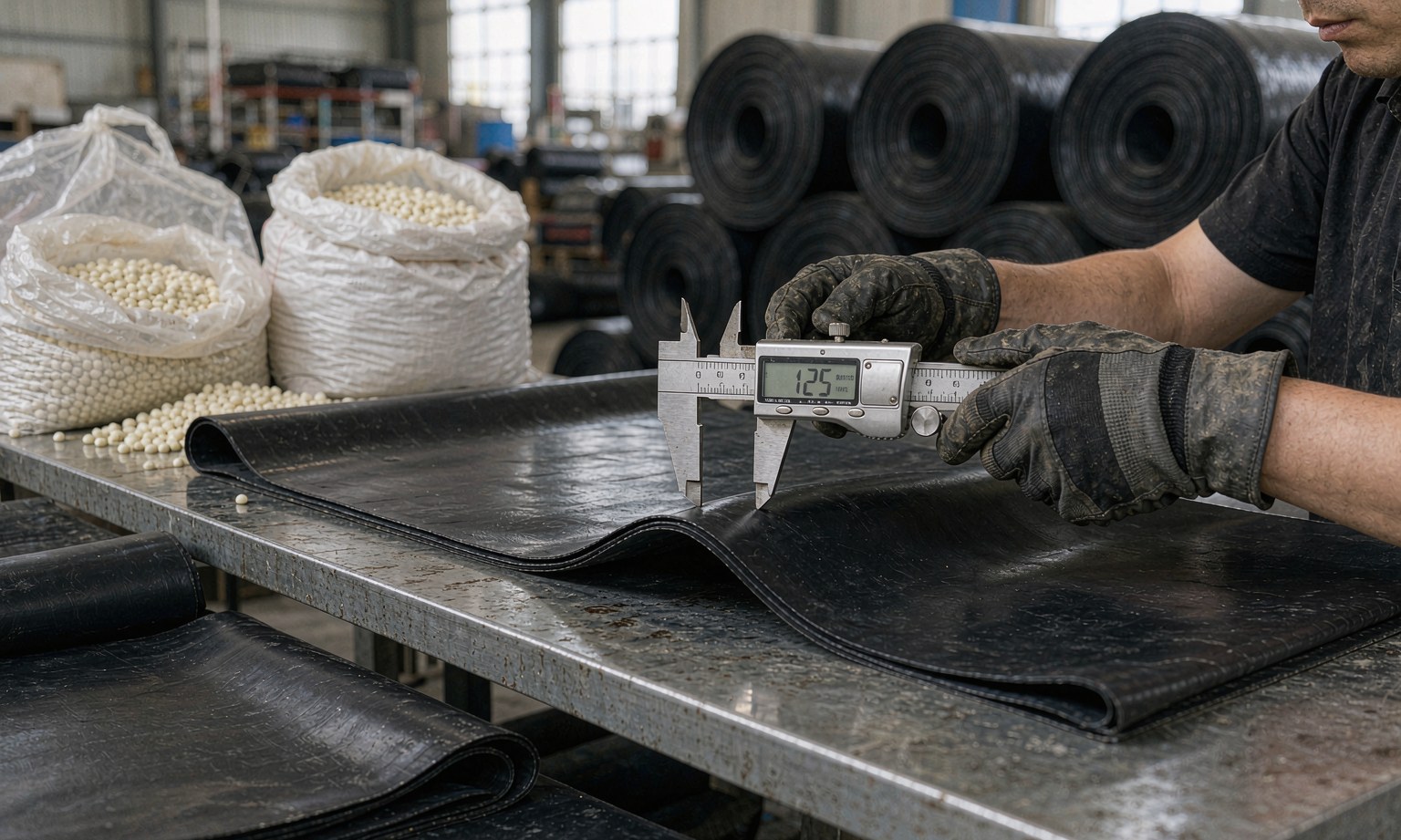
The second mover is unit weight. "1.5 mm" sounds like a fixed quantity, but you pay for kilograms per square meter, and thickness alone stops telling the story once texturing or a co-extruded skin enters the sheet. Two rolls both called 1.5 mm can differ by more than ten percent in resin content. The fix: require the quote to state unit weight in kg/m², measured per ASTM D5199, not just a thickness.
How a Price per Square Meter Is Actually Built
Any geomembrane quote reduces to one line:
price per m² ≈ unit weight (kg/m²) × resin index + conversion + texturing + packing
The unit weight part you can check without us. HDPE runs about 0.94 g/cm³, so multiply any thickness in millimeters by 0.94 and you have kilograms per square meter — 1.5 × 0.94 = 1.41 kg/m². From there, everything scales:
| Nominal thickness | Unit weight (kg/m²) | m² per 40HQ at 26 t payload | Resin cost per m² (1.0 mm = 1.00) |
|---|---|---|---|
| 0.75 mm | 0.705 | ≈ 36,900 | 0.79 |
| 1.0 mm | 0.94 | ≈ 27,700 | 1.00 |
| 1.5 mm | 1.41 | ≈ 18,400 | 1.50 |
| 2.0 mm | 1.88 | ≈ 13,800 | 2.00 |
Read the third column before you lock a thickness. Moving from 1.0 mm to 1.5 mm adds fifty percent to the resin in every square meter — and because the container payload is fixed at roughly 26 tonnes, it adds fifty percent to the freight per square meter too. Thickness is the single biggest lever on delivered cost. That is not an argument to under-specify. Specify deliberately, with the family comparison below open.
A typical geomembrane for landfill China export — say that 60,000 m² cell — fills just over three 40HQ containers at 1.5 mm before a single roll reaches the subgrade.
The Liner Family: What You Are Actually Comparing
Most price confusion I see is products that should never share a column. These are the sheets we extrude, with the numbers straight off our data sheets:
| Product | Material / structure | Where it wins | Watch for |
|---|---|---|---|
| HDPE geomembrane | High-density polyethylene (HDPE), Smooth / textured available | Chemical resistance; landfill and pond basins | Needs a cushion geotextile on sharp subgrade |
| Textured geomembrane | HDPE, textured surface; Single-side / double-side | Steep slopes — raises interface friction | Texturing is an extra production step; confirm which side(s) |
| LLDPE geomembrane | Linear low-density polyethylene (LLDPE) | Conforms to irregular subgrade, settlement-tolerant | Lower tensile than HDPE at equal thickness |
| Composite geomembrane | Membrane + nonwoven geotextile (1-side / 2-side) | Liner and protection in one roll, fewer site operations | Lamination adds lead time |
| GCL | Sodium bentonite between woven and nonwoven geotextile | Self-sealing, low heads, capping layers | Not a standalone liner under high head |
| Geonet drainage net | Tri-planar / bi-planar geonet, optional geotextile lamination | Leachate collection above the primary liner | Transmissivity, not strength, is the spec |
For a flat pond basin, the cheapest compliant answer is usually smooth HDPE over a nonwoven cushion. On a 1V:2 cut slope, textured sheet — single-side if only the soil interface needs friction, double-side if the geotextile above must hold too — keeps the veneer in place. Paying textured prices for a flat basin is the most common over-buy I quote against. The full HDPE geomembrane data sheet lists surface options and roll program.
MOQ: What a Source Factory Can Actually Split
One tonne of HDPE resin covers 1,064 m² at 1.0 mm (1,000 ÷ 0.94) and 709 m² at 1.5 mm. When a mill says MOQ is "one resin batch", ask how many tonnes that batch is and do the division: that is the real minimum run in square meters, usually far below what a trading company passes along.
Roll arithmetic makes the container side concrete. A 6 m × 50 m roll at 1.5 mm carries 300 m² and weighs about 423 kg. Sixty-one of them bring a 40HQ to payload: roughly 18,300 m², one shipment. Buying factory direct from a source factory means those 61 rolls can be split across two or three widths and lengths inside the same production run — same resin, same QC lot — so a site with awkward geometry does not pay a second minimum. A reseller holding another brand's stock cannot re-cut the production plan. The mill has to.
Lead Time: Where the Weeks Actually Go
Extrusion is rarely the bottleneck. The honest sequence for an export order runs:
- Resin lock — fixing the index and the batch; the quote validity exists for this step.
- Extrusion run — the fast part once resin is on site.
- Texturing — an extra pass; confirm single-side or double-side early, because it changes both price and schedule.
- Lamination — composite sheet adds the geotextile bonding stage.
- QC hold — per-lot sampling to ASTM D5199 (thickness), ASTM D6693 (tensile) and ASTM D4833 (puncture) against GRI-GM13 before anything rolls.
- Packing and loading — a full 40HQ loads in one shift.
- Ocean transit — three to five weeks to most destinations in normal market conditions.
What compresses: booking the container before QC closes, with the mill's agreement. What does not: the QC hold — skipping it to save a week is how seams open in year two, and no freight saving covers re-lining a cell.
What a Real Geomembrane China Quotation Should Print
When you compare one HDPE geomembrane supplier in China against another, this is the line-item list that makes quotes actually comparable:
| Line item | Why it matters |
|---|---|
| Unit weight, kg/m² (per ASTM D5199) | Thickness alone hides a 10–15% resin swing between "equal" sheets |
| Surface | Smooth / textured available is not binary — single-side vs double-side changes price and friction |
| Resin basis | Virgin percentage and batch ID; recycled content shows up as brittle welds, not as a visible discount |
| Roll plan | Width and length per roll — it sets your seam meterage and site labor |
| Test lot & certificates | GRI-GM13 conformance with per-lot ASTM D6693 tensile and D4833 puncture, not a catalogue copy |
| Incoterm & container plan | FOB, CIF or DAP decides who owns the freight and the risk |
| Validity date | The resin index moved while you were reading this |
A quote that prints most of that list came from a plant that plans production. A quote that prints a thickness and a number came from a margin. Vetting the plant itself — extrusion lines, QC lab, who actually answers the phone — is a separate exercise; we wrote it up in how to vet a geogrid China source factory, and the checklist transfers word for word to geomembrane.
Where to Go Next
- Product data — the HDPE geomembrane page carries surface options, thickness classes and the roll program, plus the geomembrane range.
- Talk to an engineer — message us on WhatsApp for a same-day answer, or email cn8978688@gmail.com with area, thickness and destination port. Send those three and a factory-direct quotation — unit weight, roll plan, validity date included — usually comes back within one working day.
- Related reading — HDPE Geomembrane for Fish Pond: Thickness and Cost runs the same unit-weight logic for pond basins.
GeoTexGrid is a source factory for geosynthetics in China — HDPE, LLDPE, textured and composite geomembrane off the same extrusion floor as our geotextile and geogrid lines, quoted factory direct with the resin basis printed on the page.
相关文章
Fiberglass Geogrid China Supplier: Mesh and Coat
How to vet a fiberglass geogrid China supplier: mesh size, bitumen vs polymer coating, and the rib-count arithmetic that proves a 30-100 kN/m datasheet.
Woven Geotextile China Manufacturer: Slit Film
A woven geotextile China manufacturer explains slit film tapes, the grab-versus-wide-width trap, and how roll width changes the area you pay for.
Geocell China Manufacturer: Perforation Surface
Perforated or textured walls decide how a geocell drains and grips. A geocell China manufacturer explains wall options, weld QC and checks before order.