
复合排水网:土工排水网选型指南
作者 GeoTexGrid Engineering Team
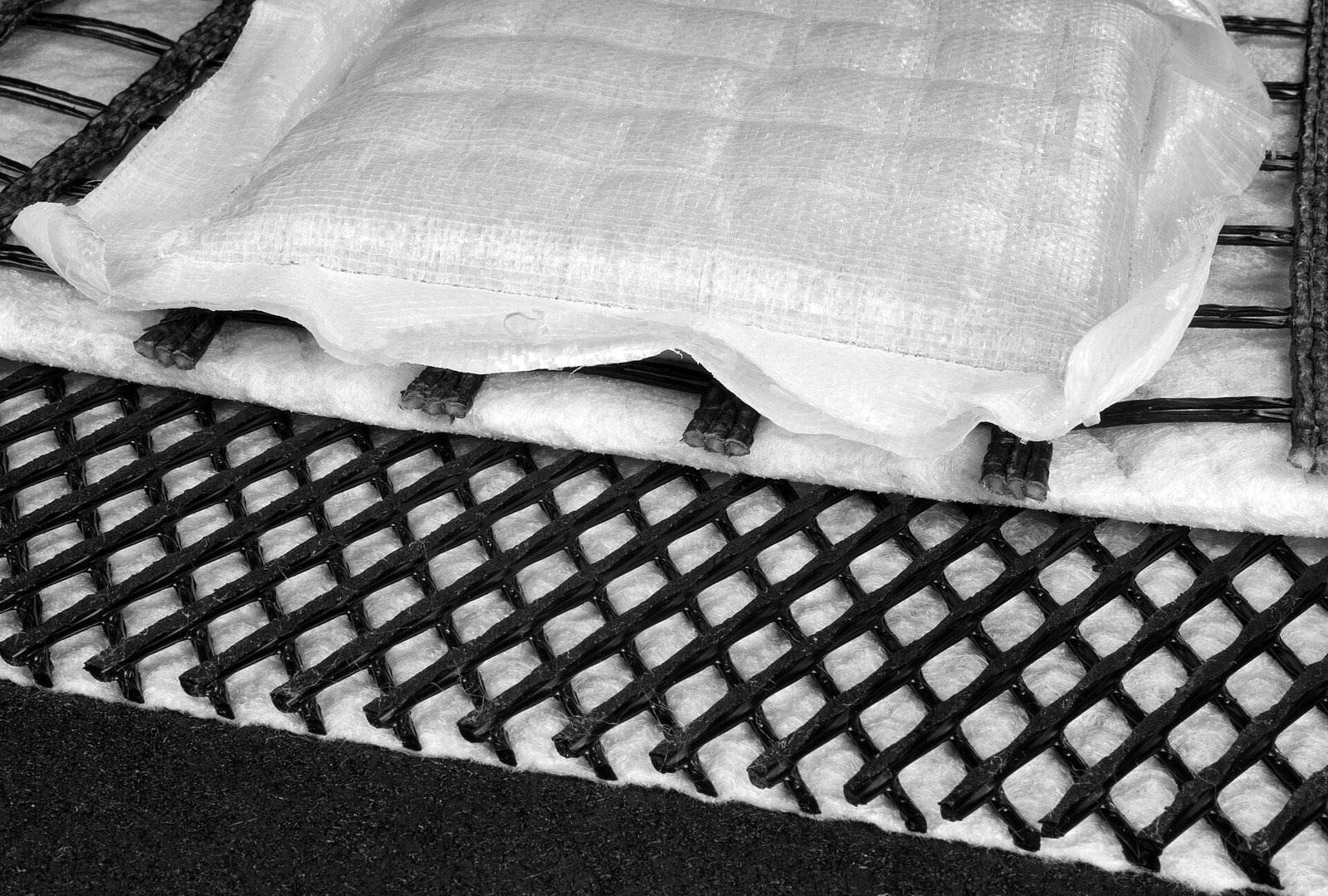
A geocomposite drainage net replaces a thick, carefully graded granular drainage layer with a single factory-made roll: an HDPE geonet core that carries water and gas in-plane, bonded to a geotextile filter that keeps soil out. Specified correctly, it does the work of half a metre of drainage stone in a few millimetres of thickness. Specified wrongly, it silts up within the first year — and once it is buried under backfill, nothing on site can fix it.
Photo: Wikimedia Commons contributor, Wikimedia Commons, CC BY 3.0
What a Geocomposite Drainage Net Actually Does
A drainage geocomposite has one job: collect water — or landfill gas — arriving perpendicular to the sheet and move it along the sheet to an outlet. You find it in landfill caps, leachate collection layers, behind retaining walls, in tunnel linings and under green roofs. In every case it competes with the traditional free-draining granular blanket on thickness, predictability and speed of installation.
The product is a sandwich. The core is a structured High-density polyethylene (HDPE) net — our geonet and composite drainage net is supplied as a tri-planar / bi-planar geonet, optional geotextile lamination on one or both faces. The skin is a geotextile filter, usually needle-punched. Both layers must work; neither can compensate for the other being wrong.
Geonet Core vs Filter Fabric: How the Layers Split the Work
The two layers fail for different reasons, so they are specified with different numbers:
- The core handles flow capacity. Water moves in the voids between the ribs, so the property that matters is transmissivity — in-plane flow rate per unit width at a defined hydraulic gradient and normal stress. It is measured with ASTM D4716, which reports flow under the actual confining pressure the core will see after backfill.
- The filter handles retention and permeability. The geotextile must pass water quickly enough to avoid a pressure build-up behind it, while holding the surrounding soil in place. Its controlling properties are the apparent opening size (AOS), measured per ASTM D4751, and permittivity, measured per ASTM D4491.
A core with plenty of flow capacity wrapped in a fabric that clogs is a drain in name only. Likewise, an excellent filter around a core that crushes under the first lift of fill simply stops being a void.
Geocomposite Drainage Net Selection Table
The table compares the layers of a complete drainage system using real product structures from the GeoTexGrid range:
| Layer | Material and structure | Function in the drainage system | Verify with |
|---|---|---|---|
| Geonet core | High-density polyethylene (HDPE), tri-planar / bi-planar geonet, optional geotextile lamination | In-plane liquid and gas flow to the outlet | ASTM D4716 transmissivity at design normal stress |
| Nonwoven filter geotextile | Needle-punched nonwoven (PET / PP) | Filtration: retain soil particles, pass water continuously | ASTM D4751 AOS and ASTM D4491 permittivity |
| Woven geotextile (where load demands it) | Woven PP slit film / PET yarn | Separation plus higher tensile strength at low elongation | ASTM D4595 wide-width tensile |
| Optional protection layer | Nonwoven cushion over the geomembrane (smooth / textured available) | Puncture protection where the drain sits on a liner | ASTM D6241 CBR puncture |
The nonwoven filter is the default choice for most drainage work — see the nonwoven geotextile product page for PET and PP options. The woven option earns its place where the fabric also has to span soft ground or carry load, because woven structures deliver strength with very little elongation.
Filter Design Check: AOS and Permittivity
Both parts of the check use the site soil, not the catalogue:
- Retention — keep the soil in place. A widely used practice is to require the geotextile AOS to be no larger than the D85 of the protected soil (the sieve size that 85% of the soil passes). On soils with a small fines fraction this is sometimes relaxed toward two or three times D85, but the one-to-one rule is the safe default for a drain you cannot inspect after burial.
- Permeability — let the water through. The geotextile should be at least an order of magnitude more permeable than the soil it protects, commonly written as k(geotextile) ≥ 10 × k(soil). The margin covers long-term blinding of the fabric surface, which always reduces the as-installed flow rate below the laboratory value.
Worked example: a silty backfill behind a wall has D85 = 0.25 mm and k(soil) = 1 × 10⁻⁵ m/s. The retention rule calls for an AOS no larger than 0.25 mm; a needle-punched nonwoven with an AOS around 0.10–0.15 mm satisfies it comfortably. For the permeability rule, choose a fabric whose permittivity, converted through its thickness, exceeds 10 × 10⁻⁵ m/s by a clear margin. Where the project follows US highway practice, AASHTO M288 geotextile classes set the default permittivity, AOS and strength values for drainage applications, and EN 13252 plays the same role for European drainage works.
Flow Capacity Check: From Inflow to Required Transmissivity
The core is sized from the inflow it must carry, using the in-plane form of Darcy's law:
Q = θ × i × W, where Q is the flow to be collected, θ the transmissivity (m²/s), i the hydraulic gradient and W the flow width.
Take a wall drain that must collect a design inflow of 0.1 L/s per metre of wall (1 × 10⁻⁴ m³/s per metre of width) under a gradient of 1.0:
- Required ultimate transmissivity: θ = 1 × 10⁻⁴ / (1.0 × 1.0) = 1 × 10⁻⁴ m²/s
- Apply a total reduction factor of 3 for creep, geotextile intrusion into the core channels and long-term clogging (standard practice under GRI-GC8, which converts the ultimate D4716 flow rate into an allowable value): θ(allowable requirement) = 3 × 10⁻⁴ m²/s
Now the check is concrete: the D4716 report must show a transmissivity of at least 3 × 10⁻⁴ m²/s at the confining pressure and gradient of the actual installation, not just at the light test conditions on the front page of the data sheet. A tri-planar core holds its voids far better under load than a thin bi-planar one, which is why heavily loaded landfill and wall applications usually move up a core type rather than adding more fabric.
Failure Modes: What Goes Wrong When the Drainage Layer Is Wrong
Every drainage geocomposite failure on site can be traced to one of a handful of property shortfalls. This table is the diagnostic we use when an installed drain underperforms:
| Symptom observed | Property that failed | Standard to check |
|---|---|---|
| Water ponds behind the wall or the cap drains slowly | Filter permittivity too low, or fabric blinded by fines | ASTM D4491 (permittivity) |
| Fines migrate into the core and the outlet runs cloudy | AOS too coarse for the soil gradation | ASTM D4751 (AOS) |
| Filter torn or punctured during stone placement | CBR puncture strength too low for the aggregate | ASTM D6241 (static puncture) |
| Flow rate drops after backfill reaches full height | Core creep and geotextile intrusion under sustained load | ASTM D4716 (transmissivity at design normal stress) |
| Core crushed by compaction of the first lift | Core compression strength too low for the method | ASTM D4716 plus installation damage checks |
Two of these — puncture and crush damage — happen in the first hour of construction, long before the design load arrives.

Choosing a Geocomposite Drainage Net for Your Project
- Product range and data sheets — see the geonet and composite drainage net product page for core structures and roll dimensions, plus the full geosynthetics product range for the filter and liner products that pair with it.
- Talk to an engineer — message us on WhatsApp for a same-day technical answer, or email cn8978688@gmail.com. Send the soil gradation and the expected inflow — we will confirm the core type and filter class, and quote roll sizes cut to your layout.
- Related reading — Nonwoven Geotextile as Landfill Liner Protection Layer covers the protection layer directly under a drainage blanket, and Geotextile Filter Fabric: Matching AOS and Permeability walks through filter design step by step.
GeoTexGrid manufactures HDPE geonets, geocomposite drainage nets and the nonwoven and woven geotextiles that complete a drainage system, with D4716, D4751 and D4491 test data available for project submittals. Send your section drawing — you will get a confirmed specification and quotation within one working day.
相关文章
Fiberglass Geogrid China Supplier: Mesh and Coat
How to vet a fiberglass geogrid China supplier: mesh size, bitumen vs polymer coating, and the rib-count arithmetic that proves a 30-100 kN/m datasheet.
Woven Geotextile China Manufacturer: Slit Film
A woven geotextile China manufacturer explains slit film tapes, the grab-versus-wide-width trap, and how roll width changes the area you pay for.
Geocell China Manufacturer: Perforation Surface
Perforated or textured walls decide how a geocell drains and grips. A geocell China manufacturer explains wall options, weld QC and checks before order.